



Executive Summary
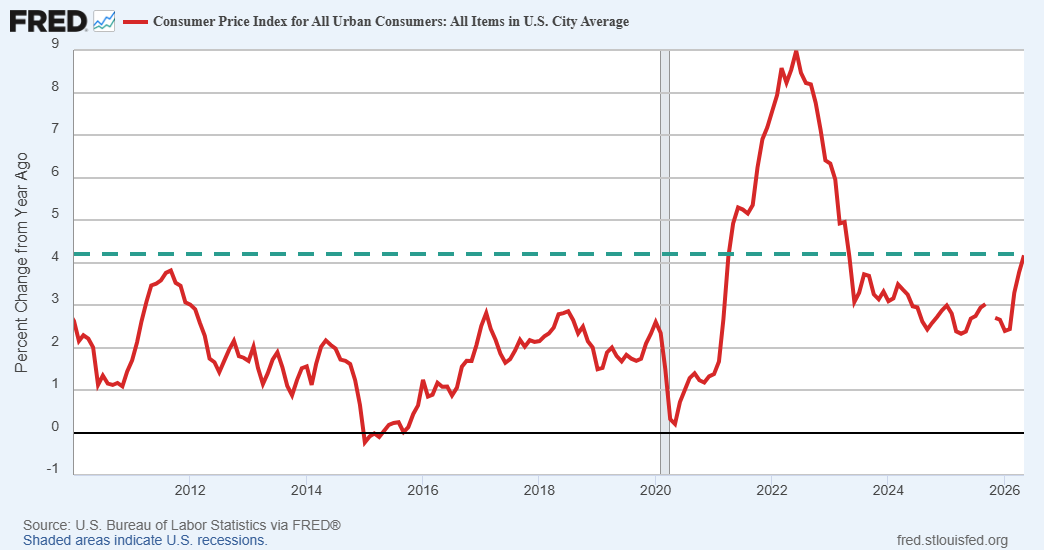
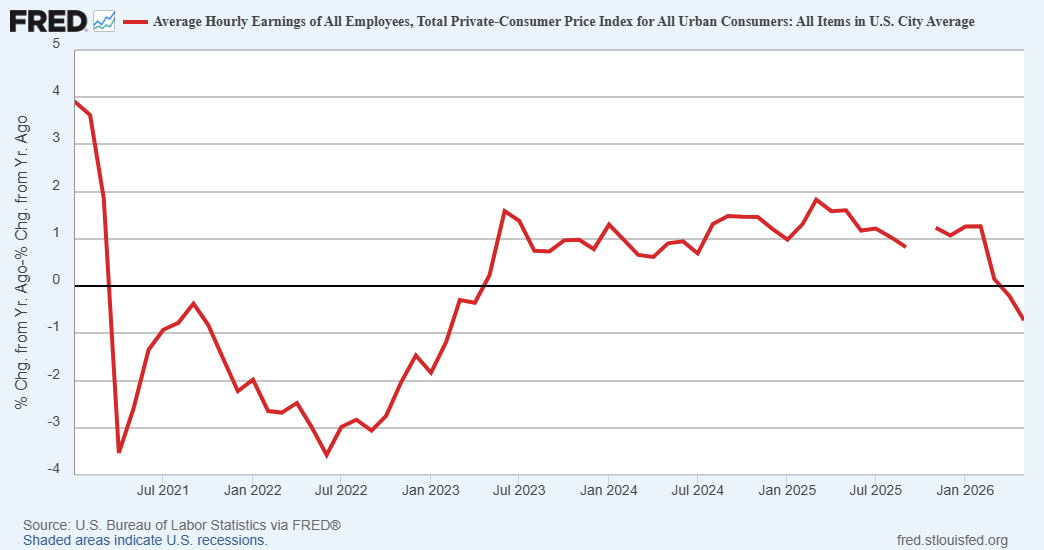
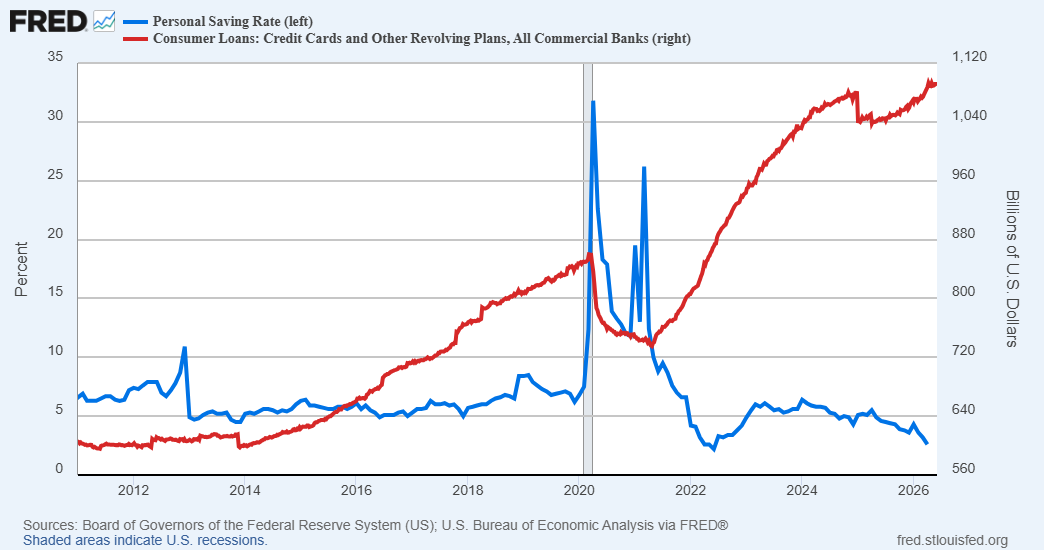
Although the University of Michigan Consumer Sentiment Index rose slightly in June, it remains near the lowest level on record (1st graph). Since Covid, goods and services prices are up 25-30% cumulatively, and they rarely decrease outside of a depression. At the same time, real (inflation adjusted) wages have decreased (3rd graph). Consumers adapted by reducing their savings rate and increasing credit card usage (4th graph). While the end of the Iran war may raise hopes for lower gas prices, overall sentiment is very low. For that to change wages need to increase.
For further analysis, continue to read The Details below for more information.
“To contract new debts is not the way to pay old ones.”
–George Washington
The Details
The University of Michigan Consumer Sentiment Index rose slightly in June; however, it remains near the lowest level on record since the survey began, as shown in the graph below from VettaFi. Why do consumers have such a gloomy outlook?
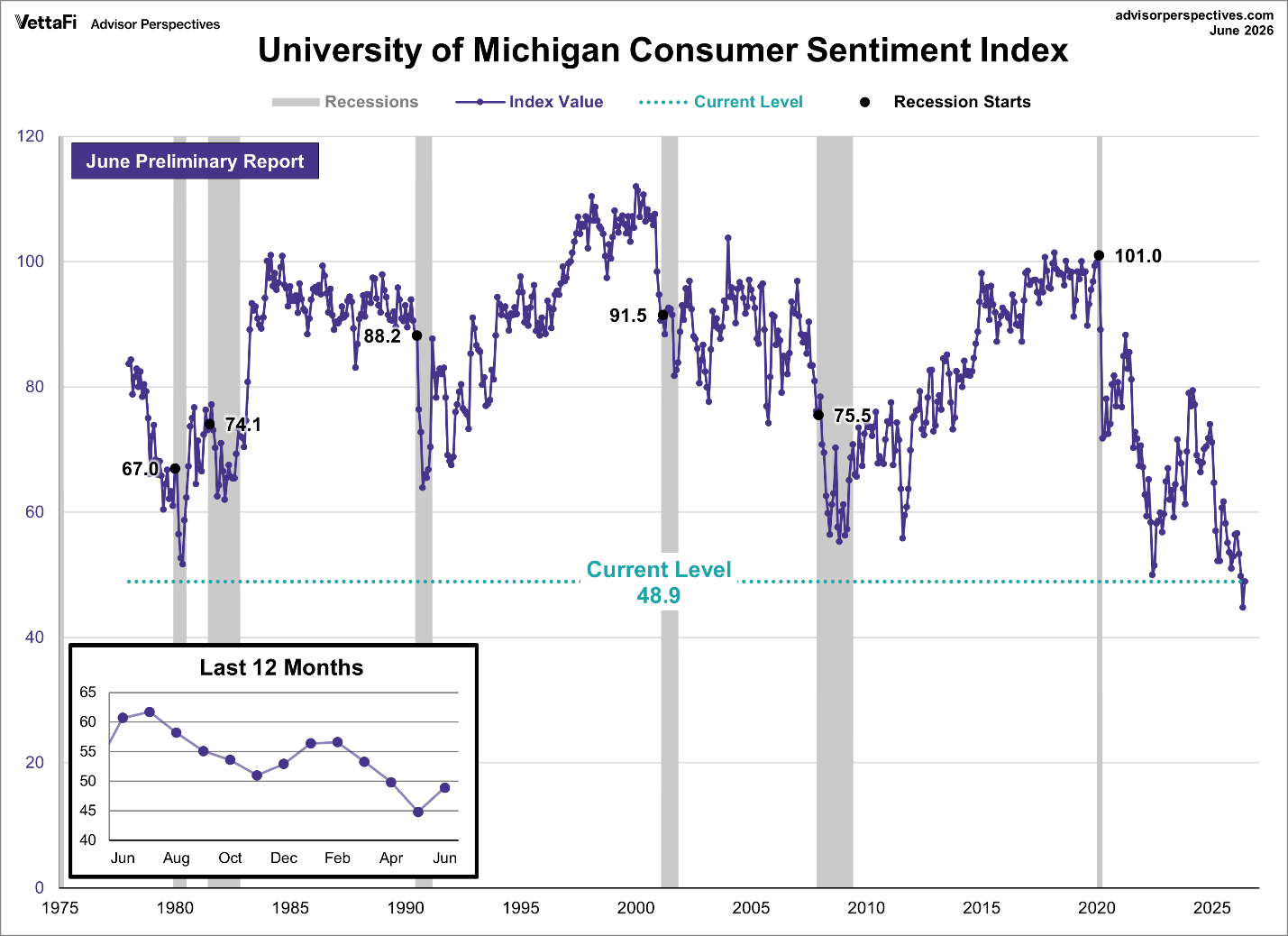
The main contributor to consumers’ depressed outlook, which is worse than all prior recessions since 1980, including the Great Recession/Financial Crisis, is the high price of goods and services. After the post-Covid surge in prices, many people hoped that prices would return to pre-Covid levels. However, barring a depression, prices rarely decrease. The rate of increase slowed, but the cumulative price levels remain high. In fact, prices are cumulatively up between 25-30% over the past five years. And with the war with Iran, energy costs have skyrocketed. According to the report released by the BLS on June 10, the CPI rose 4.2% compared to last year, as shown in the graph below. Outside of the Covid era spike, this was the highest reading since 2008.
At the same time inflation remains high, real (inflation-adjusted) earnings are shrinking as can be seen in the graph below.
The impact of falling real wages and high prices is lower savings. The personal savings rate has dropped to 2.6%, far below the long-term average of around 8.5%. Additionally, in order to make ends meet, consumers are resorting to the use of credit cards. Notice in the graph below that the savings rate (blue line) is plunging while credit card balances (red line) are soaring.
The potential agreement with Iran to open the Strait of Hormuz sent oil prices plunging on Monday, June 15. However, this is an expected speculative move by investors. The fact remains that oil and gasoline inventories remain at critically low levels. Many countries have dipped into their strategic petroleum reserves. The replenishment of inventories, even with week demand due to a slow economy, could send oil prices higher. A reprieve in gasoline prices is welcome; however, the possibility of higher prices returning remains elevated.
The pressure of high prices, especially gasoline and energy, on consumers is affecting their behavior and outlook. Struggling to make ends meet, consumers are saving less and borrowing more. This is negatively affecting consumers’ outlook for the future. Hence, the record low sentiment readings. The possibility of higher interest rates, as inflation continues to rise, could add another obstacle for consumers.
For consumer sentiment to increase, real wages need to rise so that consumers are not reliant on debt to make ends meet.
The S&P 500 Index closed at 7,431, up 0.6% for the week. The yield on the 10-year Treasury Note fell to 4.49%. Oil prices decreased to $85 per barrel, and the national average price of gasoline according to AAA dropped to $4.07 per gallon.
© 2026. This material was prepared by Bob Cremerius, CPA/PFS, of Prudent Financial, and does not necessarily represent the views of other presenting parties, nor their affiliates. This information should not be construed as investment, tax or legal advice. Past performance is not indicative of future performance. An index is unmanaged and one cannot invest directly in an index. Actual results, performance or achievements may differ materially from those expressed or implied. All information is believed to be from reliable sources; however we make no representation as to its completeness or accuracy.
Securities offered through Registered Representatives of Cambridge Investment Research, Inc., a broker/dealer, member FINRA/SIPC. Advisory services offered through Cambridge Investment Research Advisors, Inc., a Registered Investment Advisor. Prudent Financial and Cambridge are not affiliated.
The information in this email is confidential and is intended solely for the addressee. If you are not the intended addressee and have received this message in error, please reply to the sender to inform them of this fact.
We cannot accept trade orders through email. Important letters, email or fax messages should be confirmed by calling (901) 820-4406. This email service may not be monitored every day, or after normal business hours.