



Executive Summary
Currently stock market valuations, which are notably bad timing measures, are near all-time highs (see first graph). Investors are paying almost 2.6 times more for corporate earnings than the long-term median price. During similar times in history, investors bought stocks on margin (loans which use the stock as collateral) to amplify gains. In the second graph below, one can see margin debt peaks have coincided with stock market peaks. For perspective, at the peak of the 2000 Tech Bubble, margin debt was less than $600 billion. Today it is over $1.4 trillion! Although using margin can amplify earnings when the market rises, it can be devastating when the market tumbles. As the collateral value declines, margin calls are triggered requiring additional cash, often resulting in forced selling. Investors should consider prudent investment allocations given the extent of current risks.
For further analysis, continue to read The Details below for more information.
“We learned in the ’20s that markets with participants playing heavily on margins could be more dangerous than markets where people are dealing in cash.”
–Warren Buffett
The Details
When the stock market becomes significantly overvalued, speculative behavior tends to increase. Currently, the S&P 500 is just below its most overvalued level in history, according to the Shiller P/E Ratio, as shown in the graph below from multpl.com.
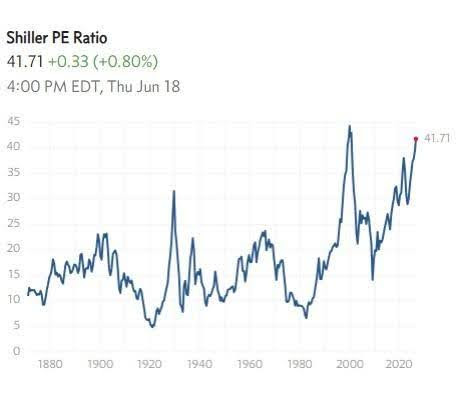
The long-term median Shiller P/E Ratio is 16.1. Therefore, the current level is approximately 2.6 times the long-term median. Said differently, investors in the S&P 500 today are paying $2.60 for something that is effectively worth $1.00. The last time the S&P 500 was notably undervalued was in 1982. At that time, one could purchase $1.00 worth of the Index at a discount, effectively paying $0.41 for $1.00.
FOMO, or the fear of missing out, takes over during stock market bubbles. Since it appears the market “only goes up,” speculators do everything possible to increase their exposure. This includes borrowing money to invest in the stock market or purchasing on margin. Margin debt can add substantial risk to one’s portfolio. The loan is collateralized by the stock purchased. Buying shares with borrowed funds can accelerate gains if the price increases; however, if the value of the stock drops materially, the investor could be forced to pay down the loan. If the investor does not have the available cash to pay the loan down, then a margin call ensues requiring a forced sale of the holdings purchased on margin. In a rapid downturn, selling begets selling as margin calls increase.
In May, margin debt grew by 8.5% to an all-time record high of $1.42 trillion. Margin debt is up about 54% year-over-year. Notice the correlation between the S&P 500 and the balance of margin debt in the graph below from VettaFi. Debt balances tend to top out around the same time as the market peaks, just prior to a major correction. Since bottoming at the end of 2022, margin debt has almost doubled in a near vertical ascent.
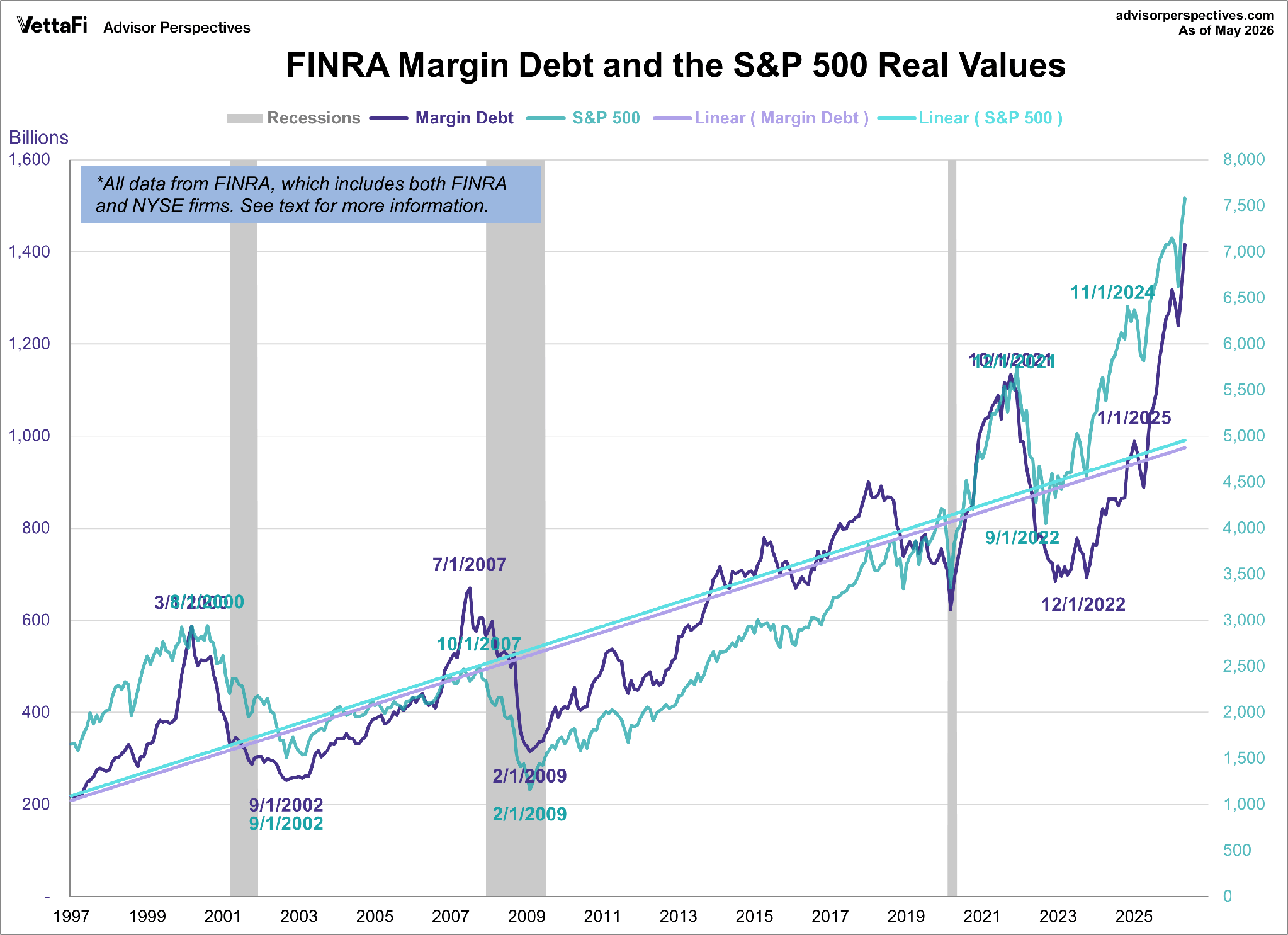
The rise in interest rates adds more risk to margin loans, as it adds to the cost of servicing the outstanding debt. The drastic increase in margin debt should give investors pause. In one of the most overvalued stock markets in history, investors are willing to pay $2.60 for something that, by certain measures, is only worth $1.00, because they have been convinced that the stock market can only go up. To ramp up the speculation further, many have borrowed heavily to increase their exposure. This accelerates their earnings on the way up; however, a substantial and swift downturn could inflict significant pain and forced selling. The forced selling takes on the snowball effect. At the peak of the Technology Bubble in March of 2000, margin debt totaled less than $600 billion. Today, margin debt exceeds $1.4 trillion.
Risk is rampant in the stock market today. The balance in margin debt adds another reason for investors to reassess potential outcomes of excessive valuations and debt.
The S&P 500 Index closed at 7,501, up 0.9% for the week. The yield on the 10-year Treasury Note fell to 4.45%. Oil prices decreased to $77 per barrel, and the national average price of gasoline according to AAA dropped to $3.94 per gallon.
© 2026. This material was prepared by Bob Cremerius, CPA/PFS, of Prudent Financial, and does not necessarily represent the views of other presenting parties, nor their affiliates. This information should not be construed as investment, tax or legal advice. Past performance is not indicative of future performance. An index is unmanaged and one cannot invest directly in an index. Actual results, performance or achievements may differ materially from those expressed or implied. All information is believed to be from reliable sources; however we make no representation as to its completeness or accuracy.
Securities offered through Registered Representatives of Cambridge Investment Research, Inc., a broker/dealer, member FINRA/SIPC. Advisory services offered through Cambridge Investment Research Advisors, Inc., a Registered Investment Advisor. Prudent Financial and Cambridge are not affiliated.
The information in this email is confidential and is intended solely for the addressee. If you are not the intended addressee and have received this message in error, please reply to the sender to inform them of this fact.
We cannot accept trade orders through email. Important letters, email or fax messages should be confirmed by calling (901) 820-4406. This email service may not be monitored every day, or after normal business hours.