


Executive Summary
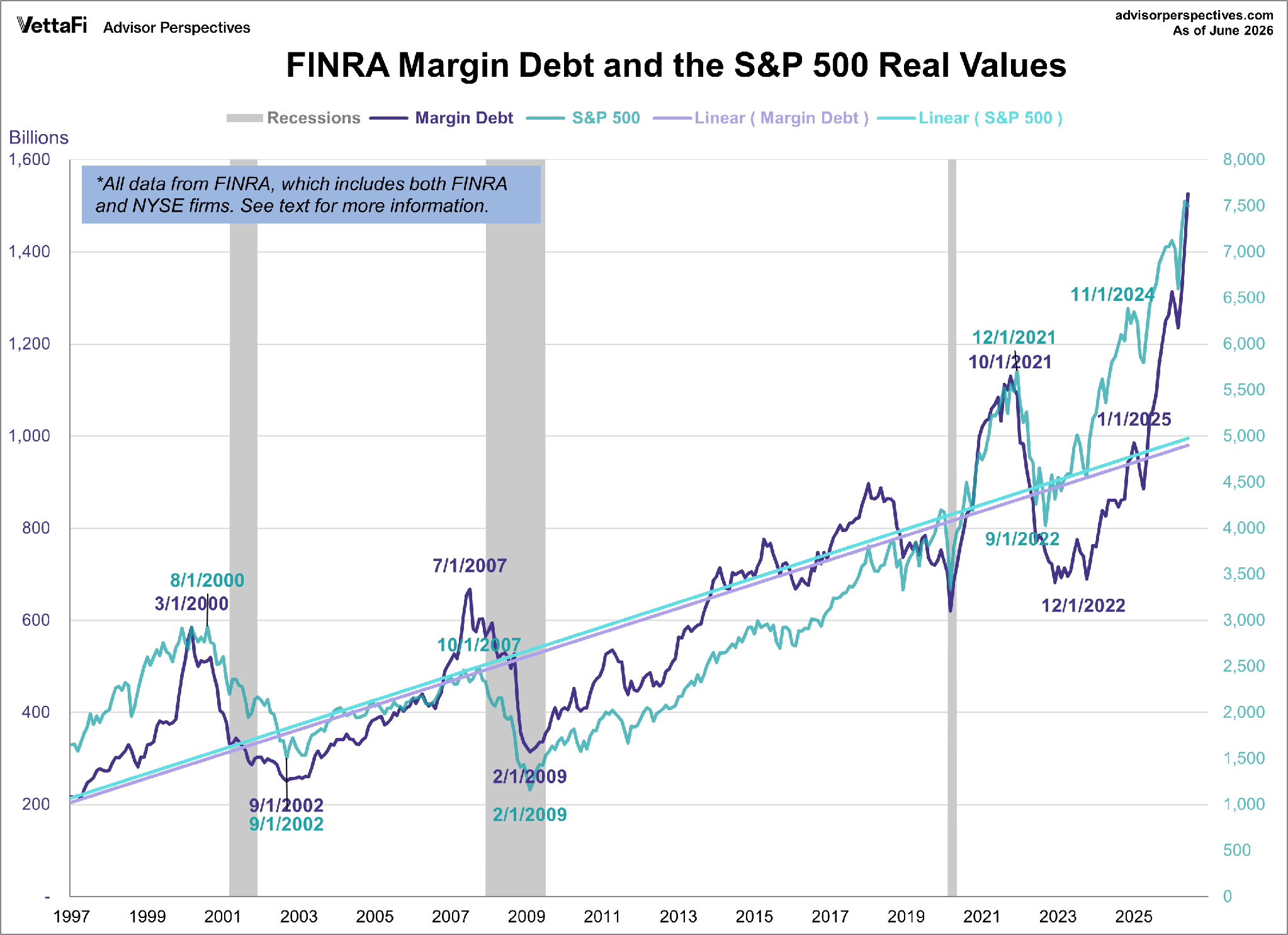
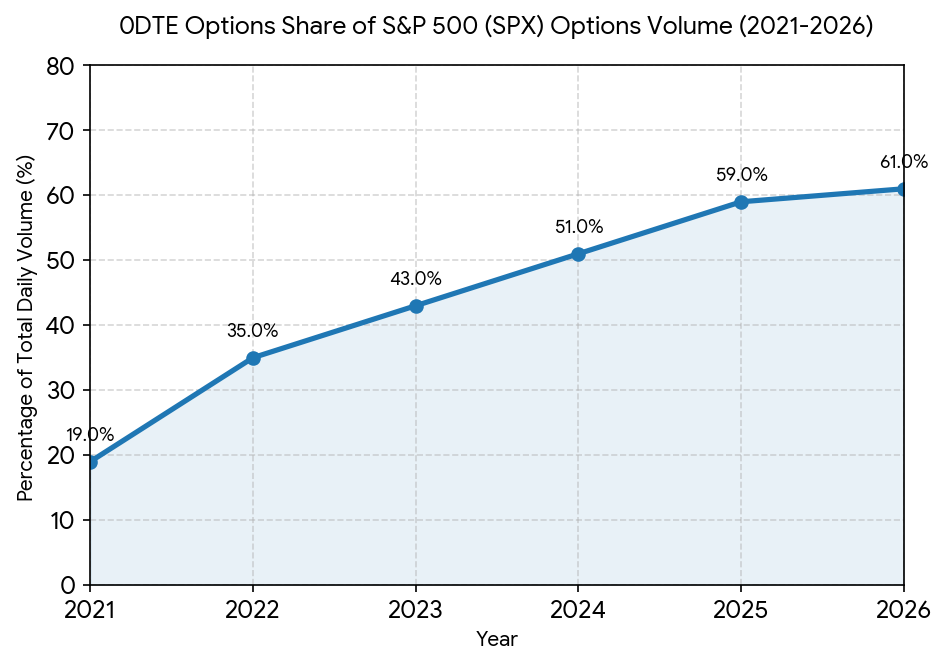
U.S. stock market capitalization has reached nearly $75 trillion, but many investors may not understand what is happening beneath the surface. Alongside enormous interest in AI, margin borrowing to buy stocks has increased (see first graph). Another sign of speculation, sometimes described as gambling, is daily market betting through 0DTE options trading (see second graph). Many 401(k) investors assume an S&P 500 index fund is broadly diversified, without realizing about 40% of the index is concentrated in 10 stocks. The AI boom adds another layer of risk: OpenAI and Anthropic have contracts totaling roughly $2.1 trillion with computing companies including Microsoft, Oracle, Google, and Amazon. Those companies are borrowing against future contract revenue to build AI data centers. Meanwhile, Anthropic and OpenAI have raised large sums through new equity investments despite remaining unprofitable. In short, unprofitable companies are borrowing to meet contractual obligations to computing companies that are also borrowing to build facilities that may or may not become profitable. See the Details for how China may also be a threat to this setup.
For further analysis, continue to read The Details below for more information.
“The stock market is designed to transfer money from the active to the patient.”
–Warren Buffett
The Details
Unfortunately, most investors today have no clue what is happening under the hood of the stock market. As long as the market rises, they are happy. It doesn’t really matter what is supporting unheard of valuations. All caution is thrown to the wind. In this missive, I will share a summary of some of the most important factors, which many are oblivious to, propping up the market. I have touched on some of these points before, but I will describe an important aspect of the new AI (Artificial Intelligence) rage that has added enormous risk to the stock market.
The total market capitalization of the U.S. stock market is roughly $75 trillion. Buying stocks on margin has reached a record $1.53 trillion as shown in the graph below from VettaFi.
One measure of the level of gambling in the market today can be viewed by examining how much of the daily option trading volume on the S&P 500 is via 0DTE (zero days to expiration) options. This is essentially day trading with options. See the graph below showing the rising share of 0DTE options, now over 60%.
As speculation rises in the stock market, it becomes more concentrated. People investing in S&P 500 Index funds in their 401(k) plans think they are getting a fund diversified by over 500 companies. In reality, almost 40% of the S&P 500 is concentrated in 10 stocks. The current impetus generating the no holds barred speculation in the stock market centers on the AI craze. Lifting the hood on the financial scheme funding the AI sector might astound investors. The remainder of this newsletter will focus on the incredible amount of risk underlying AI stocks. Much of this information was drawn from podcaster, investor, and entrepreneur, Jay Martin and his episode, “2008 vs 2026: The Same Dominoes Are Falling.” In this episode he draws a parallel to one of the underlying factors that led to the Financial Crisis. This is not about real estate, but instead the financial machinations used to fuel manias.
I will attempt to explain what is really going on behind the scenes. For a more detailed description, I encourage readers to watch the video which can be found on YouTube. Two of the largest AI companies are Open AI and Anthropic. Both companies have incurred billions of dollars in net losses. These companies, among others, have contracted with large technology companies, including Microsoft, Oracle, Google and Amazon for utilization of their massive computing infrastructures. These contracts total about $2.1 trillion and are labeled “take-or-pay,” meaning Open AI and Anthropic are on the hook for these payments, whether used or not.
The providers, Microsoft et al., consider this “locked-in future demand.” But remember, these promises are being made by companies that are presently unprofitable. In order to build the facilities to generate more computing power, Microsoft et al. are borrowing money against these IOUs. The planned spending on Capex for 2026 is about $725 billion, or more than all of the cash generated by these providers.
So here is how it works, in order to pay on their contracts to Microsoft et al. Open AI and Anthropic must continue to raise money from investors based upon growing valuations. (Just as teaser mortgages relied on growing house values to allow refinancing when the teaser period expired.) To fund their growing Capex needs, the contract providers (think Microsoft) are borrowing against future revenue that is promised but not paid by companies which are unprofitable. The key to keeping this game going is that valuations in Open AI and Anthropic must continue to grow fast enough to allow fundraising sufficient to meet their obligations. Open AI’s valuation has grown from $86 billion in early 2024 to $852 billion in March 2026. (Using new funding to pay for existing obligations sounds eerily similar to a Ponzi Scheme.)
What could cause a disruption? In a word, China. China’s AI company, Moonshot AI, recently debuted an AI model called Kimi K3, which outperformed Open AI’s GPT-5.5 and Anthropic’s Claude Opus 4.8 on key coding and agentic benchmarks at a fraction of the cost. Moonshot AI released the underlying code and full model weights of Kimi K3 for free (with certain legal catches.)
As is evident, the risk to markets is that with the introduction of Moonshot AI (and potentially others in the future), Open AI’s and Anthropic’s growth begin to slow resulting in lower valuations. If this happens, will they be able to raise enough new money to meet their obligations to Microsoft, Oracle, Google and Amazon? And if they can’t meet these obligations, how will these companies pay the loans they incurred to build out the facilities necessary to meet the compute requirements which they are obligated? Could China be the player who collapses the house of cards?
Presently, the stock market is worth about $75 trillion. Fundamentally, the market is worth less than half of that. The market is being propped up by margin debt, gamblers, AI hopes and regular people who have no idea what is going on under the hood. The risk in the stock market has never been greater. Caution is urged. Confused about what to do? Please refer to my August 5th newsletter here.
The S&P 500 Index closed at 7,786, up 0.4% for the week. The yield on the 10-year Treasury Note rose to 4.70 %. Oil prices increased to $82 per barrel, and the national average price of gasoline according to AAA rose to $4.07 per gallon.
© 2026. This material was prepared by Bob Cremerius, CPA/PFS, of Prudent Financial, and does not necessarily represent the views of other presenting parties, nor their affiliates. This information should not be construed as investment, tax or legal advice. Past performance is not indicative of future performance. An index is unmanaged and one cannot invest directly in an index. Actual results, performance or achievements may differ materially from those expressed or implied. All information is believed to be from reliable sources; however we make no representation as to its completeness or accuracy.
Securities offered through Registered Representatives of Cambridge Investment Research, Inc., a broker/dealer, member FINRA/SIPC. Advisory services offered through Cambridge Investment Research Advisors, Inc., a Registered Investment Advisor. Prudent Financial and Cambridge are not affiliated.
The information in this email is confidential and is intended solely for the addressee. If you are not the intended addressee and have received this message in error, please reply to the sender to inform them of this fact.
We cannot accept trade orders through email. Important letters, email or fax messages should be confirmed by calling (901) 820-4406. This email service may not be monitored every day, or after normal business hours.