


Executive Summary
Long-term interest rates are typically determined by economic conditions. Last week, in addition to U.S. debt crossing $40 trillion, Treasury Secretary Scott Bessent announced that the Treasury Department would double its bond buyback operation. On Monday, August 24, Bessent revealed his concern about long-term rates by announcing that the Treasury could use its pile of cash in the Treasury General Account (TGA) (see first graph), to repurchase Treasury Securities. This action would inject new liquidity into the economy and would be inflationary. As bond yields rise (third graph), interest costs of debt rise for both public and private debt. Purchases such as homes, automobiles and other durable goods which require debt financing slow down with higher rates. Instead of concentrating on the causes of high interest rates, the Treasury is attempting to disrupt market forces by implementing short-term measures, which will most likely only provide short-term relief. It seems, once again, the Fed and the Federal government are trying to manipulate markets to get the result they desire. This is a losing proposition.
For further analysis, continue to read The Details below for more information.
“Some people use half their ingenuity to get into debt, and the other half to avoid paying it.”
–George D. Prentice
The Details
Last week the Federal debt reached a milestone, as it crossed the $40 trillion mark (although not updated in the Fed’s FRED database per the graph below). In a debt-laden economy, the cost of carrying the debt is critical. Recent declarations by Treasury Secretary Scott Bessent bring to light his concern about rising long-term interest rates. In an announcement last week, Bessent stated that the Treasury Department would be doubling the size of their buyback operation, effectively replacing long-term notes and bonds with short-term Treasury Bills. The impact of the announcement lasted approximately one day, as long-term rates briefly dipped before rising back above pre-announcement levels the following day.
Concern by the administration is building as Scott Bessent announced, Monday, August 24, that the Treasury could use their General Account, known as the TGA, to fund long-term Treasury repurchases. This would be another attempt at manipulating long-term interest rates. The TGA began to grow during the 2008 Financial Crisis; however, after the pandemic, it has skyrocketed. The TGA balance prior to 2008 hovered around $5 billion. Today the balance is approximately $935 billion, projected to hit $1 trillion soon. As a percentage of the economy, the TGA balance has grown from 0.05% in 2004 to about 3% today, a roughly 60-fold increase relative to the size of the economy and a 163-fold increase in nominal terms!
There are many reasons the Treasury uses to justify the need for such a large TGA balance, from meeting the Government’s needs when there are halts due to debt-limit negotiations, the Fed’s move to an “abundant reserve” policy, and growth in the size and scope of the Federal Government, among others. There are many economists, including First Trust’s Chief Economist Brian Wesbury, who have argued against a large TGA balance. I agree with Wesbury, the TGA seems excessive. Notice in the graph below, the extreme rise in the TGA balance (red line).
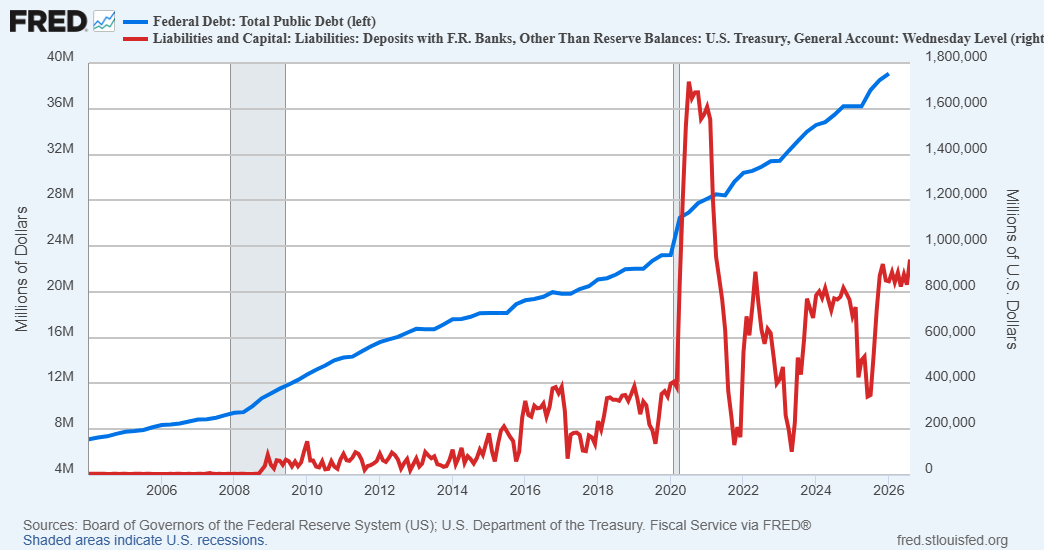
With Bessent’s recent announcement that the TGA could be used to repurchase long-dated Treasuries, the effect would be drops in both the TGA and the Federal debt balance. One might see the debt drop back below $40 trillion, temporarily, not because of fiscal surpluses but merely draining of the TGA. Of course, with deficits running around $2 trillion per year, it won’t take long to jump back above $40 trillion. And, if the Treasury foresees other financial issues on the horizon, they will likely replenish the TGA by issuing Treasury Bills, which would then push the debt balance back up. If the Federal Reserve were to buy the Treasury Bills, that would represent a return to QE (Quantitative Easing). Notice in the graph below, the Fed’s holdings of Treasury Bills have been on the rise.
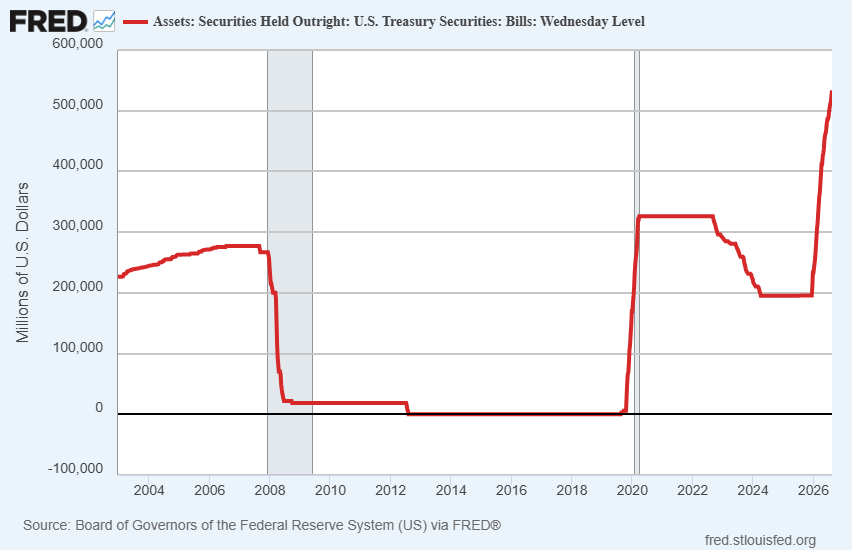
Using the TGA to fund repurchases or issuing Treasury Bills funded by the Fed would both inject new liquidity into the economy and would be inflationary.
Again, the reason for the Treasury Department’s repurchasing operations is to attempt to stymie the rise in long-term interest rates. The rise in long-term rates is due to the fear of continued inflation. See the rise in the 10 and 30-year Treasury yields, since bottoming during the pandemic, in the graph below.
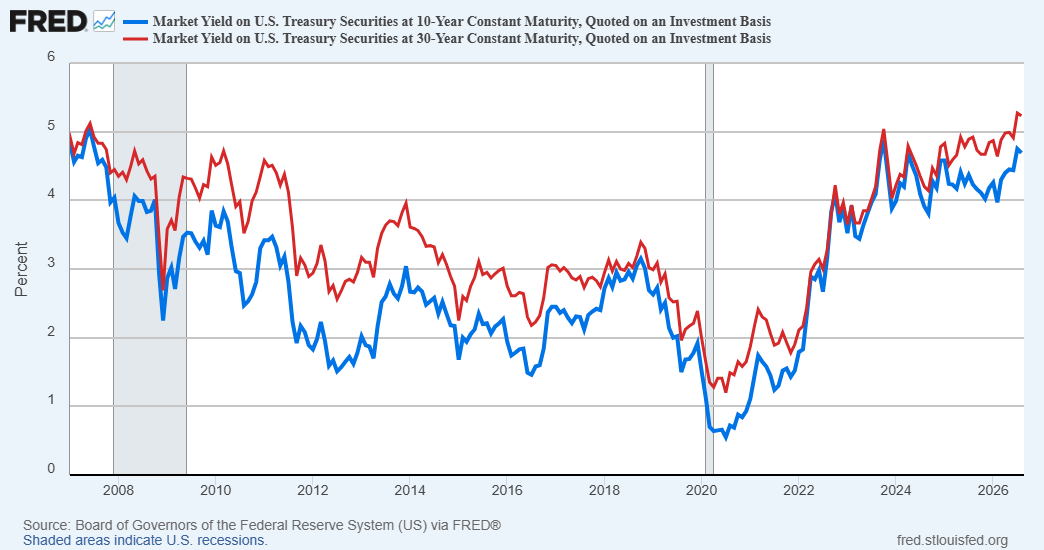
As yields rise, the cost of debt increases, both public and private. This not only places heavy burdens on a Federal Government with $40 trillion in debt, but slows down debt-funded economic activity, such as purchases of homes, automobiles and other durable goods. Focusing on the Federal Government’s debt-service obligations, the graph below illustrates the interest cost of Federal debt as a percentage of the economy (blue line), and total debt as a percentage of the economy (red line).
Notice that interest expense as a percentage of GDP was greater in the 1980’s and early 1990’s. This was due to the massive increase in interest rates resulting from the inflation of the 1970’s. But more importantly, total debt as a percentage of GDP today is over double what it was back then. This is more troubling, because the base or debt is much larger. If inflation were to continue to rise, then long-term rates would likely follow. With debt-to-GDP over 2.4 times the late 1980’s level, even a much lower interest level than the 1980’s would result in higher interest costs as percentage of GDP.
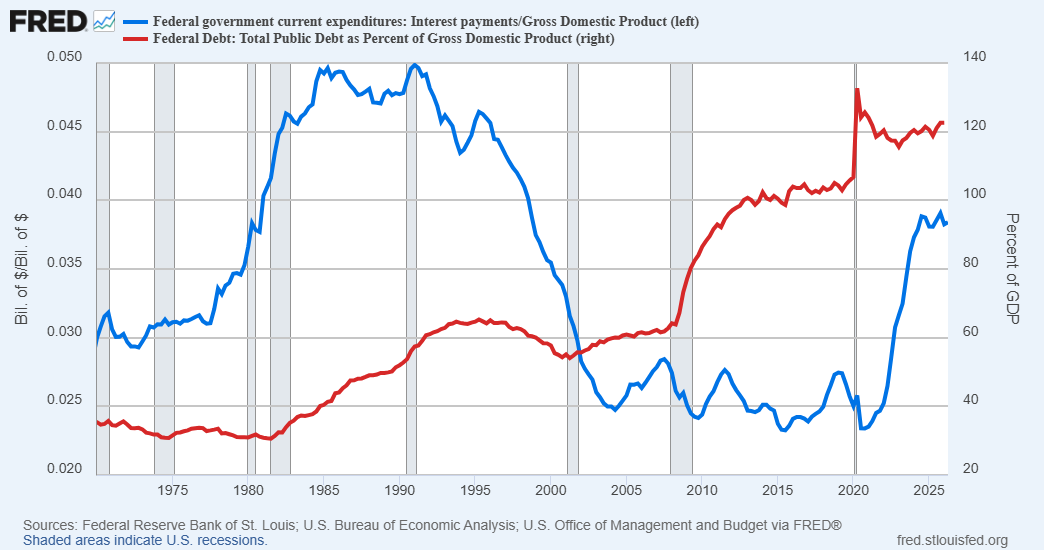
Instead of concentrating on the causes of high interest rates, the Treasury is attempting to disrupt market forces by implementing short-term measures which will most likely only provide short-term, if any, relief. By kicking the can down the road, the possibility of even higher rates in the future are even greater. The mountain of debt becomes a drag on economic growth. Turning to the Treasury’s and Fed’s playbooks, the “solutions” include some combination of deficit spending and QE. These solutions are inflationary, which will put upward pressure on long-term interest rates. Repurchases of long-term notes and bonds by the Treasury Department are limited by their available funds (TGA). After the TGA is gone, the Treasury can sell Treasury Bills. However, if buyers disappear, they will have to turn to the Fed, and inflationary QE returns. It will be interesting to see what gimmicks the Treasury Department comes up with next in attempts at manipulating long-term rates. And as legendary investor, Stanley Druckenmiller, wrote in a recent opinion column in The Wall Street Journal, “Governments defending prices against fundamentals always lose. The only variable is how much they spend before conceding.”
The S&P 500 Index closed at 7,674, down 1.4% for the week. The yield on the 10-year Treasury Note rose to 4.74 %. Oil prices increased to $87 per barrel, and the national average price of gasoline according to AAA rose to $4.10 per gallon.
© 2026. This material was prepared by Bob Cremerius, CPA/PFS, of Prudent Financial, and does not necessarily represent the views of other presenting parties, nor their affiliates. This information should not be construed as investment, tax or legal advice. Past performance is not indicative of future performance. An index is unmanaged and one cannot invest directly in an index. Actual results, performance or achievements may differ materially from those expressed or implied. All information is believed to be from reliable sources; however we make no representation as to its completeness or accuracy.
Securities offered through Registered Representatives of Cambridge Investment Research, Inc., a broker/dealer, member FINRA/SIPC. Advisory services offered through Cambridge Investment Research Advisors, Inc., a Registered Investment Advisor. Prudent Financial and Cambridge are not affiliated.
The information in this email is confidential and is intended solely for the addressee. If you are not the intended addressee and have received this message in error, please reply to the sender to inform them of this fact.
We cannot accept trade orders through email. Important letters, email or fax messages should be confirmed by calling (901) 820-4406. This email service may not be monitored every day, or after normal business hours.