



Executive Summary
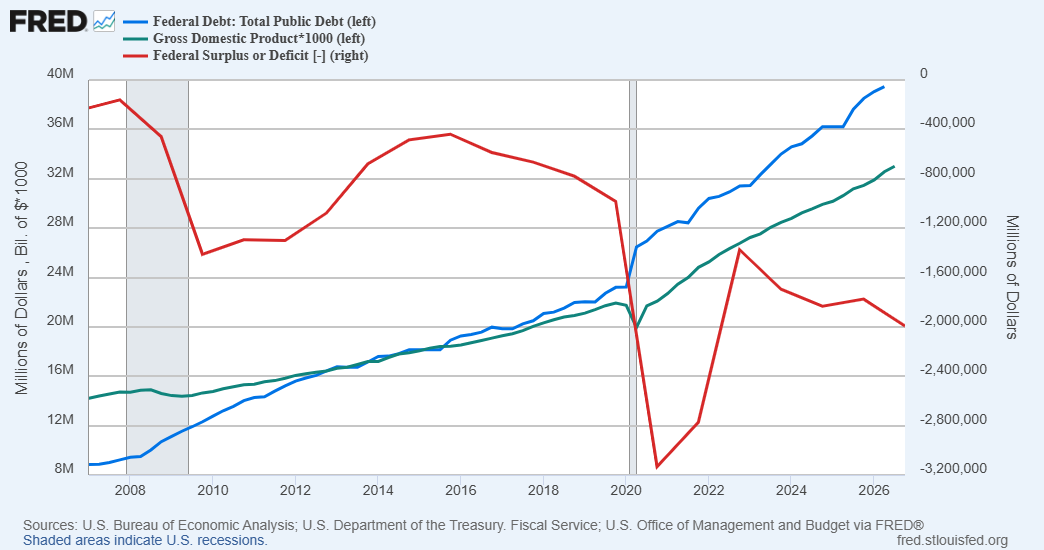
With the Mid-Term elections now in the review mirror, it is apparent neither party seems to care that Federal Debt now exceeds $40 trillion. For perspective, in January of 2007 it was only $8.9 trillion. During the 2008 Financial Crisis, Federal deficit spending rose, as well as from 2016-2019, then it blew out of the water during the Covid Pandemic and now is back on the 2016-2019 trajectory (see first graph, red line, inverse). The most recent increases were in “good times” before the war with Iran. The issue is with interest rates rising, the cost of debt payments is nearing 40% of income tax receipts. In the event of an economic downturn, income tax receipts may decline while debt service is increasing. At some point holders of Federal notes and bonds will come concerned about the ability of the Federal Government to repay the bonds. If this happens, the Fed will have to step in to purchase the bonds to fund the government. This in turn would risk driving higher inflation.
For further analysis, continue to read The Details below for more information.
“Chains of habit are too light to be felt until they are too heavy to be broken.”
–Warren Buffett
The Details
The Mid-Terms are a wrap and once again, one of the most important issues facing our Nation was ignored…by both parties. Federal debt has crossed $40 trillion, but apparently no one cares. Economist John Mauldin took notice as he wrote in his recent blog, Thoughts from the Front Line, that he considers a worldwide, US-led sovereign debt crisis to be the top global economic danger today. He went on to write, “Democrats ran on expanding access to healthcare and bringing back the temporary increase in Medicaid that was passed in the Covid era. Which reminds us of the Milton Friedman (paraphrased) old line, ‘There is nothing more permanent than a temporary government program.’ The defense budget, while bloated, is going to need attention as we have run through our missiles and arsenal.”
The graph below compares the Federal debt (blue line, left side) to Gross Domestic Product (GDP) (green line, left side). In January 2007, the Federal debt stood at $8.9 trillion, and GDP totaled approximately $14.2 trillion. Then, the Financial Crisis hit, and deficit spending soared (red line, right side). Deficits began falling beginning around 2012 before increasing again in 2016. However, when the pandemic hit, deficits skyrocketed to unheard of levels. After the pandemic, deficit spending fell but remained higher than pre-pandemic levels. In 2023 the increasing trend in deficit spending established from 2016-2019 resumed. And this was in “good times” before the war with Iran. Current deficits are running around $2 trillion annually and growing. And, as mentioned by John Mauldin above, the war will require increased military spending, and the newly elected Democrats will push for their priority of Medicare for all. In 2016, the Federal debt balance jumped above gross GDP and never looked back, with the gap only widening.
The following graph highlights the dilemma. As the debt balance has soared to about $40.6 trillion and interest rates have risen, the cost of servicing the debt has reached crisis levels. Interest costs have surged to around $1.3 trillion annually (blue line, left side). This expense is serviced primarily through personal and corporate income taxes. Social Security taxes are already fully consumed by their benefit payments. The Social Security Trust Fund will be depleted in about six years. Currently, interest payments consume about 39% of income tax receipts. Any further rise in interest rates will increase the percentage of income taxes required to service the massive debt.
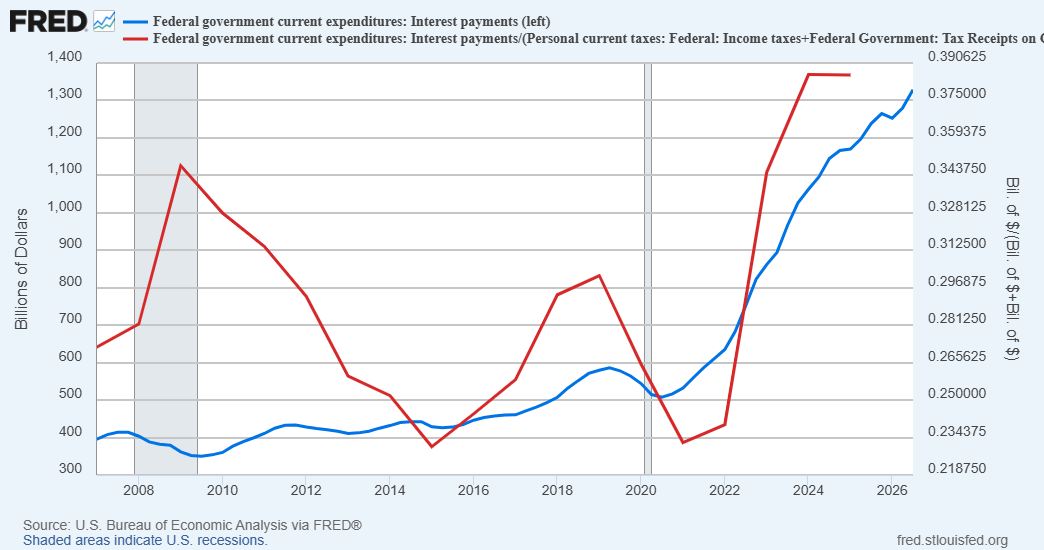
With debt servicing costs approaching 40% of all income tax payments collected, something has to give. Unfortunately, the last election taught us that tackling this crisis is not on the agenda. And no thought seems to be given to the possibility of a recession reducing income tax collections and increasing debt, and therefore, debt service costs. At some point holders of Federal notes and bonds will become concerned about the ability of the Federal Government to repay the bonds. If this happens, the Fed will have to step in to purchase the bonds to fund the government. This in turn would risk driving inflation higher, which then accelerates the spiral.
I remain frustrated and concerned that our elected officials seem so lackadaisical when it comes to one of, if not the most important issue, facing our country. The time to act is now. Any further delay almost assures a future debt crisis.
The S&P 500 Index closed at 7,377, down 2.7% for the week. The yield on the 10-year Treasury Note fell to 4.86%. Oil prices decreased to $91 per barrel, and the national average price of gasoline according to AAA fell to $4.01 per gallon.
© 2026. This material was prepared by Bob Cremerius, CPA/PFS, of Prudent Financial, and does not necessarily represent the views of other presenting parties, nor their affiliates. This information should not be construed as investment, tax or legal advice. Past performance is not indicative of future performance. An index is unmanaged, and one cannot invest directly in an index. Actual results, performance or achievements may differ materially from those expressed or implied. All information is believed to be from reliable sources; however, we make no representation as to its completeness or accuracy.
Securities offered through Registered Representatives of First Heartland Capital, Inc., a broker/dealer, member FINRA/SIPC. Advisory services offered through First Heartland Consultants, Inc., a Registered Investment Advisor. Prudent Financial and First Heartland are not affiliated.
The information in this email is confidential and is intended solely for the addressee. If you are not the intended addressee and have received this message in error, please reply to the sender to inform them of this fact.
We cannot accept trade orders through email. Important letters, email or fax messages should be confirmed by calling (901) 820-4406. This email service may not be monitored every day, or after normal business hours.