


Executive Summary
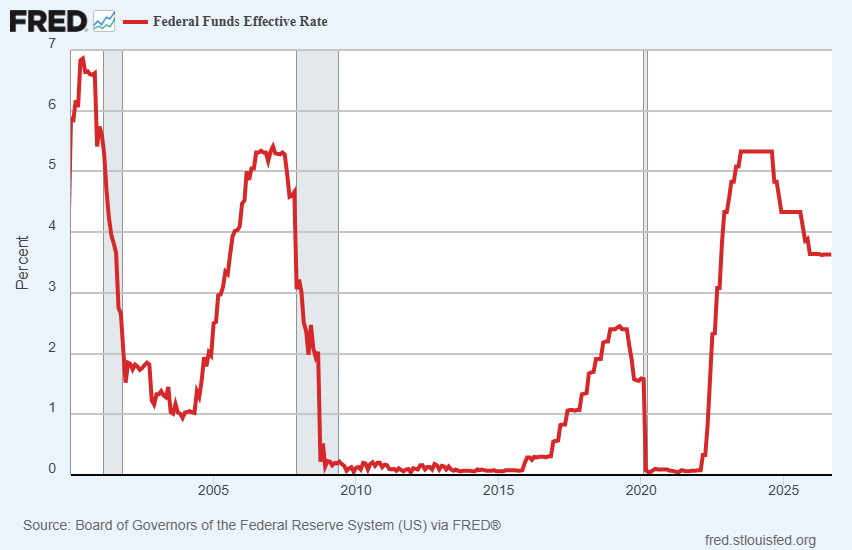
As I have written before, the Fed has boxed itself in a corner. The current administration wants lower interest rates, but the Fed’s 2% inflation target suggests rate increases. The short-term Fed Funds Rate, shown in the first graph, is the only rate the Fed directly controls. Meanwhile, its August 19 Treasury buyback announcement, intended to lower longer-term rates, has not had its intended effect as the 10-year Treasury touched 5% on Monday. Last week’s CPI report showed headline inflation up 3.4% year over year, while core inflation, excluding food and energy, rose 2.4%. With inflation still not tamed, this week should reveal whether the Fed is more focused on controlling inflation or reducing debt costs.
For further analysis, continue to read The Details below for more information.
“Interest rates are to asset values what gravity is to the earth.”
–Warren Buffett
The Details
The Fed’s Federal Open Market Committee (FOMC) is meeting this week and will announce on Wednesday afternoon their decision on short-term interest rates. I would love to be a fly on the wall in that meeting. They have essentially boxed themselves into a corner. The current administration is pushing heavily towards a reduction in interest rates. Many believe that inflation due to an oil supply problem cannot be solved by raising interest rates. Others fear that the stage is set with rising oil prices for inflation to surge higher and therefore, rates need to be hiked immediately. Of course, both arguments ignore one big piece of the equation, the Fed only controls short-term interest rates, despite their attempts to move long-term rates through Treasury repurchases. On August 19, Treasury Secretary Scott Bessent announced the Treasury would increase their debt buyback program from $2 billion to $4 billion per operation. Then on September 9 he increased the program further announcing they would repurchase $6 billion instead of $4 billion. The goal was to reduce long-term interest rates; however, since they started these operations, the yield on the 10-year Treasury has increased from about 4.70%, touching 5% on Monday, September 14.
The short-term Fed Funds Rate (FFR) is set by the FOMC and affects many other short-term interest rates. The graph below shows the track of the FFR since 2000. Fear over a slowing economy pushed the Fed to begin lowering the FFR in 2024. The effective FFR has been lowered from 5.33% to 3.63%. The debate now is can the Fed stop inflation from rising by increasing the rate, or would an increase create more havoc in the economy due to the total amount of debt outstanding?
Last week the Consumer Price Index (CPI) for August was released. The Headline Index rose 3.4% year-over-year, and 0.4% month-over-month. The monthly increase was 0.3% higher than in July, largely attributable to energy. The “Core” Index rose 2.4% year-over-year, and 0.3% month-over-month. The “Core” excludes food and energy and increased 0.1% more than July. The month-over-month increases suggest the possibility that inflation is not tamed. See the graph of CPI below from VettaFi.
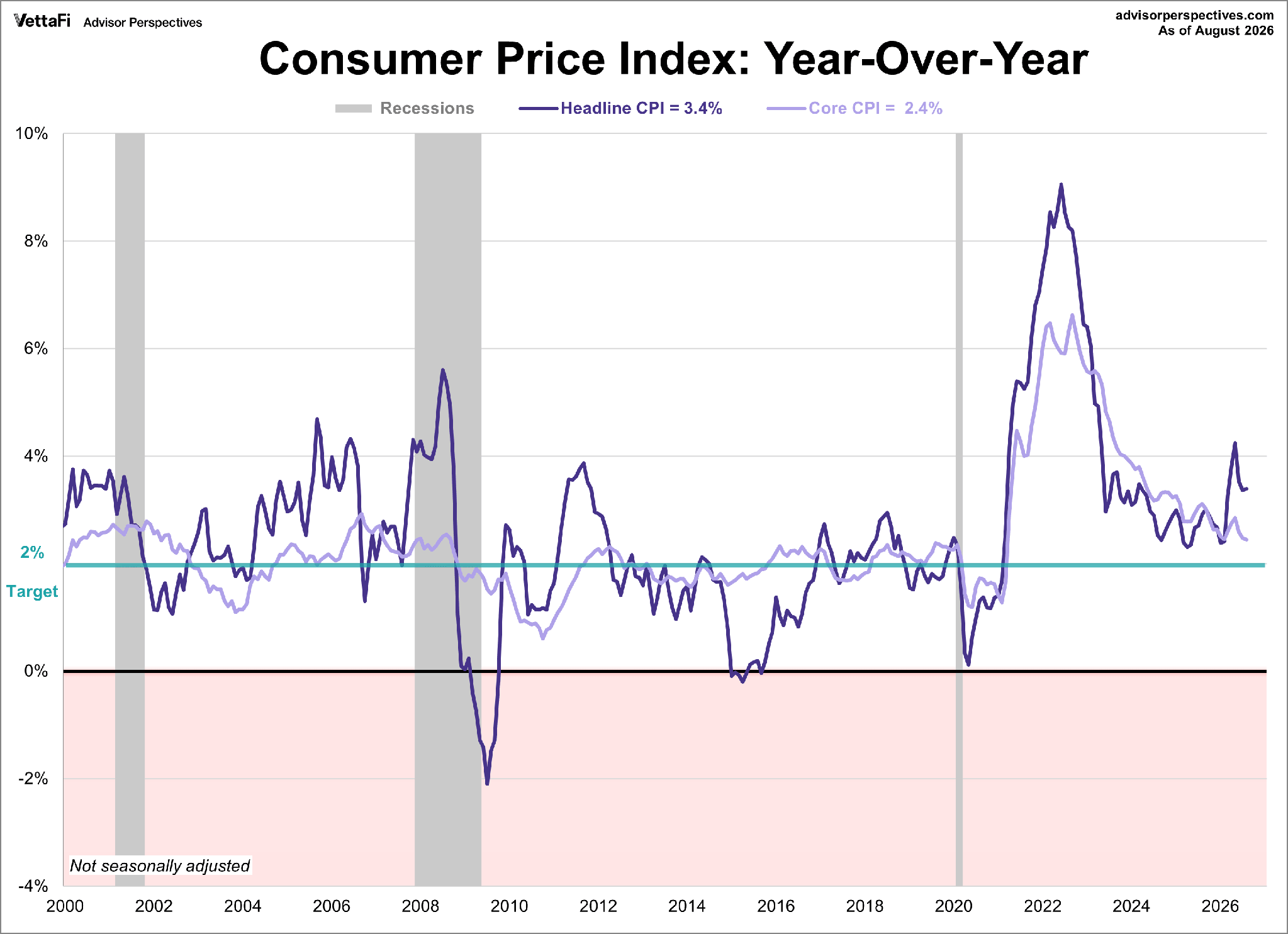
One of those concerned about rising inflation, Charlie Bilello, Chief Market Strategist @ Creative Planning, stated via X, “66. As in 66 consecutive months with US inflation above the Fed’s 2% target. The Fed has lost all credibility when it comes to fighting inflation.”
The Fed’s dilemma is obvious. Lower long-term rates are more desirable in a debt-ridden economy. But the Fed only controls short-term rates, despite their best efforts otherwise. According to VettaFi, current market expectations show an 87% chance of a 25-basis point hike this week. Wednesday, we will learn the accuracy of market predictions. We will also determine if the Fed is serious about attempting to control inflation, or if their concern over the cost of debt takes precedence.
The S&P 500 Index closed at 7,657, down 0.8% for the week. The yield on the 10-year Treasury Note rose to 4.98 %. Oil prices increased to $100 per barrel, and the national average price of gasoline according to AAA rose to $4.31 per gallon.
© 2026. This material was prepared by Bob Cremerius, CPA/PFS, of Prudent Financial, and does not necessarily represent the views of other presenting parties, nor their affiliates. This information should not be construed as investment, tax or legal advice. Past performance is not indicative of future performance. An index is unmanaged and one cannot invest directly in an index. Actual results, performance or achievements may differ materially from those expressed or implied. All information is believed to be from reliable sources; however we make no representation as to its completeness or accuracy.
Securities offered through Registered Representatives of Cambridge Investment Research, Inc., a broker/dealer, member FINRA/SIPC. Advisory services offered through Cambridge Investment Research Advisors, Inc., a Registered Investment Advisor. Prudent Financial and Cambridge are not affiliated.
The information in this email is confidential and is intended solely for the addressee. If you are not the intended addressee and have received this message in error, please reply to the sender to inform them of this fact.
We cannot accept trade orders through email. Important letters, email or fax messages should be confirmed by calling (901) 820-4406. This email service may not be monitored every day, or after normal business hours.