



Executive Summary
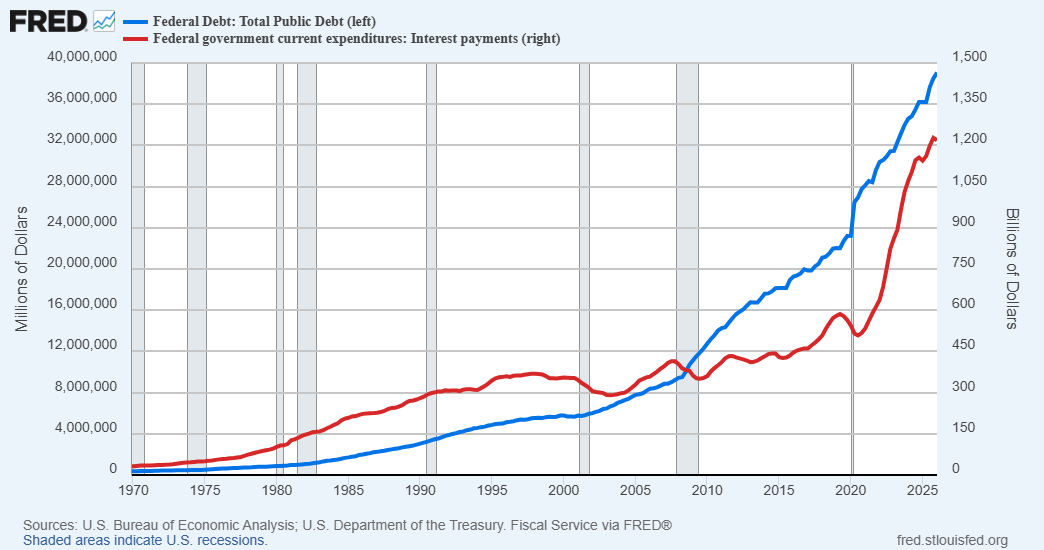
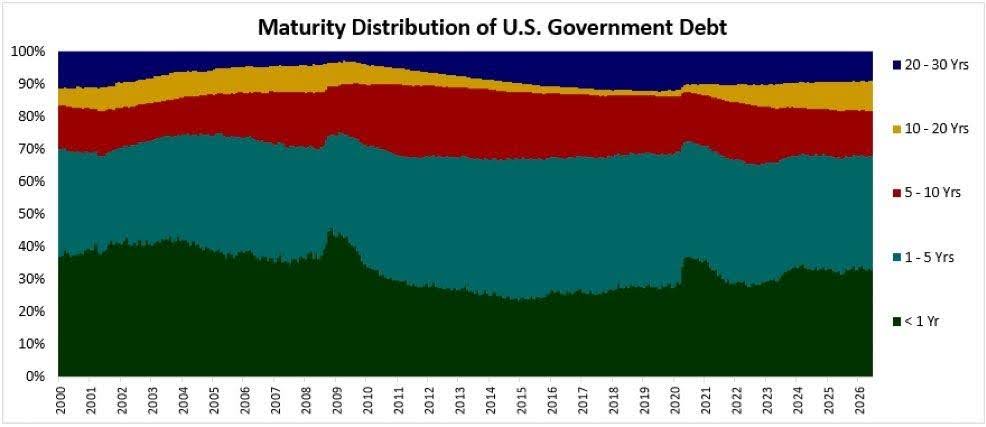
The U.S. currently runs a budget deficit of almost $2 trillion, and total U.S. Federal debt is approaching $40 trillion. With rising interest rates in recent years, the cost to service the debt, which consumes nearly 38% of total income taxes collected, has skyrocketed with the debt (first graph). The interest rate on Federal outstanding debt currently averages 3.41%; however, the nearly 70% maturing within the next five years could be refinanced at higher rates (see 3rd illustration). Add in defense spending with interest costs and 75% of income tax receipts are gone, leaving 25% for everything else. It seems long overdue for policymakers to address the U.S. fiscal dilemma.
For further analysis, continue to read The Details below for more information.
“Deficit spending is simply a scheme for the confiscation of wealth.”
–Alan Greenspan
The Details
The fiscal dilemma facing the United States is getting worse by the day. It seems any thought of fiscal responsibility is the last thing on the minds of policymakers. This apathy could lead to disastrous consequences. The U.S. continues running crisis-level budget deficits, presently almost $2 trillion. The rise in interest rates has drastically increased the cost of servicing this debt obligation, now approaching $40 trillion. The graph below shows the growth in Federal debt in blue (left side) and the related interest cost in red (right side).
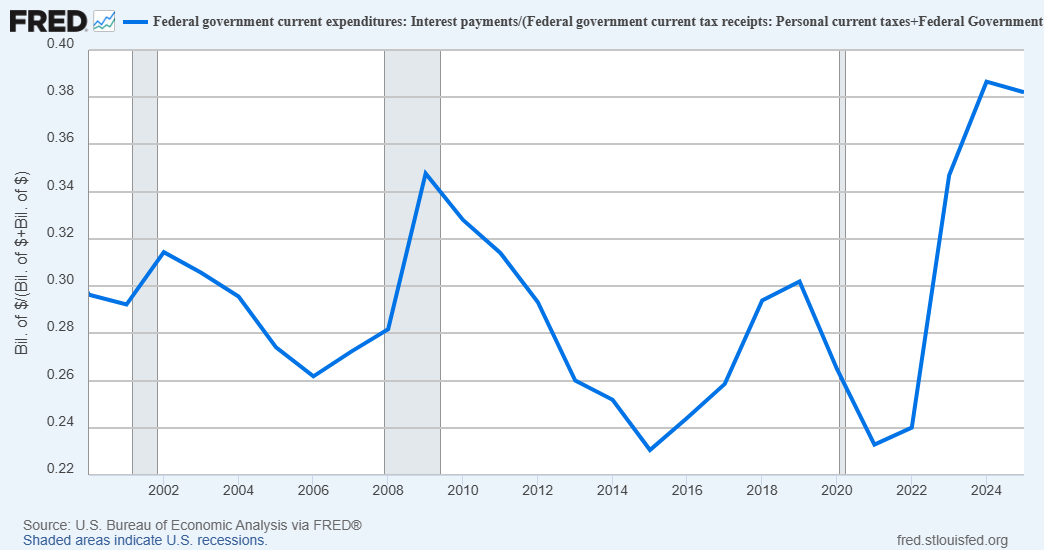
The Federal government is primarily financed through the collection of income taxes on individuals and corporations. Payroll taxes are collected primarily for Social Security and Medicare benefits. Currently, annual payroll tax collections fall short of the required disbursements for these programs, therefore increasing the amount of new Treasuries to be issued. To see how dire the fiscal dilemma is, the following graph illustrates that current interest expense consumes just over 38% of total income tax collections. When defense spending is added, the total of only gross interest costs plus defense spending is almost 75% of income tax collections. That leaves the remaining 25% to cover the entire remaining parts of the Federal Government.
But it gets worse. Remember, interest rates have been increasing. This means that issuing new Treasury Securities to cover maturities and additional deficits will be at higher interest rates. The current average interest rate on outstanding Federal debt is about 3.41%. The level of debt soon to mature which will require refinancing is significant.
According to TreasuryBonds.com, via X, here is a schedule of upcoming maturities and a graph of maturity distributions:
🟢 <1 year: ~32%
🔵 1–5 years: ~36%
🔴 5–10 years: ~14%
🟡 10–20 years: ~9%
🔵 20–30 years: ~9%
“That means nearly 70% of all Treasury debt matures within the next 5 years, forcing the government to refinance trillions of dollars at whatever interest rates prevail.”
With inflation still a concern, it remains possible for interest rates to continue their rise. This added cost would significantly increase annual deficits, now approaching $2 trillion. It is far past time to take the fiscal picture seriously. If policymakers continue to ignore the situation, the effects will be seen in the pricing of Treasury Securities, as well as the value of the dollar.
It is projected that in five years, the cost of interest alone could consume almost 41% of income tax collections, and in ten years over 45%. And we all know how projections turn out. The actual outcome could be much higher. In any event, addressing the fiscal dilemma is long overdue.
The S&P 500 Index closed at 7,412, down 0.6% for the week. The yield on the 10-year Treasury Note rose to 4.68 %. Oil prices increased to $89 per barrel, and the national average price of gasoline according to AAA rose to $4.11 per gallon.
© 2026. This material was prepared by Bob Cremerius, CPA/PFS, of Prudent Financial, and does not necessarily represent the views of other presenting parties, nor their affiliates. This information should not be construed as investment, tax or legal advice. Past performance is not indicative of future performance. An index is unmanaged and one cannot invest directly in an index. Actual results, performance or achievements may differ materially from those expressed or implied. All information is believed to be from reliable sources; however we make no representation as to its completeness or accuracy.
Securities offered through Registered Representatives of Cambridge Investment Research, Inc., a broker/dealer, member FINRA/SIPC. Advisory services offered through Cambridge Investment Research Advisors, Inc., a Registered Investment Advisor. Prudent Financial and Cambridge are not affiliated.
The information in this email is confidential and is intended solely for the addressee. If you are not the intended addressee and have received this message in error, please reply to the sender to inform them of this fact.
We cannot accept trade orders through email. Important letters, email or fax messages should be confirmed by calling (901) 820-4406. This email service may not be monitored every day, or after normal business hours.