



Executive Summary
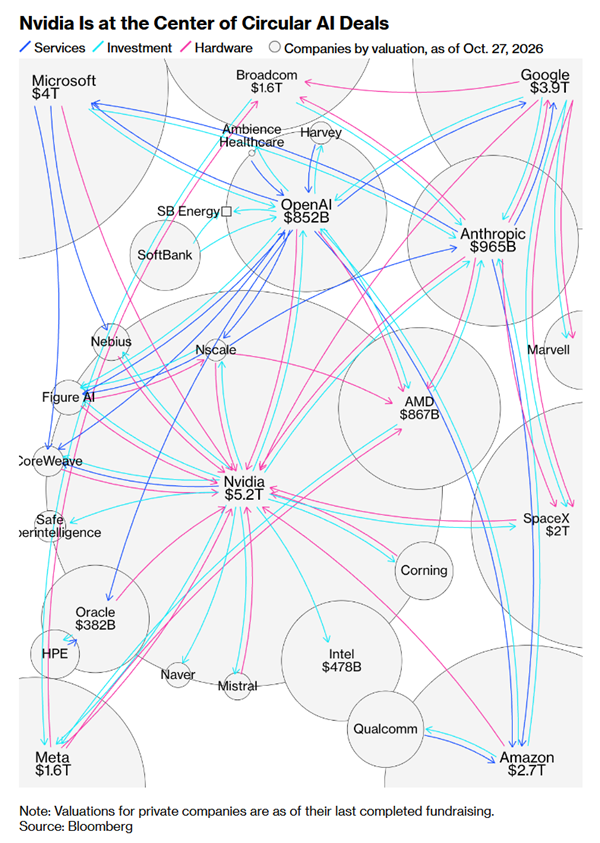
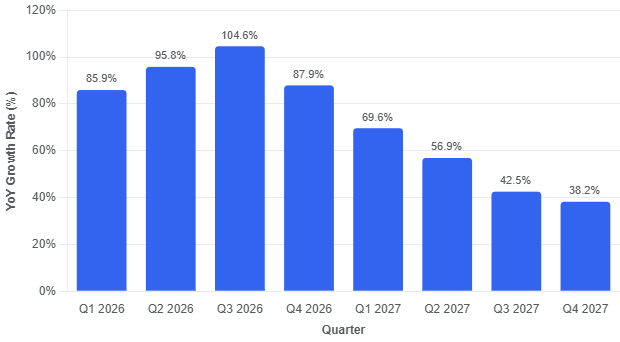
Artificial intelligence has become almost synonymous with Nvidia, whose stock is down 33% from its October 2026 peak. Former CEO Jensen Huang just resigned amid scandal over an affair with an alleged Chinese spy. I have previously written about AI’s circular deals (see first graph), and investors are now examining the latest AI wobble in the market. Capital spending on the AI buildout appears to have peaked in the third quarter of 2026, with much smaller growth now projected (see third graph). With revenue falling and capex being reduced, many creditors are watching closely to see how those circular deals will fare. Finally, the last graph compares Nvidia with Cisco during the Tech Bubble.
For further analysis, continue to read The Details below for more information.
“Knowledge, indeed, is the enemy of a speculator during a boom.”
–Edwin Lefevre
The Details
When people think of AI (artificial intelligence), they typically think of chipmaker Nvidia. Nvidia chips power the engines that run most AI applications like ChatGPT. Jensen Huang, hands-on CEO of Nvidia has held the reins for 33 years. So, it should come as no surprise that many are clamoring for his return after being ousted, after admitting to an affair with an alleged Chinese spy. With no successor in sight, investors are concerned. Nvidia’s stock has fallen around 33% since its early October peak.
As reported by Bloomberg, “Huang is a consummate dealmaker and has used the company’s vast resources to invest in the AI supply chain and a variety of startups. He’s also a top evangelist for the AI revolution itself, downplaying fears about the risks to humanity and talking up the benefits.” The graph below illustrates the circular deals surrounding Nvidia.
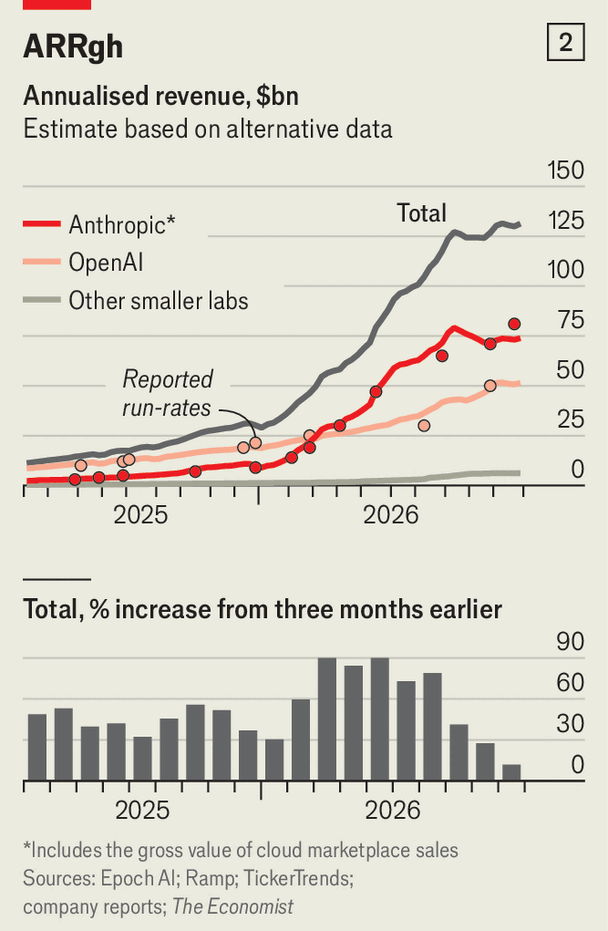
The fall in AI stock prices of late may not be solely tied to Nvidia. According to a recent article in The Economist entitled, Can the AI boom make enough money to sustain itself? “One cause of AI’s recent wobble was a fear that revenue growth may be slowing. Alternative-data proxies like Ramp, which tracks AI spending on company credit cards, and TickerTrends, which collates data such as social-media posts and spending patterns from panels of businesses and consumers, point to slowing revenue growth among the AI developers. A model fitting those data sets to the revenue figures that Anthropic, OpenAI and others have released suggests three-month revenue growth slowed from 80-90% in the spring to 12% in October (see chart 2[below]).
The use of debt-financed capex by developers, often off-balance sheet, has been tremendous. However, some, including Bob Elliot CIO of Unlimited Funds, have pointed out that while the dollar amounts are still extreme, the rate of growth in capex spending is expected to fall precipitously. The peak in capex growth was in the third quarter, 2026. Notice in the graph below (via AI), that growth rates are expected to drop from the peak of about 105% to 38% by the fourth quarter, 2027.
And Cameron Crise, macro strategist at Bloomberg, points out, “The drawdown overlay between Cisco and Nvidia looks remarkably similar. The analogy suggests that we are now in what’s the equivalent of May 2000, after the peak of the dot-com Nasdaq complex.”
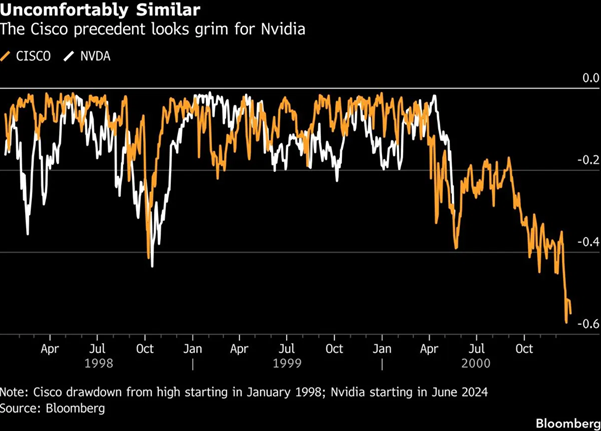
It appears AI is getting hit from all sides. To say that the recent drop in stock prices is only attributable to Huang’s affair with an alleged Chinese spy is vastly oversimplifying the situation. Revenue growth for developers is dropping. Potentially recognizing the potential over build in data center infrastructure, developers are expected to slow growth rates on capex spending. While AI is different than the internet boom in the late 1990’s, Nvidia stock price eerily rhymes with Cisco during the Tech Bubble. (h/t to Jesse Felder for links to articles.)
Has the AI boom gone too far too soon? There are many creditors watching billions, if not trillions, in outstanding debt who are hoping this is not true.
The S&P 500 Index closed at 7,377, up 2.5% for the week. The yield on the 10-year Treasury Note rose to 5.15%. Oil prices decreased to $89 per barrel, and the national average price of gasoline according to AAA fell to $3.82 per gallon.
© 2026. This material was prepared by Bob Cremerius, CPA/PFS, of Prudent Financial, and does not necessarily represent the views of other presenting parties, nor their affiliates. This information should not be construed as investment, tax or legal advice. Past performance is not indicative of future performance. An index is unmanaged, and one cannot invest directly in an index. Actual results, performance or achievements may differ materially from those expressed or implied. All information is believed to be from reliable sources; however, we make no representation as to its completeness or accuracy.
Securities offered through Registered Representatives of First Heartland Capital, Inc., a broker/dealer, member FINRA/SIPC. Advisory services offered through First Heartland Consultants, Inc., a Registered Investment Advisor. Prudent Financial and First Heartland are not affiliated.
The information in this email is confidential and is intended solely for the addressee. If you are not the intended addressee and have received this message in error, please reply to the sender to inform them of this fact.
We cannot accept trade orders through email. Important letters, email or fax messages should be confirmed by calling (901) 820-4406. This email service may not be monitored every day, or after normal business hours.