



Executive Summary
This week’s newsletter builds on the August 18th issue, which examined circular financing in the A.I. space. Billions of dollars are being borrowed and spent to build A.I. infrastructure, with investors betting on miraculous, life-changing results. Much of this issue draws on The New York Times opinion piece by Robin Wigglesworth, an editor at the Financial Times, titled “This Is How the A.I. Debt Binge Sinks the Economy.” As the article notes, the U.S. has a long history of debt-fueled investment sprees, from 19th-century railway euphoria to the 20th-century technology boom and the 21st-century housing bubble. Each ultimately proved transformative over the long term, but each also triggered near-term economic downturns. So, while the investment, speculation, and gambling may excite Wall Street, the accompanying debt has often created painful consequences.
For further analysis, continue to read The Details below for more information.
“There is an amazing family resemblance about all stories of all booms.”
–Charles P. Kindleberger
The Details
In my August 18th newsletter, I lifted the hood on the circular financing in the A.I. (Artificial Intelligence) space. Billions of dollars are being invested, borrowed, and spent on the hopes of miracle results. But, as important as the internet is to daily life today, its results did not appear overnight. Recently, in The New York Times, Robin Wigglesworth, an editor at the Financial Times, penned an opinion piece entitled, “This Is How the A.I. Debt Binge Sinks the Economy” in which he states, “Unfortunately, manias fueled mainly by credit almost inevitably end badly.”
The U.S. has a long history of debt-fueled investment sprees as outlined in the article, from the 19th century railway euphoria, to the 20th century technology revolution to the 21st century housing boom. “They all resulted in nasty economic downturns, even if the underlying technology proved transformative.”
The amount of debt necessary to finance the massive capital expenditures required to develop the datacenters essential for hyperscalers is enormous. “Last year, analysts at Barclays, the British bank, collected a string of unsourced quotes from an A.I. data center conference they attended, which ranged from ‘enjoy the ride on a rocket without seatbelts’ to the ‘best way to describe the market is bonkers.’”
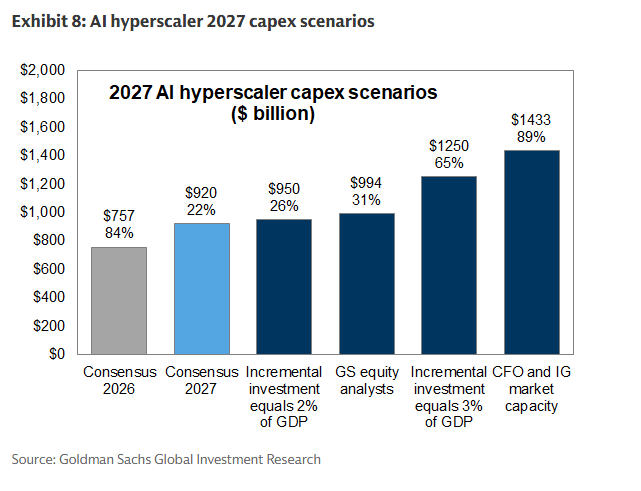
By the end of 2026, the debt financing is expected to hit about $600 billion. “Their future capital expenditure plans amount to roughly 3 percent of US GDP a year, in 2027 to 2029, according to calculations by Torsten Slok, the chief economist of Apollo, an investment firm.” The graph below from Goldman Sachs shows the massive range of capex scenarios.
The size and scope of the capex being incurred has changed the game for some tech companies. For instance, Google had accumulated almost $600 billion in free cash flow since listing in 2004; however, in the second quarter of 2026 their free cash flows turned negative.
Creative accounting is being used to keep debt off of balance sheets by structuring investments as lease commitments. “Take Meta’s titanic Hyperion data center project in Louisiana, for example. Instead of issuing bonds, the company secured most of the financing money by promising to rent the data center itself for 20 years. As a result, the $27.3 billion loan appears nowhere on Meta’s balance sheet – even though it is in practice on the hook for making these future lease payments…As Goldman blandly noted: ‘This treatment can understate leverage and future liquidity needs as these obligations are eventually recognized and contractual payments come due.’” And this is in addition to the $1.5 trillion in purchase commitments for chips and electricity that aren’t on the balance sheets.
“Adding to the dangers, the A.I. ecosystem has become remarkably incestuous, with a wildly complicated tangle of business, investment and lending relationships tying most of the companies together. Even idiosyncratic problems in one corner could easily ripple across the whole industry. […]
At the peak of the 1870s railway mania, one American financier is said to have quipped that ‘no railroad has ever been placed on a paying basis until it has been through a receivership.’ Perhaps the same will be said for the A.I. data centers now being constructed around the world.
That might leave us with cheap and abundant computing power — even many bankrupt railways proved a long-term boon — but in the short term, Americans would be left dealing with a painful economic setback. The crash that followed an epic railway bond bust of 1873 was long known as the Great Depression — until that label was usurped in the 1930s. Today, it is commonly called the ‘Long Depression,’ and is a testament to the dangers of even well-founded technology booms that come to rely too much on debt. And railroad tracks last much longer than chips.”
And once again, it is a debt problem.
The S&P 500 Index closed at 7,712, up 0.5% for the week. The yield on the 10-year Treasury Note fell to 4.72 %. Oil prices decreased to $83 per barrel, and the national average price of gasoline according to AAA dropped to $4.08 per gallon.
© 2026. This material was prepared by Bob Cremerius, CPA/PFS, of Prudent Financial, and does not necessarily represent the views of other presenting parties, nor their affiliates. This information should not be construed as investment, tax or legal advice. Past performance is not indicative of future performance. An index is unmanaged and one cannot invest directly in an index. Actual results, performance or achievements may differ materially from those expressed or implied. All information is believed to be from reliable sources; however we make no representation as to its completeness or accuracy.
Securities offered through Registered Representatives of Cambridge Investment Research, Inc., a broker/dealer, member FINRA/SIPC. Advisory services offered through Cambridge Investment Research Advisors, Inc., a Registered Investment Advisor. Prudent Financial and Cambridge are not affiliated.
The information in this email is confidential and is intended solely for the addressee. If you are not the intended addressee and have received this message in error, please reply to the sender to inform them of this fact.
We cannot accept trade orders through email. Important letters, email or fax messages should be confirmed by calling (901) 820-4406. This email service may not be monitored every day, or after normal business hours.