


Executive Summary
In 2026 oil prices have round-tripped from $57 per barrel to over $110 per barrel and then back to around $70 per barrel (see first graph). With the apparent breach of the ceasefire with Iran, prices recently jumped to $78 per barrel. The blockade of the Strait of Hormuz had some predicting $150 per barrel. According to economist John Mauldin, three things kept oil from reaching the $150 mark: 1. Large releases from governments’ strategic reserves 2. Oil producers used alternative routes to avoid the Strait and 3. China’s substantial drop in demand. Interestingly, major oil producers such as ExxonMobil and Chevron have warned that any price stability is an illusion. It appears volatility and higher prices could be the future for oil.
For further analysis, continue to read The Details below for more information.
“A shortage is a sign that somebody is keeping the price artificially lower than it would be if supply and demand were allowed to operate freely.”
–Thomas Sowell
The Details
At the start of the war with Iran, fear entered the oil markets. As concerns arose about the ability to ship oil through the Strait of Hormuz, oil prices soared. Prices at the beginning of 2026 hovered around $57 per barrel for West Texas Intermediate (WTI) crude oil. Quickly, prices jumped over $110 per barrel. The longer the crisis persisted, the lower the potential supply. This concern had many expecting oil prices to push much higher, possibly over $150 per barrel.
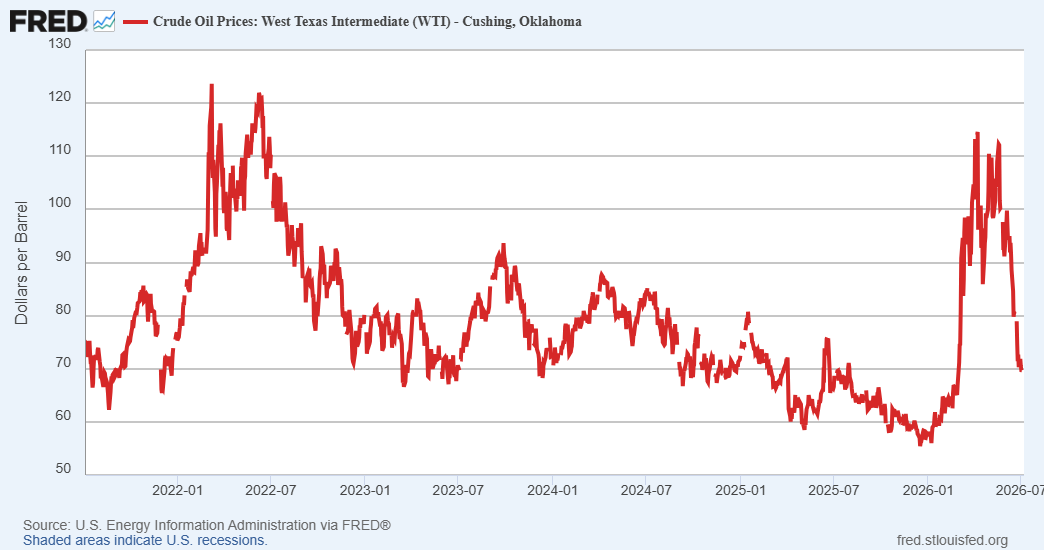
As shown in the graph of WTI prices above, as talks of a resolution increased, prices fell back to the $70 range. On Monday, July 13, with news the ceasefire had failed, new strikes on Iran began. As such, oil prices have pushed back to $78 per barrel.
The blockade of the Strait of Hormuz has forced many countries to dig into strategic reserves. And oil inventories are down to critical levels. So, why have prices not accelerated the way many experts had anticipated? According to economist John Mauldin in his Thoughts from the Front Line,
“So, what happened? Yes, the price of oil and gas has risen, but not as much as I thought it would. It seems that free markets respond the way they’re supposed to. I have used the line many times: the cure for high prices is high prices. High prices will reduce demand and increase production of whatever commodity or service we are talking about. It’s not instantaneous, but it happens over time.”
The closing of the Strait of Hormuz eliminated about 10 million barrels per day of oil or about 10% of global production. According to John Mauldin,
“The IEA report identifies three major reasons why we didn’t see oil prices in the stratosphere.
- There were large releases from private storage. Governments opened their emergency stockpiles. That added 3.8 million barrels a day to the global supply so far.
- Second, oil producers responded to the shock with crude output and sales that avoided the conflict zone. Saudi Arabia and the United Arab Emirates, for example, utilized alternative transportation routes—like the Saudis’ East-West pipeline—to bypass the strait and boost non-Hormuz oil exports by several million barrels per day.
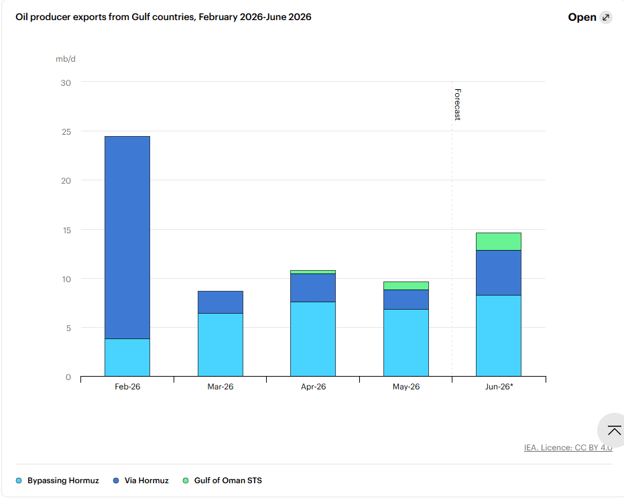
Refiners in the U.S. and Africa also boosted output and exports, especially for jet fuel to Europe—avoiding the dire consequences that many airline analysts predicted.
- Simple demand destruction. The IEA estimates that demand will be 5 million barrels per day lower than was predicted in January. China is a big part of that, with their demand dropping by 4 million barrels per day.
As Scott noted, [Scott Lincicome of The Dispatch, John Mauldin’s source] there were other smaller contributors. There was a lot of oil smuggling from Iran and Russia. Both nations had ‘shadow fleets’ already in place smuggling large amounts of oil against sanctions. Clearly that has to stop.
‘Most notably, the Trump administration the Jones Act for an unprecedented 150 days, thus boosting U.S. energy supplies (and security) by allowing foreign-flagged vessels to move American-made crude, refined products, and fertilizer between U.S. ports. So far, the waiver has allowed tens of millions of barrels and dozens of voyages that would’ve been banned by law in nonwaiver times.’”
The premise for why there has not been an oil price explosion is currently that demand is weakening, especially in China. Whether weak demand is being forced upon consumers because of high prices, or if it is due to other reasons, such as China’s push into electric vehicles, oil prices currently reflect the weak demand portion of the equation.
On the flip side, “Major producers like ExxonMobil and Chevron have warned that this price stability is an illusion. Because the current baseline is propped up entirely by draining finite commercial and strategic reserves, analysts warn that once these emergency buffers are exhausted, the market faces a violent ‘bullwhip effect’ that could rapidly force crude prices past $150 a barrel.”
There are strong arguments on both sides of the oil price dilemma. While a tapped-out U.S. consumer will likely reduce their demand for gasoline, the lack of non-reserve supported supply provides a strong case for higher oil prices. Much of the outcome will revolve around the time it takes to reach a final resolution with Iran. As of now, a volatile oil market, with potential for higher prices down the road, is highly probable.
The S&P 500 Index closed at 7,575, up 1.2% for the week. The yield on the 10-year Treasury Note rose to 4.57 %. Oil prices increased to $71 per barrel, and the national average price of gasoline according to AAA rose to $3.88 per gallon.
© 2026. This material was prepared by Bob Cremerius, CPA/PFS, of Prudent Financial, and does not necessarily represent the views of other presenting parties, nor their affiliates. This information should not be construed as investment, tax or legal advice. Past performance is not indicative of future performance. An index is unmanaged and one cannot invest directly in an index. Actual results, performance or achievements may differ materially from those expressed or implied. All information is believed to be from reliable sources; however we make no representation as to its completeness or accuracy.
Securities offered through Registered Representatives of Cambridge Investment Research, Inc., a broker/dealer, member FINRA/SIPC. Advisory services offered through Cambridge Investment Research Advisors, Inc., a Registered Investment Advisor. Prudent Financial and Cambridge are not affiliated.
The information in this email is confidential and is intended solely for the addressee. If you are not the intended addressee and have received this message in error, please reply to the sender to inform them of this fact.
We cannot accept trade orders through email. Important letters, email or fax messages should be confirmed by calling (901) 820-4406. This email service may not be monitored every day, or after normal business hours.