


Executive Summary
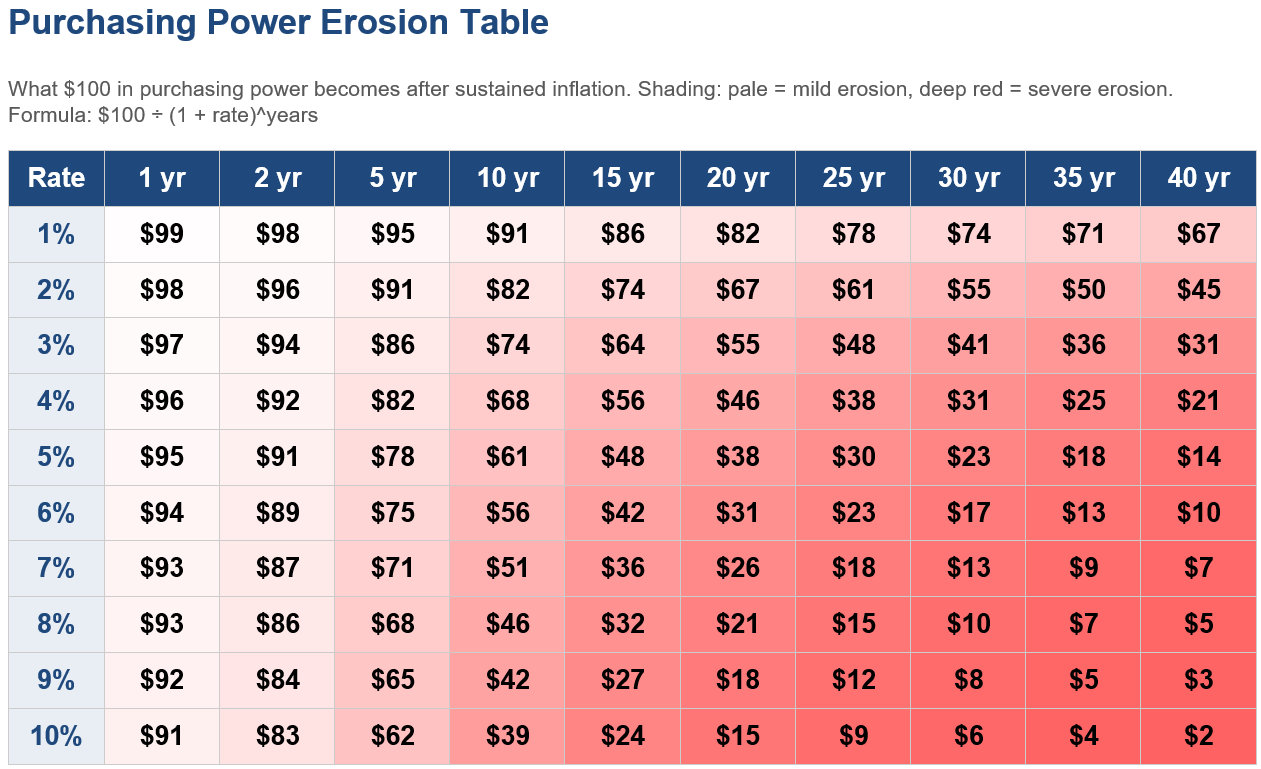
New Federal Reserve Chair Kevin Warsh faces a difficult decision on interest rates amid conflicting economic signals and persistent inflationary pressures. The first graph below titled Purchasing Power Erosion Table displays how even the Fed’s 2% inflation goal erodes the dollar. Despite recent declines in oil and gasoline prices shown in the second graph, low global oil inventories caused by the conflict with Iran and the resulting reduced Strategic Petroleum Reserve levels (3rd graph) indicate inflation remains a significant concern. In May the PCE and “Core” PCE both rose year over year (last graph) indicating continued higher prices for consumers. Together, these trends suggest inflationary pressures are not fully resolved, complicating decisions about whether the Fed should raise or delay changes to interest rates, particularly in the context of political pressure during an election year.
For further analysis, continue to read The Details below for more information.
“Inflation hasn’t ruined everything. A dime can still be used as a screwdriver.”
–H. Jackson Brown, Jr.
The Details
New Fed Chair, Kevin Warsh, faces an enormous dilemma. Should interest rates be lowered, raised or remain the same? Contradictory data, including record high debt, weak economic growth and high inflation, add to the dilemma. And to top it off, this is an election year. There will be immense political pressure on this “independent” organization to lower rates.
On the other hand, if inflation gets out of hand, it might be hard to put the genie back into the bottle. The graph below from economist John Mauldin illustrates the huge impact inflation has on the purchasing power of the dollar. Notice that at the Fed’s (absurd) 2% target rate of inflation, the dollar loses 18% of its value over ten years and a third of its value over 20 years. At 4% inflation, over half the value of your money is eroded over 20 years.
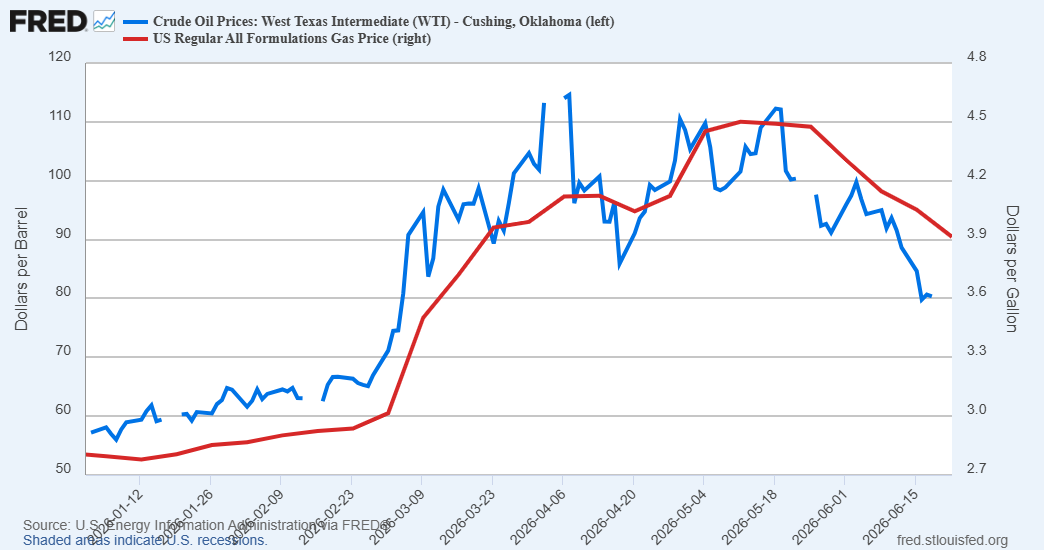
As I stated in my March 10, 2026, newsletter, inflation can arrive from either an increase in both the money supply and its turnover (velocity), or from a supply shock. The consequence of a prolonged supply shock depends upon the length of time supplies are limited. The war with Iran and closing of the Strait of Hormuz sent oil and gasoline prices soaring. Talks about ending the war and opening the Strait have pushed WTI (West Texas Intermediate) oil prices down from over $110 per barrel to around $70 per barrel. Gasoline prices have also dropped from over $4.50 per gallon to around $3.90 per gallon as shown in the graph below.
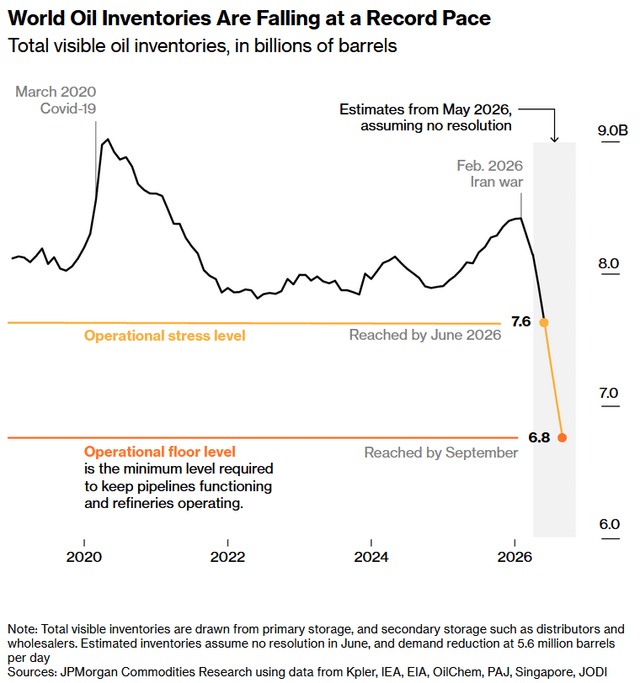
The potential for the Strait of Hormuz to open to traffic, allowing the backlog in oil to begin to unwind, has allowed the price of oil to drop. Many people believe that prices will soon return to “normal” and inflation will no longer be a problem. The issue with that argument is that it will take a substantial amount of time for the backlog to clear. Additionally, the instability in negotiations suggests that there is no guarantee of a final sustainable agreement. And the level of global oil inventories has been reduced to a critical level. Even if weak demand exists due to fragile economies, it will likely be offset by strong demand to replenish oil inventories. See the plunge in world oil inventories in the graph below from JP Morgan.
In addition to regular inventories, the Strategic Petroleum Reserve (SPR) has also been drawn down to the lowest level since 1983 as shown in the graph below.
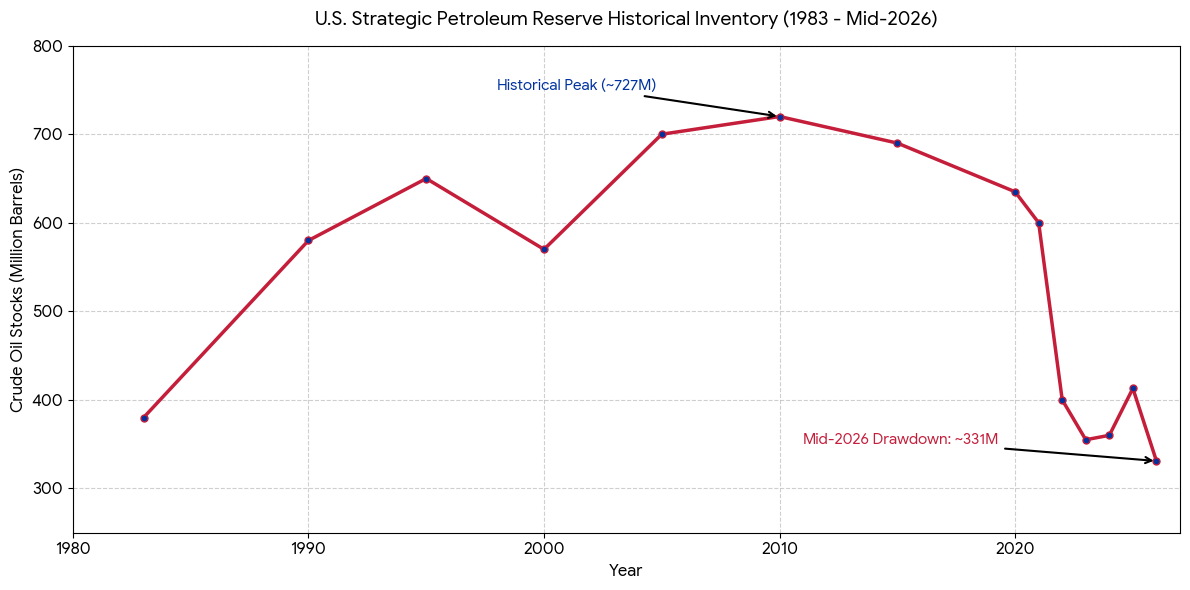
The uncertainty surrounding the movement of oil combined with the demand to replenish oil inventories, including the SPR, could put upward pressure on oil prices, which would then increase gasoline prices. The rise in inflation due to “energy” costs has not been solved. The Fed’s preferred gauge of inflation is the PCE (Personal Consumption Expenditures) Index. They also focus on the PCE excluding the more volatile categories, food and energy. This is sometimes referred to as the “Core” PCE. The PCE through May is shown below in blue and the Core PCE is in red.
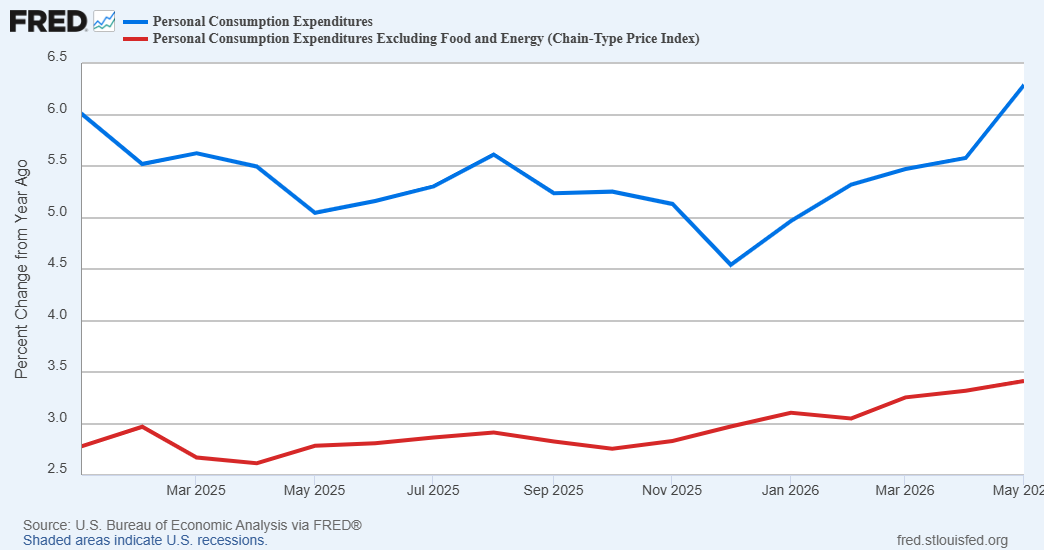
Notice that in May both the PCE and the Core PCE rose. The PCE rose a whopping 6.3% year-over-year. At the same time, oil and gasoline prices fell in the month of May. Inflation is well above the Fed’s 2% target. The volatile food and energy prices impact consumers as much or more than other categories. Certain food prices continue to rise, and energy prices will continue to be volatile and will likely rise in the near future.
Additionally, housing and related costs continue to increase. Higher mortgage rates add to the cost of housing for those purchasing a home. Currently, I expect inflationary pressures to continue. Therefore, does Chair Warsh raise rates to battle inflation or lower rates to boost economic activity? A question for another day is whether higher interest rates would slow inflation attributable to a supply shock.
Right now, Chair Warsh has his hands full. There is talk of a rate hike later in the year. Call me a cynic but, in my opinion, the chances of a rate hike before the election are slim. If correct, that would push a rate hike out to December at the earliest. However, Chair Warsh is new and could determine to assert himself now to proclaim his independence by ignoring the political pressure and raising rates sooner than later. As it stands, he is facing a real dilemma, and inflation is not solved.
The S&P 500 Index closed at 7,354, down 2.0% for the week. The yield on the 10-year Treasury Note fell to 4.37 %. Oil prices decreased to $69 per barrel, and the national average price of gasoline according to AAA dropped to $3.87 per gallon.
© 2026. This material was prepared by Bob Cremerius, CPA/PFS, of Prudent Financial, and does not necessarily represent the views of other presenting parties, nor their affiliates. This information should not be construed as investment, tax or legal advice. Past performance is not indicative of future performance. An index is unmanaged and one cannot invest directly in an index. Actual results, performance or achievements may differ materially from those expressed or implied. All information is believed to be from reliable sources; however we make no representation as to its completeness or accuracy.
Securities offered through Registered Representatives of Cambridge Investment Research, Inc., a broker/dealer, member FINRA/SIPC. Advisory services offered through Cambridge Investment Research Advisors, Inc., a Registered Investment Advisor. Prudent Financial and Cambridge are not affiliated.
The information in this email is confidential and is intended solely for the addressee. If you are not the intended addressee and have received this message in error, please reply to the sender to inform them of this fact.
We cannot accept trade orders through email. Important letters, email or fax messages should be confirmed by calling (901) 820-4406. This email service may not be monitored every day, or after normal business hours.