



Executive Summary
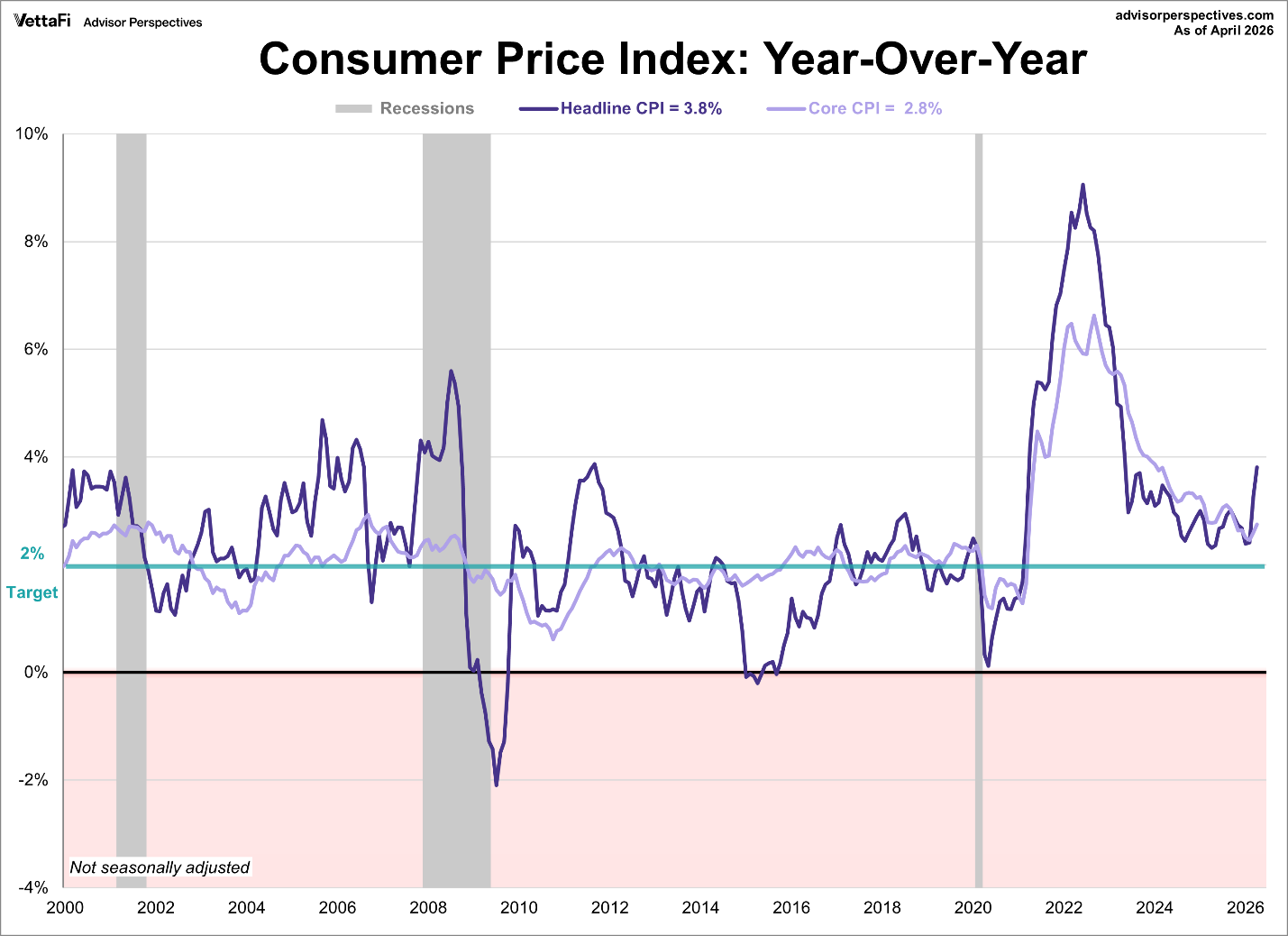
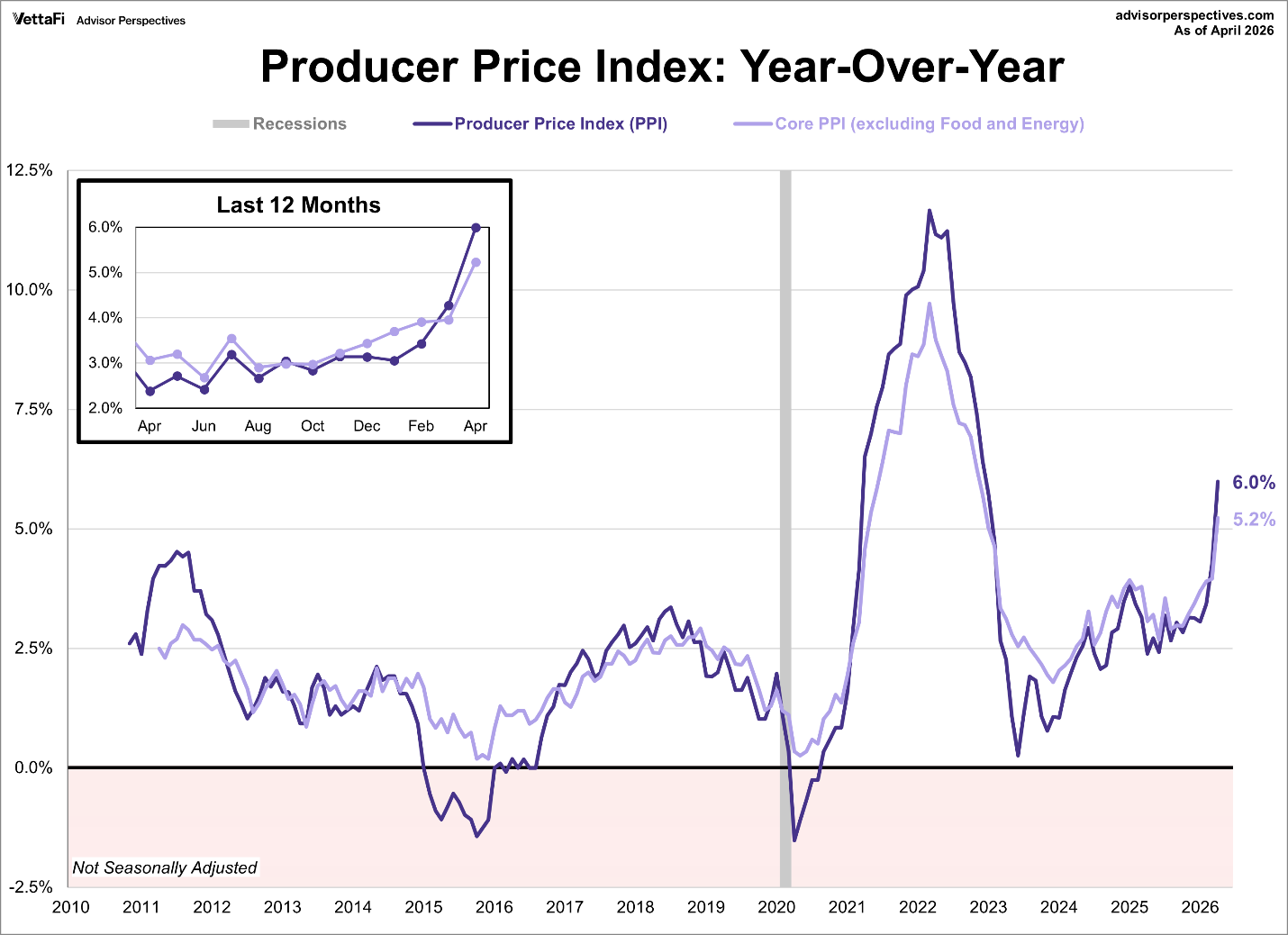
New Fed Chair Kevin Warsh faces a difficult balancing act ahead of next week’s FOMC meeting. A stronger-than-expected jobs report, combined with elevated inflation data, has reduced the likelihood of near-term rate cuts (dovish) and increased the chances of a more hawkish policy stance. At 3.8% year over year, April CPI (see first graph) remained well above the Fed’s 2% target, while rising PPI (second graph) suggests inflationary pressures may persist. The stock market reacted negatively on Friday because the Fed may now have less room to ease without worsening inflation. Warsh’s skepticism toward forward guidance and disdain for quantitative easing indicates a more hawkish view and adds more uncertainty. If the Fed shifts toward hawkish policy or reduces market signaling, stocks could face greater volatility and downward pressure in an already overvalued market. The next two weeks could be revealing.
For further analysis, continue to read The Details below for more information.
“Never try to walk across a river just because it has an average depth of four feet.”
–Milton Friedman
The Details
Next Wednesday, June 17, new Fed Chair, Kevin Warsh, will hold his first press conference following the FOMC (Federal Open Market Committee) meeting. All eyes will be watching to see how Chair Warsh handles the plethora of issues facing the economy and markets. Previously, the Fed indicated an easing bias in monetary policy, with interest rate cuts on the table for later this year. Lowering rates would help the housing market and other debt holders. The President has been very vocal about his desire to see interest rates cut significantly. Friday’s release of what was reported as a “strong” jobs report sent the stock market plunging. This seemed counterintuitive to some people. The reason for the plunge is the impact recent economic data has on future Fed policy.
The Fed has two mandates, price stability and maximum employment. With a “strong” jobs report, the Fed could be forced to change to a hawkish policy bias, especially when combined with recent price data. The CPI (Consumer Price Index) for April jumped 3.8% year-over-year. This is far above the Fed’s 2% inflation goal and is moving in the wrong direction as shown in the graph below from VettaFi.
And more disturbing for those hoping for Fed easing was the April PPI (Producer Price Index), or the change in wholesale prices, which normally precedes CPI changes by a couple months. The PPI soared a whopping 6% year-over-year, as shown in the following graph, also from VettaFi.
The combination of the jobs report and rising inflation spooked investors on Friday as the Fed’s dilemma became obvious. Not wanting to impede economic growth, the Fed does not favor the idea of raising the Fed Funds Rate. However, lowering rates at this time could accelerate inflation which would negatively impact economic growth. Also, the stock market remains at record overvaluation levels, initially spurred by low interest rates. Higher interest rates and inflation would have a potentially detrimental effect on stock prices.
Chair Warsh has been critical of the use of Quantitative Easing (purchasing bonds by the Fed with created funds) and has implied a more hawkish nature. These stances are contrary to the political goals of very low interest rates. Also, the Fed has used forward guidance, or the signaling to markets the likely direction of future monetary policy, for about 27 years. Part of the forward guidance has been the “dot plot.” The dot plot is a summary of each Fed officials’ estimate of future interest rate levels. Chair Warsh is opposed to the Fed issuing interest rate projections. He has stated that doing so causes the Fed to “hold on to those forecasts longer than they should.”
The consensus of economists now believes that the FOMC will leave interest rates unchanged at next week’s meeting. From a stock market perspective, it may be more important what Chair Warsh states about pivoting away from forward guidance and the possibility of stopping the purchase of Treasuries or other bonds by the Fed (QE). Both actions could add volatility to equity markets and put downward pressure on prices. The May CPI report will be issued this Wednesday, June 10. In my opinion, only a significant drop in the CPI could change the transition to a hawkish bias by the Fed.
The elimination of forward guidance and QE, rising inflation, and the potential for future interest rate increases could negatively impact the most overvalued stock market in history. As I have said before, the Fed is painted into a corner. New Chair Warsh must balance politics with contradictory economic data. There is no easy solution. If they are too dovish, they risk higher inflation, too hawkish and the economy and stock market suffer. If no guidance is issued, volatility will ensue.
How will new Chair Kevin Warsh tackle these issues? We will have to wait until next week to find out.
The S&P 500 Index closed at 7,384, down 2.6% for the week. The yield on the 10-year Treasury Note rose to 4.54%. Oil prices increased to $91 per barrel, and the national average price of gasoline according to AAA dropped to $4.17 per gallon.
© 2026. This material was prepared by Bob Cremerius, CPA/PFS, of Prudent Financial, and does not necessarily represent the views of other presenting parties, nor their affiliates. This information should not be construed as investment, tax or legal advice. Past performance is not indicative of future performance. An index is unmanaged and one cannot invest directly in an index. Actual results, performance or achievements may differ materially from those expressed or implied. All information is believed to be from reliable sources; however we make no representation as to its completeness or accuracy.
Securities offered through Registered Representatives of Cambridge Investment Research, Inc., a broker/dealer, member FINRA/SIPC. Advisory services offered through Cambridge Investment Research Advisors, Inc., a Registered Investment Advisor. Prudent Financial and Cambridge are not affiliated.
The information in this email is confidential and is intended solely for the addressee. If you are not the intended addressee and have received this message in error, please reply to the sender to inform them of this fact.
We cannot accept trade orders through email. Important letters, email or fax messages should be confirmed by calling (901) 820-4406. This email service may not be monitored every day, or after normal business hours.