



Executive Summary
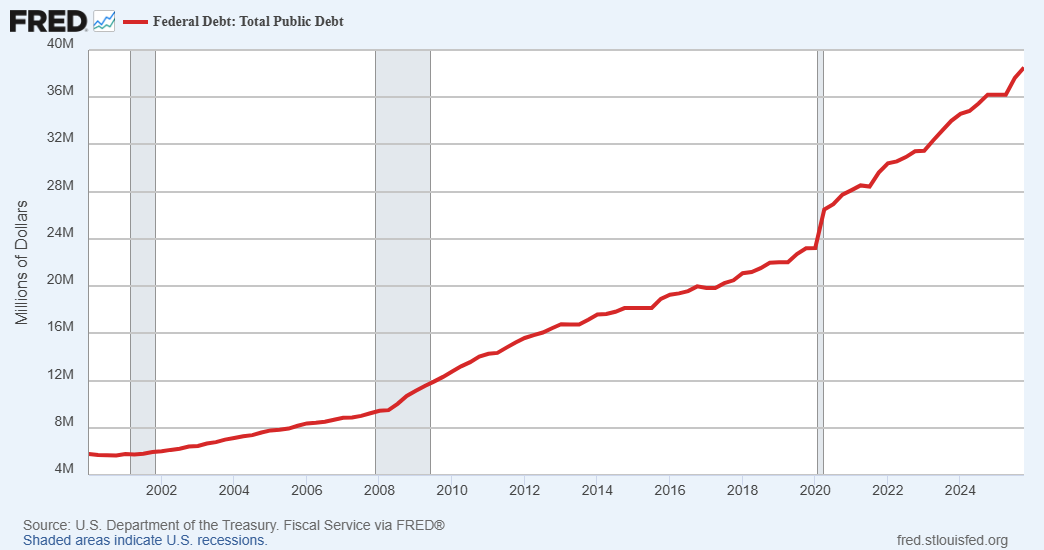
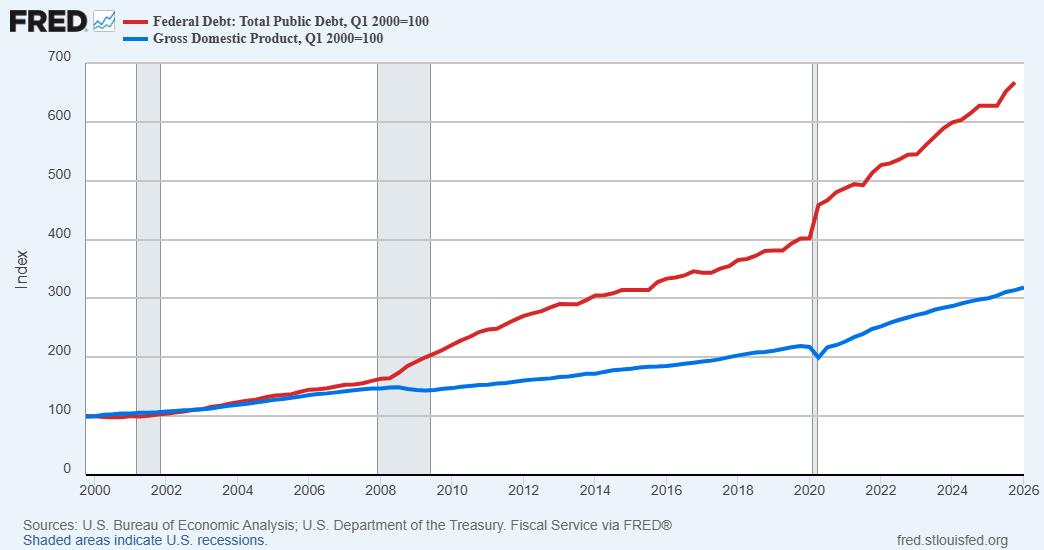
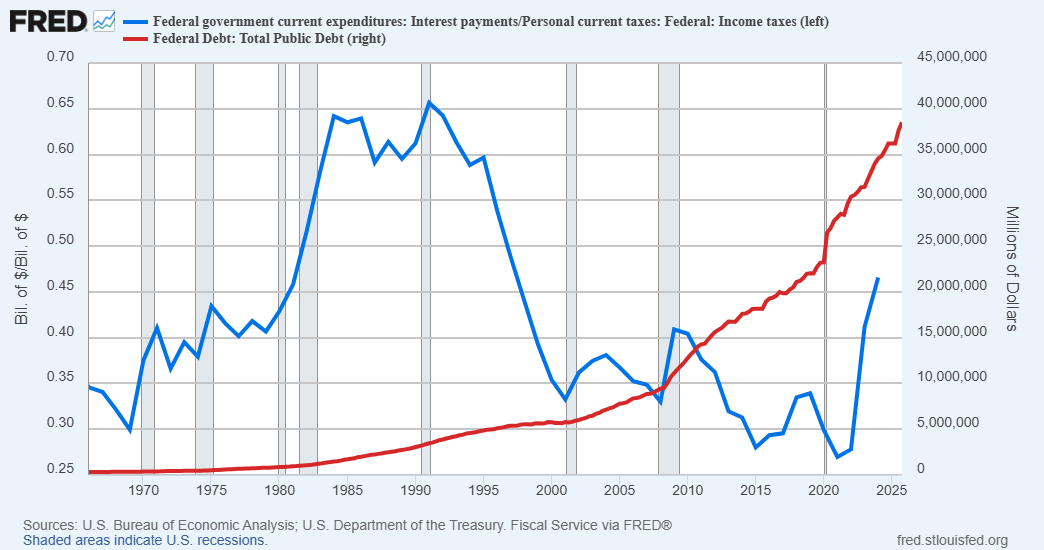
While the consensus had been for the Fed to lower interest rates this year, rising inflation could force new Fed leadership to raise rates, due to more persistent inflation concerns. That would increase borrowing costs at a time when U.S. debt has already risen to about $39.3 trillion, as shown in the first graph. The second graph shows debt growing much faster than GDP since 2000, especially after 2008. The third graph shows interest payments taking a much larger share of federal income tax revenue. Together, higher interest rates and increasing Federal debt could create serious financial strain and slow economic growth in the US.
For further analysis, continue to read The Details below for more information.
“If it isn’t the sheriff, it’s the finance company; I’ve got more attachments on me than a vacuum cleaner.”
–John Barrymore
The Details
Up until recently, it seemed baked-in-the-cake that the Fed would lower the Fed Funds Rate (FFR) this year. However, boosted by the spike in oil and gasoline prices, inflation appears to be heating up, and could be more entrenched than initially hoped. The Fed’s new leader, Kevin Warsh, is to be sworn in this Friday. Mr. Warsh has made statements in the past that suggest he could be more hawkish than former Chairman Jerome Powell. Therefore, the resurgence in inflation could result in the Fed raising the FFR, instead of lowering it. Higher rates mean higher borrowing costs. The U.S. is already $39.3 trillion in debt, and it is growing rapidly, as shown in the graph below.
The U.S. is facing serious financial troubles if the current trend continues or worsens. The following graph compares the rate of growth in the Federal debt (red line) versus Gross Domestic Product (GDP). From the start of 2000 through 2025, the Federal debt has grown at a 7.6% annual compounded rate. The economy, on the other hand, has only grown at 4.5% annually. It is evident in the graph below that the real divergence began during the Financial Crisis in 2008. Since then, the trajectory of debt increased significantly.
The real problem facing the U.S. is the combination of soaring Federal debt and rising interest rates. In the graph below, the blue line illustrates the percentage of personal Federal income taxes represented by Federal interest payments. Notice the line has jumped to over 45%. The last time this percentage was higher was during the late 1970’s through the mid-1990’s. However, notice the level of total Federal debt at that time as shown by the red line. Interest rates were extremely high back then, but the level of total Federal debt was much lower. If inflation pushes interest rates higher, after enormous growth in the debt balance (now almost vertical), the combination could be devastating.
It is beginning to appear that inflation might be a more serious long-term problem than initially thought. In addition to the impact on consumers, debt holders with variable or changing interest rates could suffer significantly higher debt service payments. For a country pushing $40 trillion in debt, already over 122% of GDP, this poses a real concern.
Any future stimulus, monetized by the Fed, would only exacerbate the growth in inflation. This in turn would push interest rates even higher, and the spiral would continue. Out of control deficit spending combined with rising interest rates could put a significant financial strain on the financial system. Higher inflation, along with this financial strain, could slow economic growth further. Unfortunately, this recipe has the Fed in a tight spot. We will be watching closely to see what new Fed Chairman Kevin Warsh has up his sleeve.
The S&P 500 Index closed at 7,409, net flat for the week. The yield on the 10-year Treasury Note rose to 4.60%. Oil prices increased to $105 per barrel, and the national average price of gasoline according to AAA fell to $4.51 per gallon.
© 2026. This material was prepared by Bob Cremerius, CPA/PFS, of Prudent Financial, and does not necessarily represent the views of other presenting parties, nor their affiliates. This information should not be construed as investment, tax or legal advice. Past performance is not indicative of future performance. An index is unmanaged and one cannot invest directly in an index. Actual results, performance or achievements may differ materially from those expressed or implied. All information is believed to be from reliable sources; however we make no representation as to its completeness or accuracy.
Securities offered through Registered Representatives of Cambridge Investment Research, Inc., a broker/dealer, member FINRA/SIPC. Advisory services offered through Cambridge Investment Research Advisors, Inc., a Registered Investment Advisor. Prudent Financial and Cambridge are not affiliated.
The information in this email is confidential and is intended solely for the addressee. If you are not the intended addressee and have received this message in error, please reply to the sender to inform them of this fact.
We cannot accept trade orders through email. Important letters, email or fax messages should be confirmed by calling (901) 820-4406. This email service may not be monitored every day, or after normal business hours.