



Executive Summary
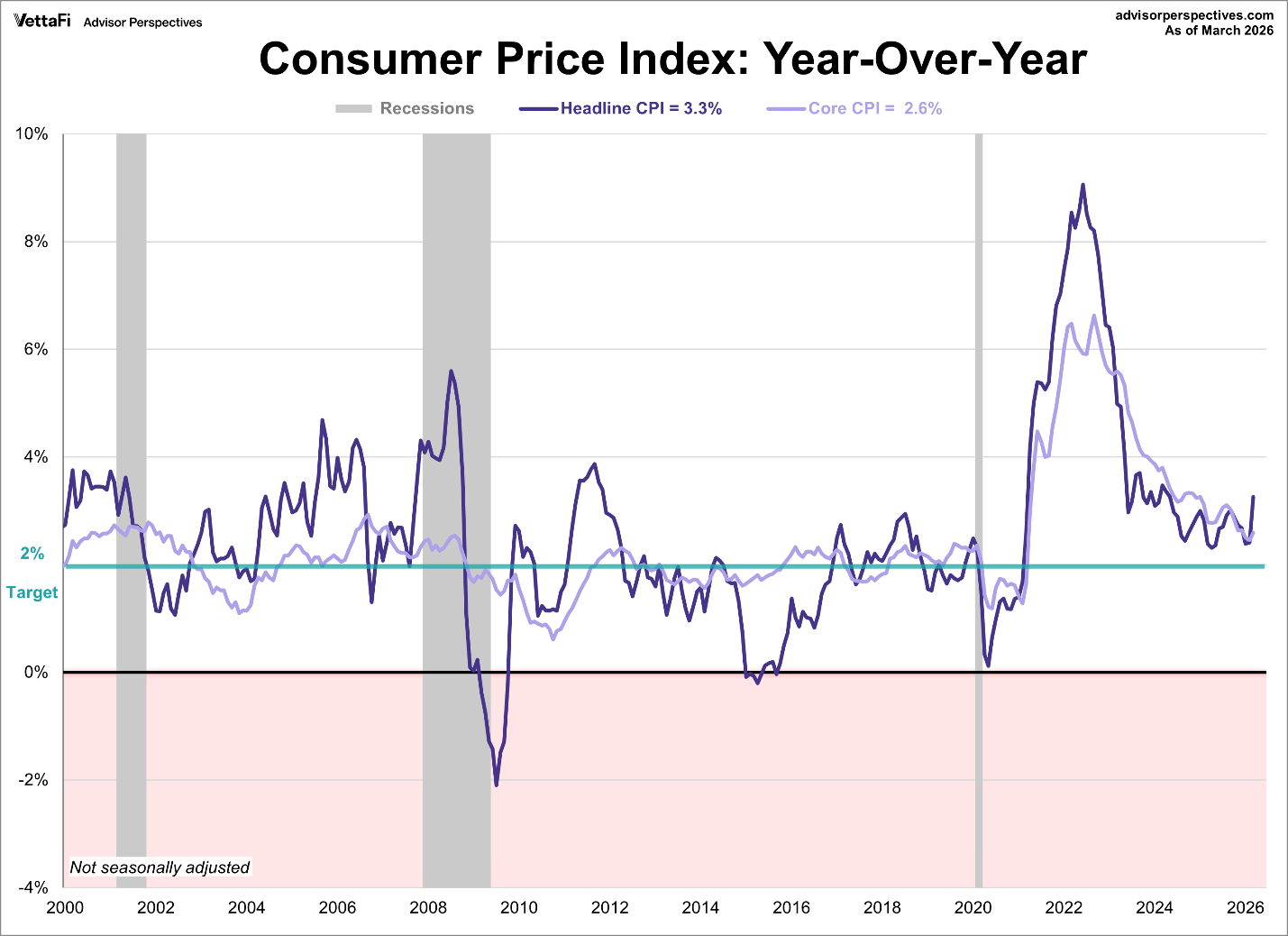
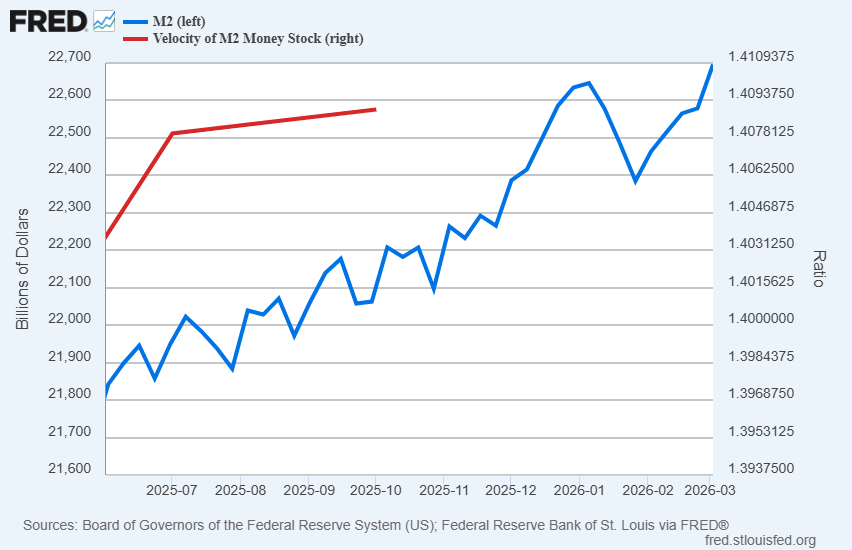
Inflation accelerated sharply in March, with headline CPI rising to 3.3% year over year and jumping 0.9% in a single month, the largest gain since 2022 (see first graph). While money supply is increasing and could contribute to higher prices, velocity is increasing at a slower pace thus not generating serious concern (second graph). Greater inflation risk stems from the war in Iran which is creating disruptions in the Strait of Hormuz. The blocked shipping has driven oil prices higher and more volatile (third graph). Gasoline and diesel prices have already surged nationwide, and sustained oil prices above $100 could push inflation significantly higher in the months ahead for consumers.
For further analysis, continue to read The Details below for more information.
“I don’t mind going back to daylight saving time. With inflation, the hour will be the only thing I’ve saved all year.”
–Victor Borge
The Details
In March, headline inflation, as measured by the CPI (Consumer Price Index) jumped to its highest level in about two years, reaching 3.3% year-over-year. On a monthly basis, headline CPI rose 0.9%, the largest monthly gain since 2022, according to VettaFi. (See graph below). If prices continue to rise at this monthly rate, the annual inflation rate would be over 11%!
As stated in my March 10th newsletter, Will Oil Prices Spark Inflation?, I stated that inflation is typically the result of an increase in the money supply and velocity (the rate money is spent), or the result of a supply shock. In the graph below, one can see the money supply (blue line) is rising. The velocity of M2 (red line) is rising but at a slow rate. This combination could contribute to rising prices, but velocity is not rising fast enough to generate a serious concern at this time. Note, however, that the data for velocity is lagging, and future results could tell a different story.
The current situation in the Strait of Hormuz and the war with Iran could produce a more durable increase in inflation. The disruption in the Strait has lasted around six weeks and created an enormous backlog in shipping. The President announced that beginning April 13, the U.S. will begin a blockade of Iranian ports and start policing traffic in the Strait. However, due to the previous delays, even if traffic were to begin to flow more normally, it could take months to clear the bottleneck. In the meantime, oil prices are bouncing around based upon the headline of the day. However, prices remain considerably higher than they were prior to the war. The chart below illustrates the rise and volatility in the price of WTI (West Texas Intermediate) crude oil.
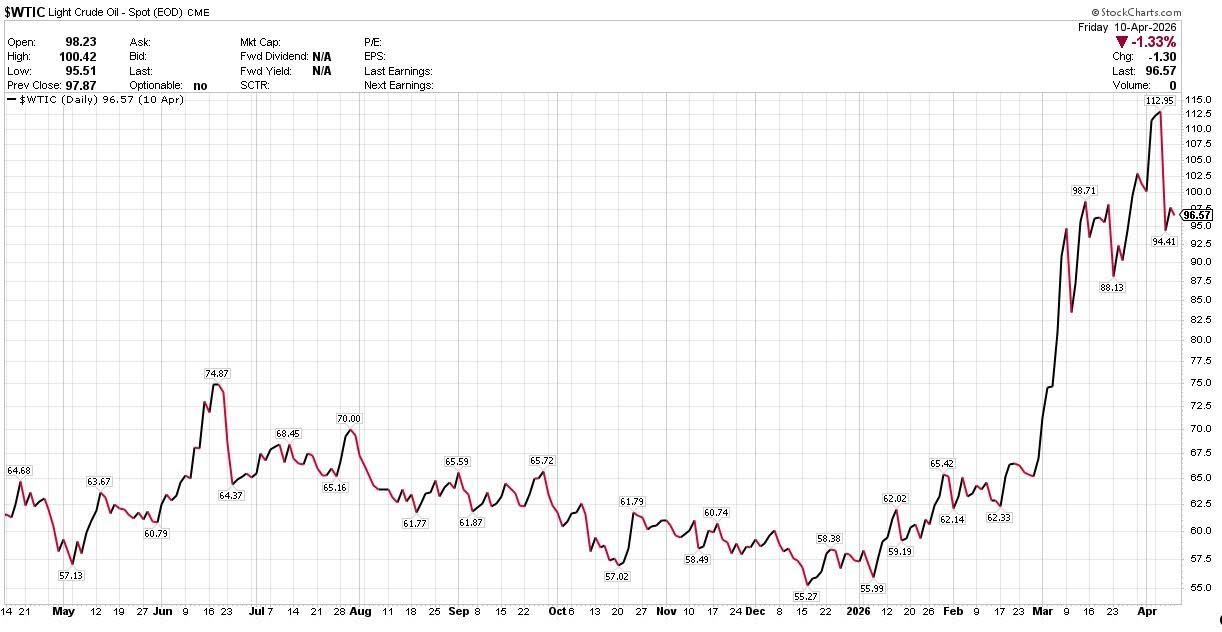
The rise in oil prices has already pushed the National average price of gasoline over $4 per gallon. Premium gasoline prices are hovering around $5 per gallon, and diesel is even higher at close to $5.65 per gallon. Any further disruption in the Strait of Hormuz will likely send oil prices higher. If so, consumers can expect even higher gasoline prices.
Current oil and gasoline prices will likely push headline CPI higher in coming months. If oil prices remain over $100 per barrel through the summer and into the fall, then the impact on inflation will be more severe. At this time the future of inflation is uncertain, but the outlook is growing more dim by the week.
The S&P 500 Index closed at 6,817, up 3.6% for the week. The yield on the 10-year Treasury Note fell to 4.32%. Oil prices decreased to $97 per barrel, and the national average price of gasoline according to AAA rose to $4.13 per gallon.
© 2026. This material was prepared by Bob Cremerius, CPA/PFS, of Prudent Financial, and does not necessarily represent the views of other presenting parties, nor their affiliates. This information should not be construed as investment, tax or legal advice. Past performance is not indicative of future performance. An index is unmanaged and one cannot invest directly in an index. Actual results, performance or achievements may differ materially from those expressed or implied. All information is believed to be from reliable sources; however we make no representation as to its completeness or accuracy.
Securities offered through Registered Representatives of Cambridge Investment Research, Inc., a broker/dealer, member FINRA/SIPC. Advisory services offered through Cambridge Investment Research Advisors, Inc., a Registered Investment Advisor. Prudent Financial and Cambridge are not affiliated.
The information in this email is confidential and is intended solely for the addressee. If you are not the intended addressee and have received this message in error, please reply to the sender to inform them of this fact.
We cannot accept trade orders through email. Important letters, email or fax messages should be confirmed by calling (901) 820-4406. This email service may not be monitored every day, or after normal business hours.