



Executive Summary
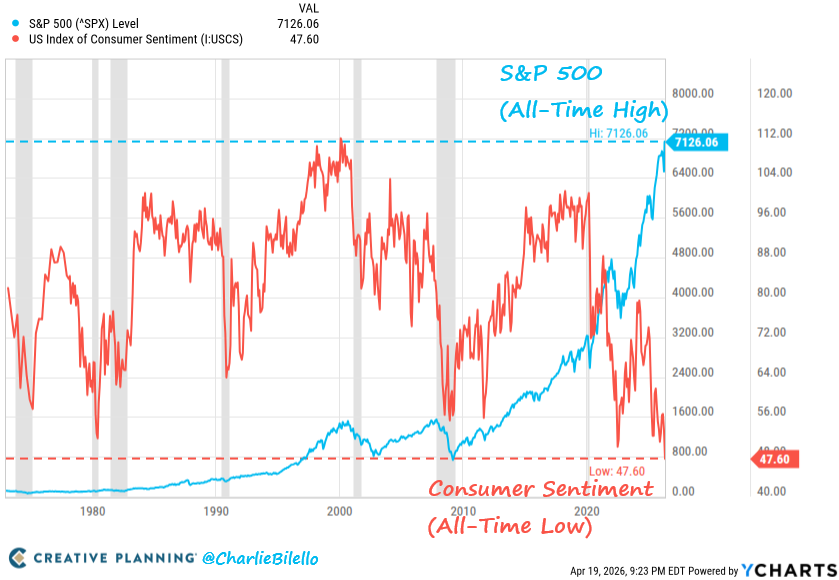
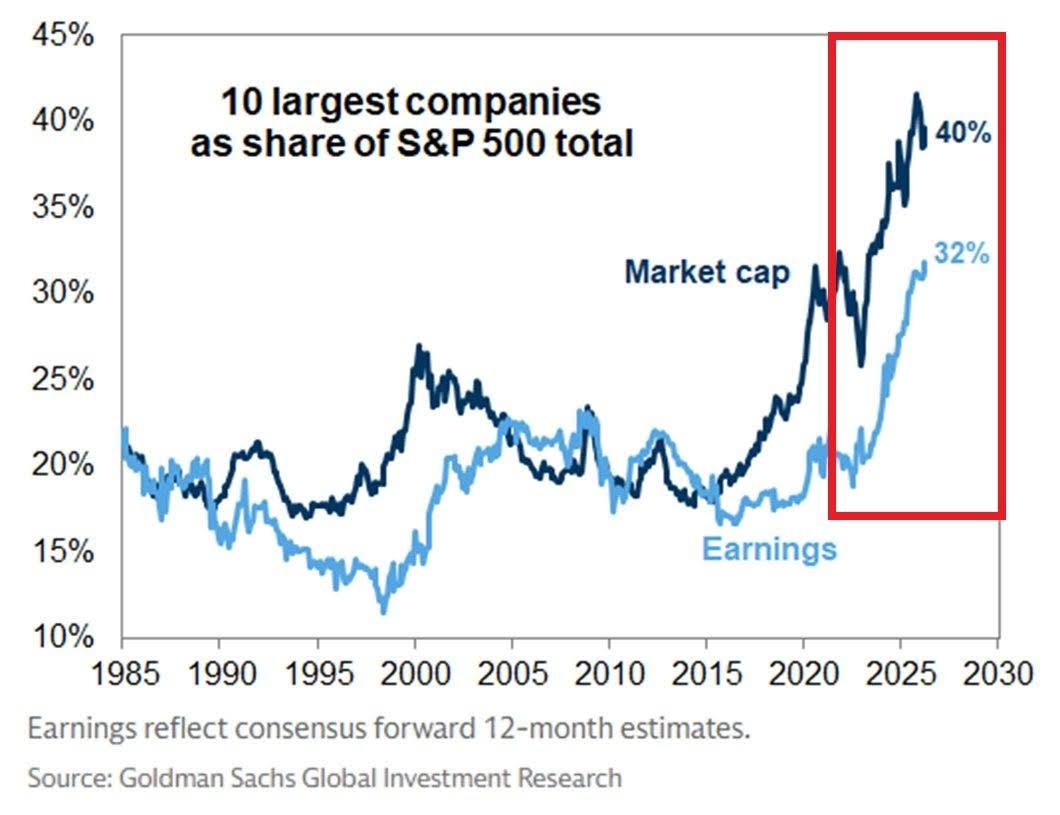
Two months into 2026 and the stock market was going nowhere, then the Iran war led the S&P 500 down about 7% for the year. On subsequent hope for an end to the war, the S&P 500 soared 13% (see first graph) to new highs. While hope sent it soaring, consumer sentiment was tanking (see second graph). The fundamental risk in the market is high as the economy is slowing, jobs market is weakening, and oil prices were climbing. Additional concentration risk is extremely high as 40% of the market capitalization of the S&P 500 is represented by only ten companies (see last graph). While no one knows what happens next, it appears investors who are unhedged or ignoring risk may see a bad ending.
For further analysis, continue to read The Details below for more information.
“In the business world, the rearview mirror is always clearer than the windshield.”
–Warren Buffett
The Details
2026 started out with concerns about a slowing economy and jobs market. The stock market bounced up and down like a yoyo for the first two months, effectively going nowhere. Then, with the start of the Iran war at the end of February, oil prices surged and the stock market plunged. By the end of March, oil prices were over $100 per barrel, and the S&P 500 was down around 7% for the year. Since the stock market low on March 30, it has experienced one of the most incredible and irrational reversals in history. There is an old saying that the stock market moves up like an escalator and down like an elevator. Well, the recent move flipped that analogy on its head. In three weeks, the S&P 500 soared around 13%, in a near vertical ascent. See the graph below from Creative Planning @CharlieBilello.
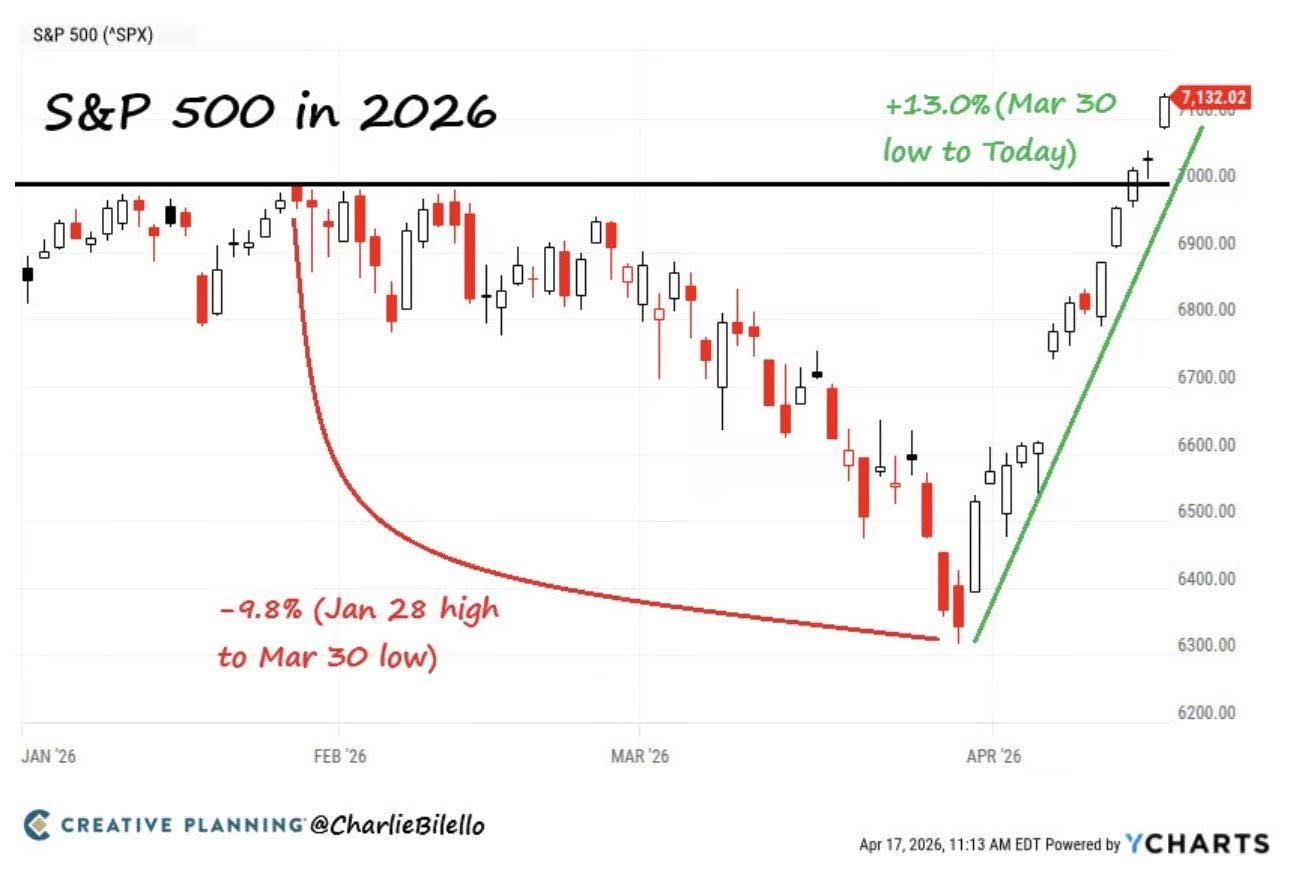
Nothing fundamentally changed to push stock prices upward in April, other than a lot of flip-flopping on the status of an agreement with Iran over the war, and the free movement of ships through the Strait of Hormuz. Currently, investors, in my opinion, have overreacted to potential positive outcomes, sending valuations back to all-time highs.
The graph below, also from Creative Planning @Charlie Bilello, shows how disconnected markets are from reality. The stock market soared to an all-time high (blue line) while consumer sentiment is at an all-time low (red line).
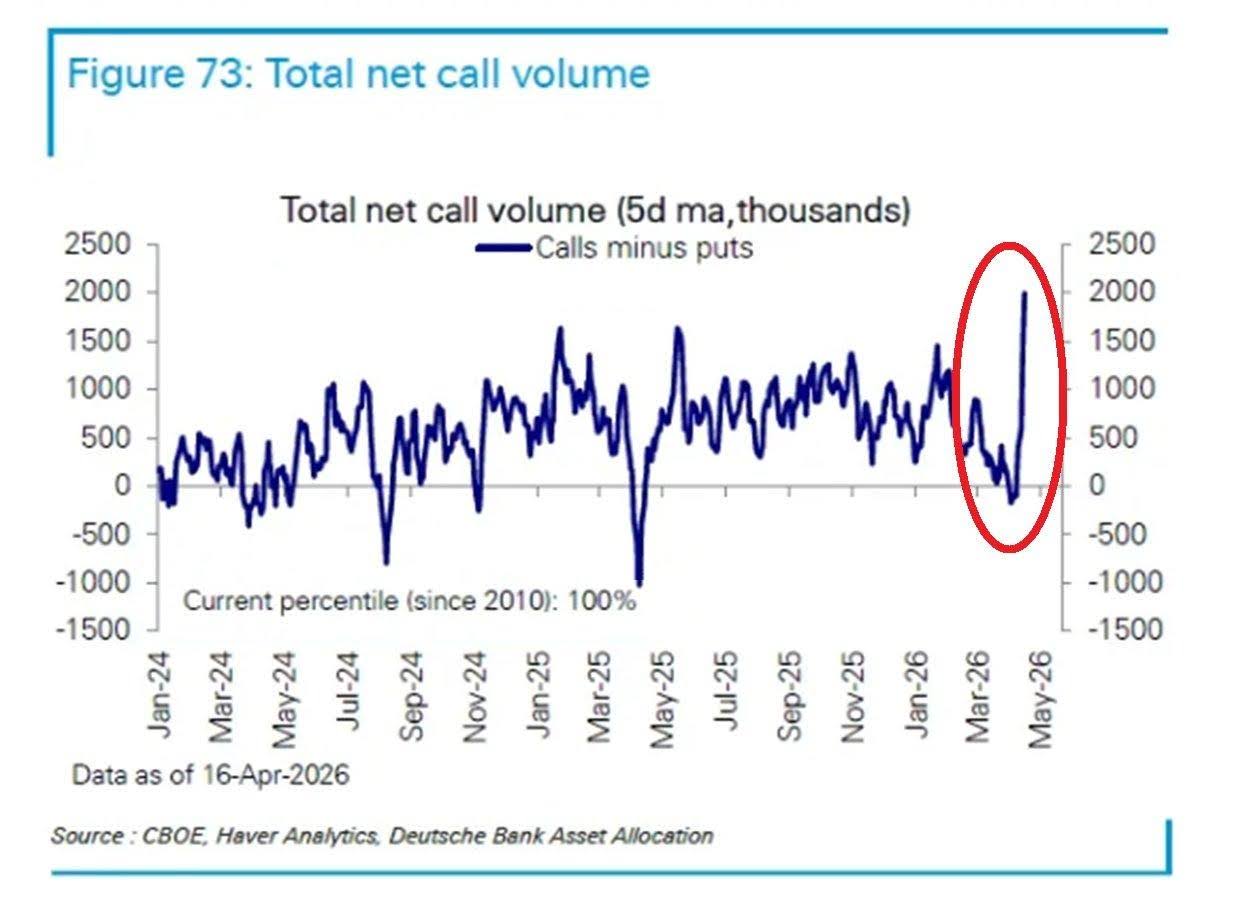
The exuberance in markets can be seen by examining investor positioning. The following graph shows that the five day moving average of net call volume (call minus put options) is at an all-time high. This means that investors are betting record amounts that the market will rise.
The amount of risk embedded in markets today is also near all-time highs. In an environment where the economy is slowing due to record amounts of debt, the jobs market is weak, oil prices remain high, and no official end is in sight for the war with Iran, it is astonishing that investors continue to pump stock prices higher. The fact that the S&P 500 is now more concentrated than any time over the past 40 years adds another layer of risk. The graph below from Global Markets Investor, via X, illustrates that 40% of the S&P 500 is represented by the 10 largest companies.
The high prices of goods and services, including gasoline prices over $4 per gallon, have consumers worried. Many are already up to their eyeballs in debt. Continued disruption in the oil markets resulting in high oil and gas prices will weigh on consumers, hence the low consumer sentiment.
On the other hand, investors are acting as if there are no problems anywhere. The amount of risk in the stock market today is exorbitant and is being ignored by investors. Unfortunately, this type of irrational movement in the stock market always ends badly. Investors who are not properly hedged today stand to lose an unspeakable amount of money when reality returns.
The S&P 500 Index closed at 7,126, up 4.5% for the week. The yield on the 10-year Treasury Note fell to 4.24%. Oil prices decreased to $84 per barrel, and the national average price of gasoline according to AAA fell to $4.05 per gallon.
© 2026. This material was prepared by Bob Cremerius, CPA/PFS, of Prudent Financial, and does not necessarily represent the views of other presenting parties, nor their affiliates. This information should not be construed as investment, tax or legal advice. Past performance is not indicative of future performance. An index is unmanaged and one cannot invest directly in an index. Actual results, performance or achievements may differ materially from those expressed or implied. All information is believed to be from reliable sources; however we make no representation as to its completeness or accuracy.
Securities offered through Registered Representatives of Cambridge Investment Research, Inc., a broker/dealer, member FINRA/SIPC. Advisory services offered through Cambridge Investment Research Advisors, Inc., a Registered Investment Advisor. Prudent Financial and Cambridge are not affiliated.
The information in this email is confidential and is intended solely for the addressee. If you are not the intended addressee and have received this message in error, please reply to the sender to inform them of this fact.
We cannot accept trade orders through email. Important letters, email or fax messages should be confirmed by calling (901) 820-4406. This email service may not be monitored every day, or after normal business hours.