



Executive Summary
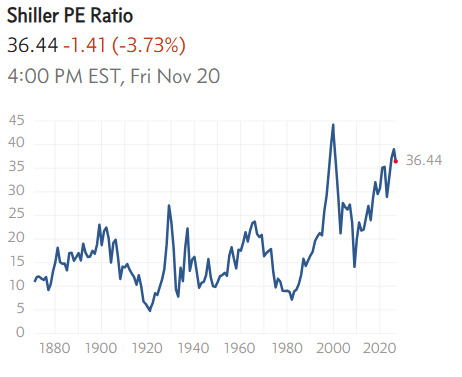
Last week the S&P 500 declined 8.6%, the ninth largest drop since 1990 (see first graph). While significant, it actually marked an 11.6% drop since the October 6th peak. However, even with this sell-off, the Shiller P/E Ratio for the S&P 500 remains the second highest on record (excluding this year’s peak) (See graph below from multpl.com). An additional contributor to the selloff was the Fed rumor of a potential “shock” rate increase of half of a percent versus a quarter percent. Will all this break market psychology and continue declines? The answer is no one truly knows, so be informed. To all our readers, Prudent Financial wishes you all a very Happy Thanksgiving!
For further analysis, continue to read The Details below for more information.
“Volatility is a symptom that people have no idea of the underlying value.”
–Jeremy Grantham
The Details
Last week’s stock market decline was historically unusual in both duration and magnitude. The S&P 500 declined 8.6% last week, and according to Liz Ann Sonders, Chief Investment Strategist at the Schwab Center for Financial Research, it was the ninth biggest drop since 1990. And, as shown in the graph below (via her X post) all prior incidents, except 2025, were during bear markets.
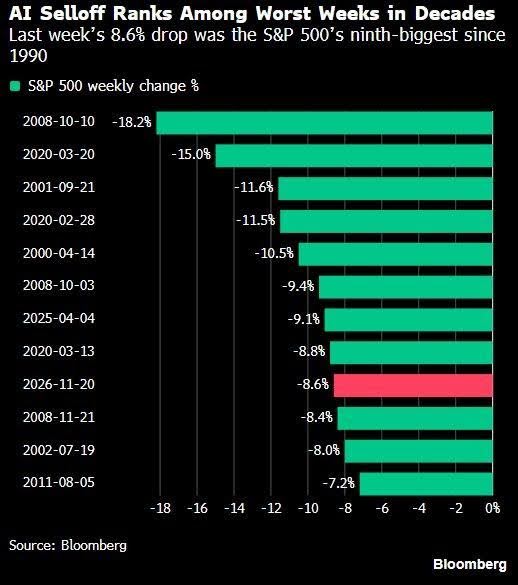
The recent uninterrupted decline actually began on November 12 and lasted seven trading days. The decline for this period totaled 9.3%. Since the October 6 peak, the market was off 11.6%.
This type of sell-off results in technical indicators signaling a significantly “oversold” short-term condition. This usually leads to a temporary, but potentially strong bounce as many dip buyers enter the market. The possible jump this week could be more pronounced than expected because Nvidia announced the reinstatement of Jensen Huang as CEO (see last week’s newsletter). The ousting of Huang contributed to the sell-off in AI stocks.
To put the sell-off in perspective, the Shiller P/E Ratio for the S&P 500 remains the second highest on record (excluding this year’s peak). The drop in stock prices has not relieved the extreme overvaluation in the S&P 500 as shown in the graph below from multpl.com.
Another contributor to the sell-off was talk from Fed members that interest rates might need to be raised more than expected to stave off inflation. The CPI (Consumer Price Index) was up 3.7% year-over-year in September, and up 0.4% month-over-month in October. These numbers are far above the Fed’s 2% goal. In a live CNBC interview on November 18, 2026, Federal Reserve Governor Christopher Waller stated that the Fed may need to “shock people” with a half-percentage-point (50 bps) rate hike at its December 8–9 meeting to break entrenched inflation psychology.
We will have to wait and see if these concerns cause investor sentiment to change enough to initiate a bear market, or if caution will again be thrown to the wind pushing prices and valuations higher.
The S&P 500 Index closed at 6,910, down 8.6% for the week. The yield on the 10-year Treasury Note fell to 4.91%. Oil prices decreased to $83 per barrel, and the national average price of gasoline according to AAA fell to $3.64 per gallon.
© 2026. This material was prepared by Bob Cremerius, CPA/PFS, of Prudent Financial, and does not necessarily represent the views of other presenting parties, nor their affiliates. This information should not be construed as investment, tax or legal advice. Past performance is not indicative of future performance. An index is unmanaged, and one cannot invest directly in an index. Actual results, performance or achievements may differ materially from those expressed or implied. All information is believed to be from reliable sources; however, we make no representation as to its completeness or accuracy.
Securities offered through Registered Representatives of First Heartland Capital, Inc., a broker/dealer, member FINRA/SIPC. Advisory services offered through First Heartland Consultants, Inc., a Registered Investment Advisor. Prudent Financial and First Heartland are not affiliated.
The information in this email is confidential and is intended solely for the addressee. If you are not the intended addressee and have received this message in error, please reply to the sender to inform them of this fact.
We cannot accept trade orders through email. Important letters, email or fax messages should be confirmed by calling (901) 820-4406. This email service may not be monitored every day, or after normal business hours.