



Executive Summary
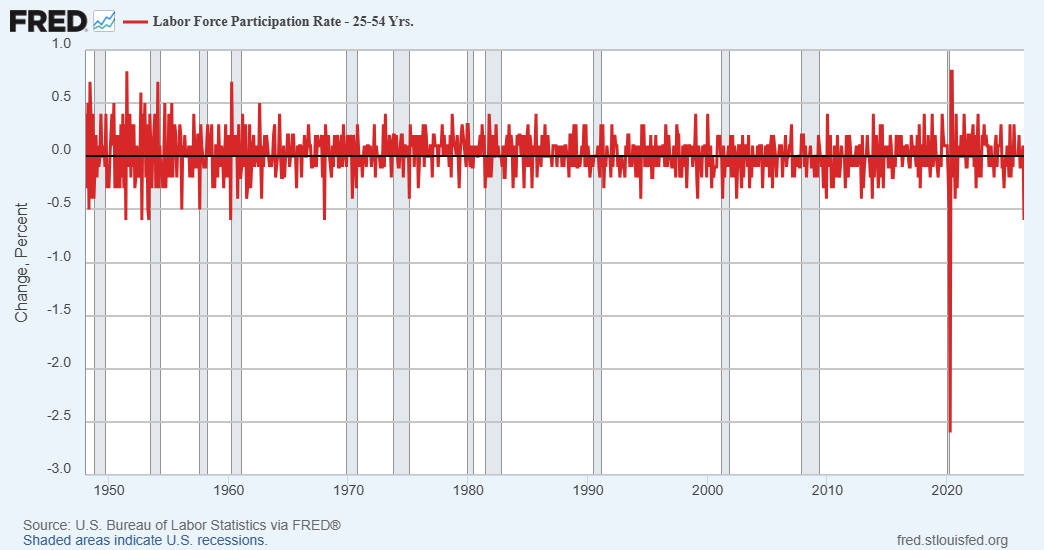
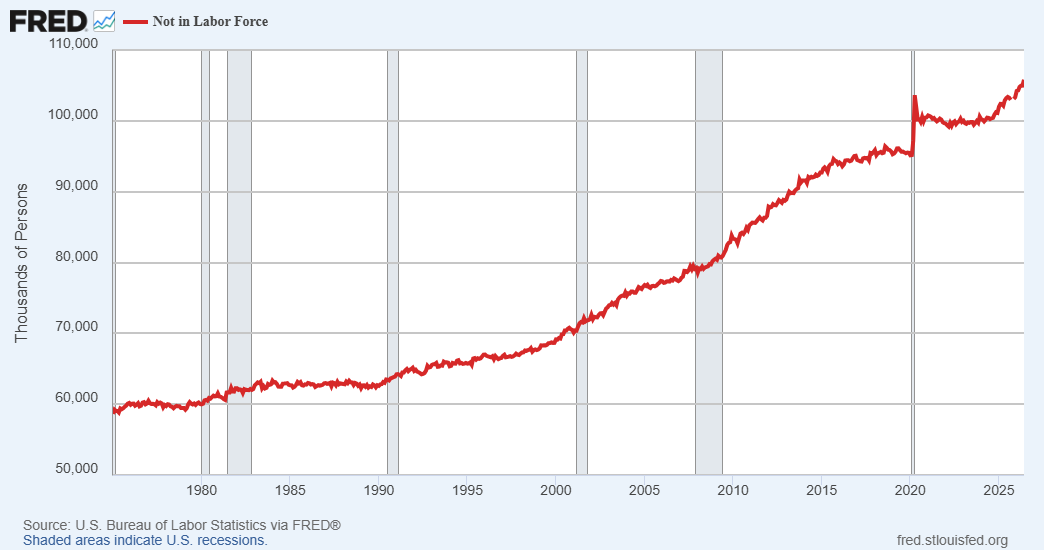
Economic growth is the sum of the growth in the labor force and growth in productivity. Recent employment data showed the working-age population grew by 1,581,000 over the last year, while the number of people employed dropped by 1,063,000. Those who dropped out of the workforce grew by 2.6 million (2nd graph). And astoundingly the prime working-age population labor force participation rate in June fell by 0.6 % month-over-month (first graph) – the only time since the late 1940’s that this participation rate fell more, month-over-month, was during the pandemic. Currently, the impact from A.I. on worker productivity, the second part of economic growth, appears to be minimal. This is based on three sources, the Federal Reserve Bank of St. Louis, The Penn Wharton Business Model and comments from Goldman Sachs’ chief economist. While A.I. may impact productivity in the future, the current employment situation and overall productivity are pointing to either a speed bump in the road or a potential recession.
For further analysis, continue to read The Details below for more information.
“What do you call Bob the builder during a recession? Bob.”
–Anonymous
The Details
From a macro perspective, economic growth is the sum of the growth in the labor force and growth in productivity. Gross Domestic Product (GDP) grows when there are more people producing goods or services, and/or more goods and services are being produced per worker. Last week the Bureau of Labor Statistics (BLS) released the June Employment Situation Summary, otherwise known as the jobs report. The accuracy of these reports has been questioned of late due to significant subsequent revisions to prior reports. As written by The Kobeissi Letter, “Since the start of 2025, U.S. jobs numbers have now been revised down in 14 out of 17 months by a total of -710,000 jobs.” Despite the obvious flaws in the reported data, let’s take a look at the June report from a labor force standpoint.
According to the Household Survey in the BLS report, over the past year, the working-age population grew by 1,581,000. The number of people employed fell by1,063,000, and the number unemployed grew by 40,000 year-over-year. When people become unemployed and stop looking for work, they fall into a category called Not in the Labor Force (NILF). The number of potential workers in the NILF category grew by 2,603,000 over the past year. More astounding is the labor force participation rate for the prime worker age group, ages 25-54, which fell 0.6% in June compared to May 2026. As shown in the graph below, the only time since the late 1940’s that this participation rate fell more, month-over-month, was during the pandemic, when the economy effectively shut down.
The graph below shows the continuous growth in the NILF category.
In addition to the fallout in the labor force, the Employment-to-Population Ratio is currently at 59.0%, lower than the pre-pandemic levels, as shown in the graph below.
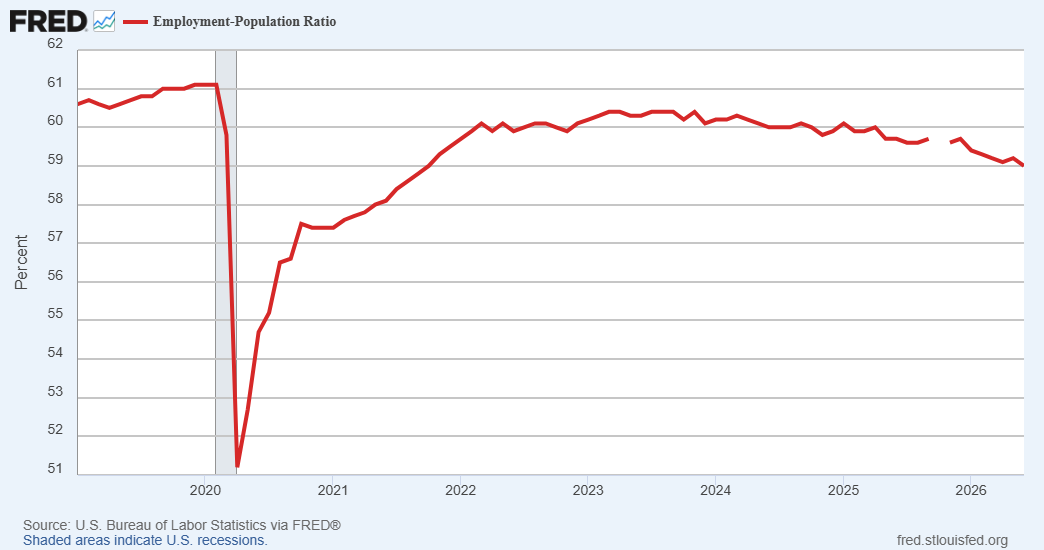
The data from the jobs report shows a decline in the number of people employed, and a drop in the labor force participation rate, as those “not in the labor force” expanded. The reason this is not reflected in the unemployment rate, which remains low at 4.2%, is because those who have stopped looking for work and have dropped out of the labor force are not included in the calculation of the unemployment rate.
The bottom line is the labor force is a net drag on GDP growth. Looking at part two of the equation, many pundits have expected A.I. (artificial intelligence) to propel productivity to be higher. A Federal Reserve Bank of St. Louis study found that while 26% of workers utilize generative A.I., it only results in a 1.1% increase in aggregate U.S. productivity. The Penn Wharton Business Model estimated that A.I.’s direct contribution to Total Factor Productivity growth was a tiny 0.01%. And Goldman Sach’s chief economist similarly noted that A.I.’s economy-wide contribution to 2025 GDP growth was “essentially zero.”
So, while A.I. could contribute to higher productivity in the future, at the present time the effects are minimal. The overall long-term historical rate of productivity growth is 2.2%. The overall productivity rate for the first quarter of 2026 was 0.3% annualized, seasonally adjusted. This represents a large drop from the 1.6% growth rate in the final quarter of 2025.
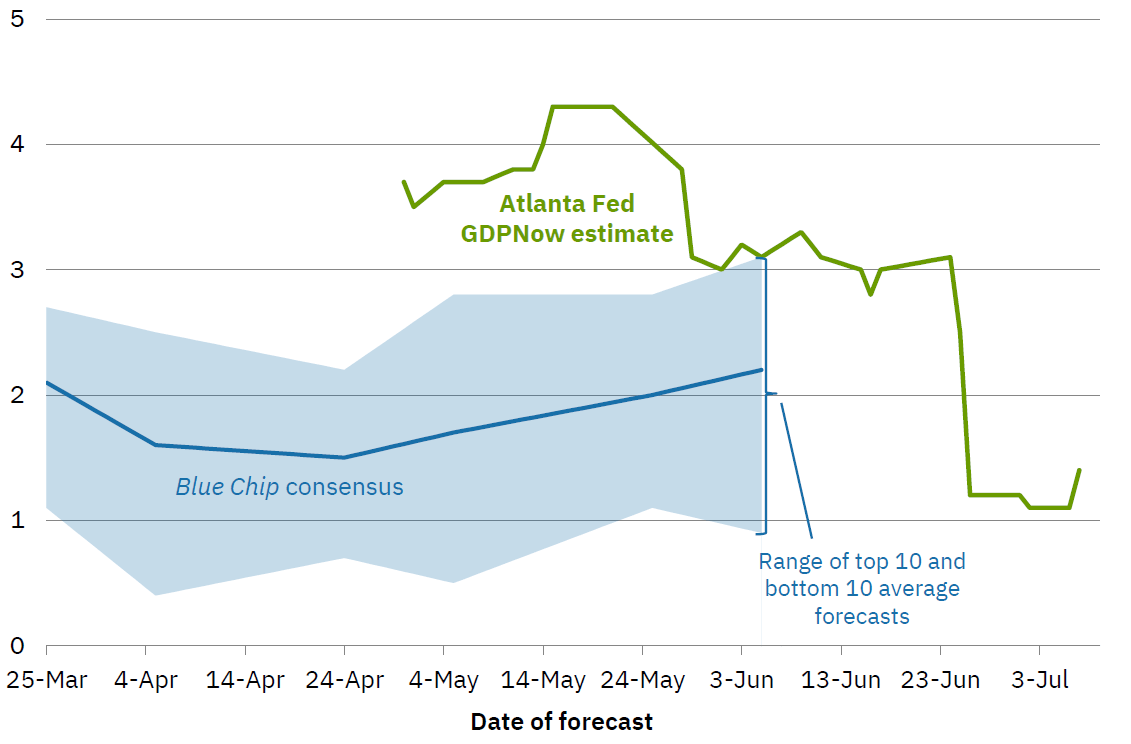
With both the labor force and productivity languishing of late, expectations for GDP growth are being revised downward. The current estimate, for the second quarter 2026, according to the Atlanta Fed’s GDPNow model is 1.4% as shown in the graph below.
Economists are watching closely to see if the U.S. has hit a temporary speed bump or if a recession is a real possiblity. The data over the next few months will shed light on the likely economic outcome for 2026.
The S&P 500 Index closed at 7,483, up 1.8% for the week. The yield on the 10-year Treasury Note rose to 4.48 %. Oil prices remained at $69 per barrel, and the national average price of gasoline according to AAA dropped to $3.80 per gallon.
© 2026. This material was prepared by Bob Cremerius, CPA/PFS, of Prudent Financial, and does not necessarily represent the views of other presenting parties, nor their affiliates. This information should not be construed as investment, tax or legal advice. Past performance is not indicative of future performance. An index is unmanaged and one cannot invest directly in an index. Actual results, performance or achievements may differ materially from those expressed or implied. All information is believed to be from reliable sources; however we make no representation as to its completeness or accuracy.
Securities offered through Registered Representatives of Cambridge Investment Research, Inc., a broker/dealer, member FINRA/SIPC. Advisory services offered through Cambridge Investment Research Advisors, Inc., a Registered Investment Advisor. Prudent Financial and Cambridge are not affiliated.
The information in this email is confidential and is intended solely for the addressee. If you are not the intended addressee and have received this message in error, please reply to the sender to inform them of this fact.
We cannot accept trade orders through email. Important letters, email or fax messages should be confirmed by calling (901) 820-4406. This email service may not be monitored every day, or after normal business hours.