



Executive Summary
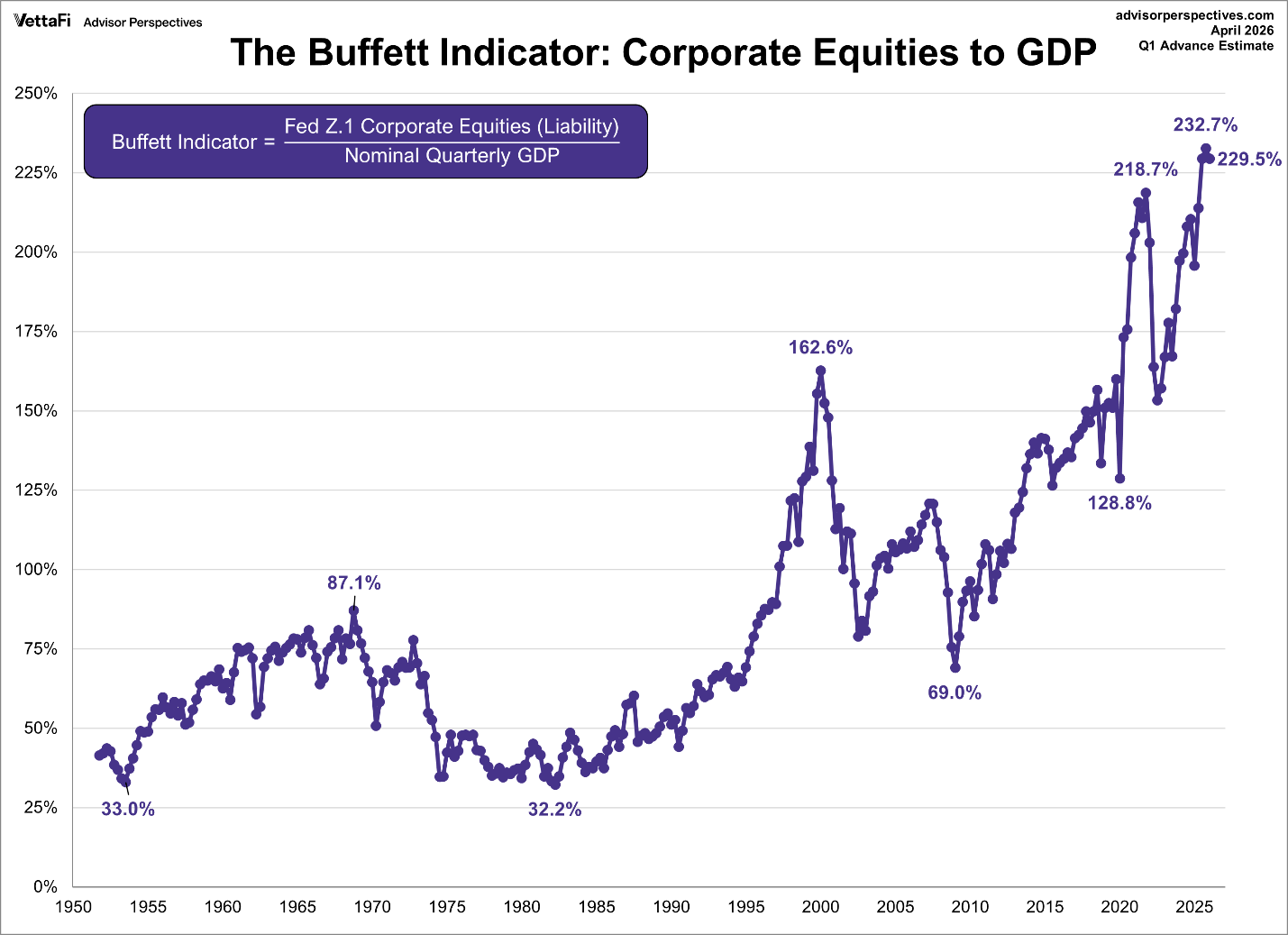
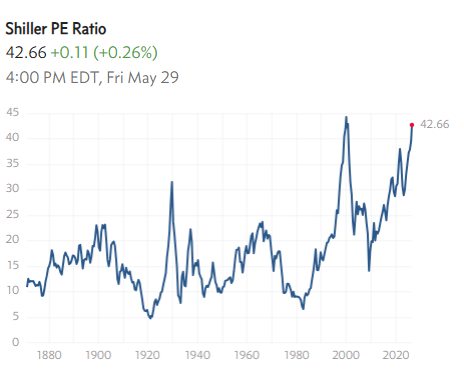
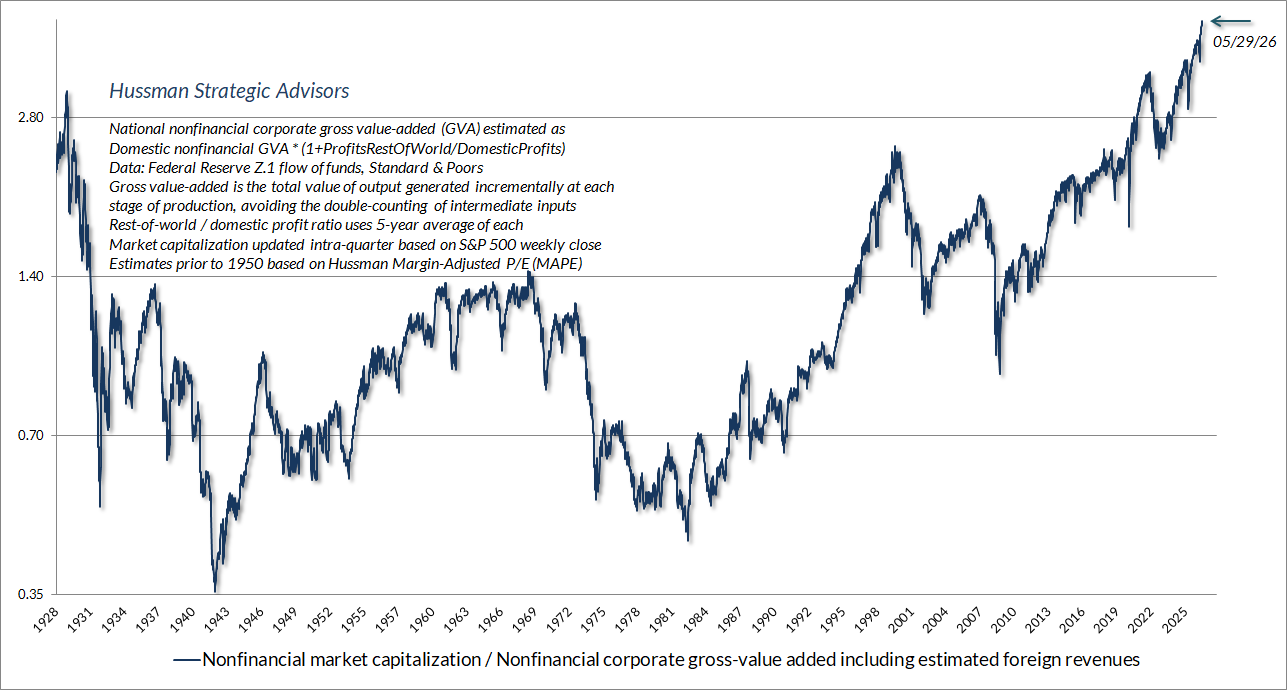
Warren Buffett’s Berkshire Hathaway is currently sitting on about $400 billion of cash, and most speculate the reason is prices of stocks are too high. This week’s update will review three notable valuation methodologies for the stock market – The Buffett Indicator, the Schiller P/E and Hussman’s nonfinancial market capitalization divided by nonfinancial corporate gross value-added. In the first graph, one can see Warren Buffett’s favorite indicator is almost at its very peak. The Schiller P/E (or Cape Ratio) is at 42.66, less than two points from its all-time high achieved in the 2000 Technology Bubble (see 2nd graph). Looking back on one hundred years of market history, Hussman’s methodology shows record overvaluation as well (see 3rd graph). While none of these are timing indicators suggesting an immediate stock market crash, they all do reflect a level of risk which should be considered. No one knows when or how much of a correction is in store, or how long the subsequent recovery process could take. Suffice it to say, Mr. Buffett appears to prefer cash to new purchases.
For further analysis, continue to read The Details below for more information.
“I have always found it easier to evaluate weights dictated by fundamentals than votes dictated by psychology.”
–Warren Buffett
The Details
There is a reason Warren Buffett’s Berkshire Hathaway is sitting on a record pile of cash, currently about $400 billion. Stocks are no longer being priced based upon past, or estimated future, revenue or earnings. Therefore, the stock market has reached the world of Alice in Wonderland. Current valuations are now on par with the two previous great bubble peaks, the New Era of 1929 and the Tech Bubble of 2000. By some measures, the market is at the same level as the prior record bubbles. By other methodologies, the market is in record overvaluation territory. Either way, reliable indicators suggest that a buy and hold of the S&P 500 today should result in a net negative return over the next decade. Hence, for long-term investors, like Warren Buffett, it makes no sense to buy at these prices.
In this missive I will review three of the most notable and reliable – relative to subsequent actual returns – valuation methodologies. The first, named after Warren Buffett himself, since he once declared it his favored valuation measurement, is The Buffett Indicator. This calculation divides the market cap of corporate equities by GDP. The graph below from VettaFi shows a reading of about 230%; however, with the market surge in May, the current result is approximately 238% – the highest valuation ever recorded by this measure. For perspective, the long-term median reading is around 80%.
The second methodology is the Shiller P/E, also known as the CAPE (Cyclically Adjusted Price-to-Earnings Ratio). This calculation was developed by Yale professor Rober Shiller, based upon the previous works of renowned value investor Benjamin Graham. Here, the S&P 500 is divided by previous 10-year inflation-adjusted earnings. The thought is that this smooths out the fluctuations in the business cycle. Previously, the highest level ever reached was 44.19, near the peak of the Tech Bubble. After the bubble burst, it was thought that this level of carelessness would never be witnessed again. Today, the Shiller P/E is sitting at 42.66, just a stone’s throw from the Tech Bubble peak. Even in the absurdity leading up to the stock market crash of 1929, the Shiller P/E only hit about 33. The long-term median is about 16. See the graph below from Multpl.com.
And finally, well-known market analyst and economist, John Hussman, has developed his own valuation methodology using a variation of price-to-revenue. After researching many different approaches to deciphering a realistic valuation measure, he chose this one (Nonfinancial market capitalization divided by Nonfinancial corporate gross-value added, including estimated foreign revenues), shown below. The reason for labeling this as his favored method is that it is most correlated with subsequent 12-year actual S&P 500 returns. Once again, the current reading is higher than any previous measurement. Said differently, the market is more overvalued than ever before in over 100 years of market history.
This type of fundamental analysis is great for estimating future long-term – 10-years or more – returns. What these should not be used for is predicting short-term market movements. It has been proven in every bubble, time and again, that the market can defy the odds in the short run and become even more overvalued. However, buy and hold investors should be aware of possible long-term results.
Many investors believe they can ride the bubble up, then get out before incurring significant losses. The problem with that type of thinking is that the market often falls 10-20% before someone from the Fed or Federal government begins to jawbone about potential support. Encouraged, speculators “buy-the-dip,” thus sending the market back to record highs. This action is so engrained in investors’ thinking that most will probably not “exit at the top,” because they assume a rebound is not far away. However, eventually there will likely be a stairstep down. One that does not recoup previous losses, but with each move investors will be encouraged to buy-the-dip. It is not until the market is down significantly, potentially 40-50% or more, that investors will panic and sell, often declaring never to return.
Riding the bubble up is easy. Knowing which downturn is the “big one” that kicks-off the next bear market is not so easy. And those who chose to “ride it out” might one day find a market cycle which does not bounce back so quickly. The graph below from VettaFi illustrates the time it took on an inflation-adjusted basis for the market to recoup losses incurred during the indicated bear market. The graph also includes the bear markets of the 1970’s and the 2007 Financial Crisis. Notice that the recovery from the Financial Crisis only took six years. The reason for this short recover period is because the Fed and the Federal government flooded the economy with stimulus paid for with created funds.
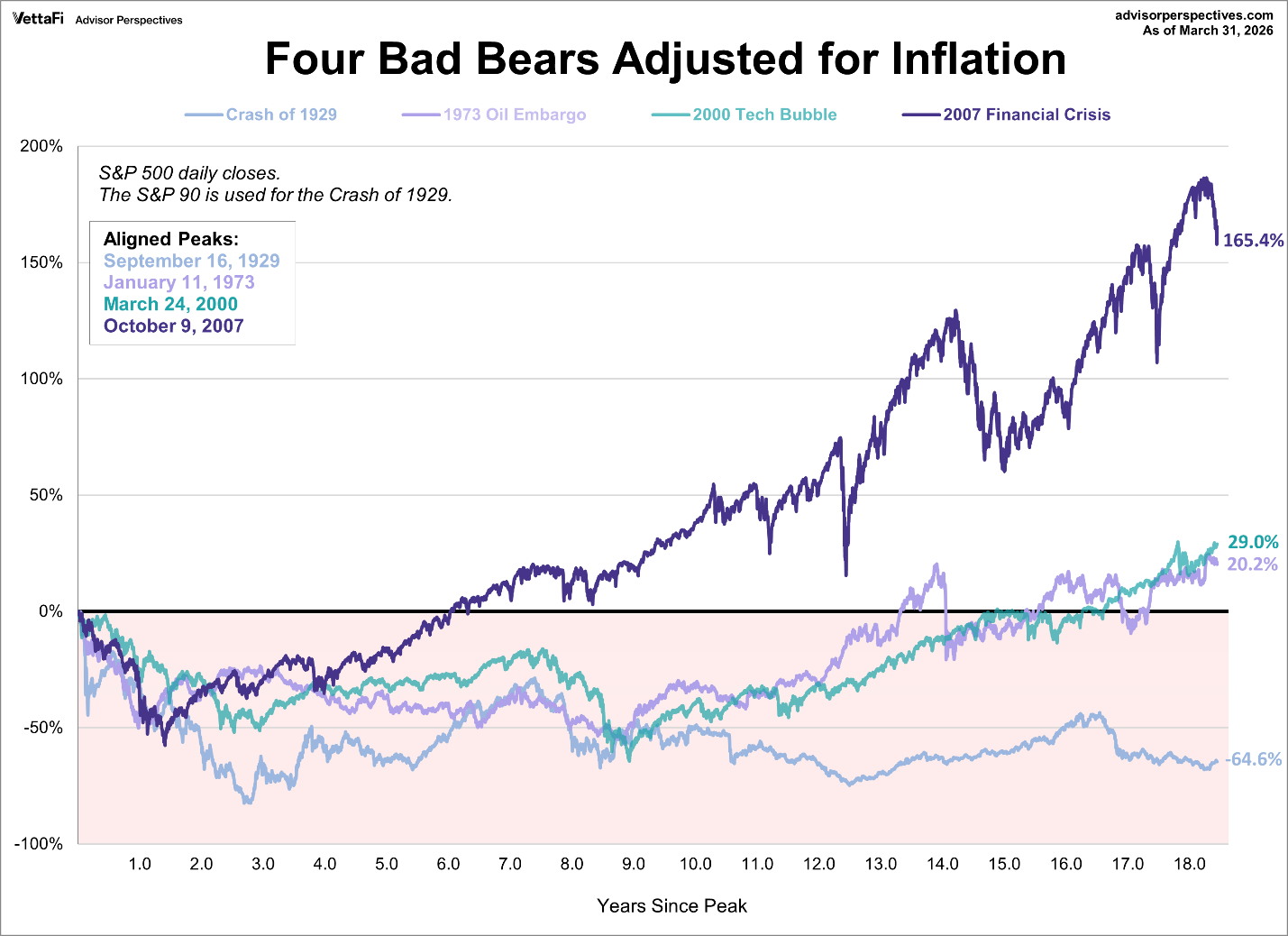
However one slices it, markets are insanely priced on a fundamental basis. Yes, the absurdity can become even more absurd. But, riding out this bubble, without protection in place, means potentially risking losses which have exceeded 80% twice in the past, and could take over 25 years to recover on an inflation-adjusted basis. There is a reason Warren Buffett likes cash today.
The S&P 500 Index closed at 7,580, up 1.4% for the week. The yield on the 10-year Treasury Note fell to 4.45%. Oil prices decreased to $87 per barrel, and the national average price of gasoline according to AAA dropped to $4.34 per gallon.
© 2026. This material was prepared by Bob Cremerius, CPA/PFS, of Prudent Financial, and does not necessarily represent the views of other presenting parties, nor their affiliates. This information should not be construed as investment, tax or legal advice. Past performance is not indicative of future performance. An index is unmanaged and one cannot invest directly in an index. Actual results, performance or achievements may differ materially from those expressed or implied. All information is believed to be from reliable sources; however we make no representation as to its completeness or accuracy.
Securities offered through Registered Representatives of Cambridge Investment Research, Inc., a broker/dealer, member FINRA/SIPC. Advisory services offered through Cambridge Investment Research Advisors, Inc., a Registered Investment Advisor. Prudent Financial and Cambridge are not affiliated.
The information in this email is confidential and is intended solely for the addressee. If you are not the intended addressee and have received this message in error, please reply to the sender to inform them of this fact.
We cannot accept trade orders through email. Important letters, email or fax messages should be confirmed by calling (901) 820-4406. This email service may not be monitored every day, or after normal business hours.