


Executive Summary
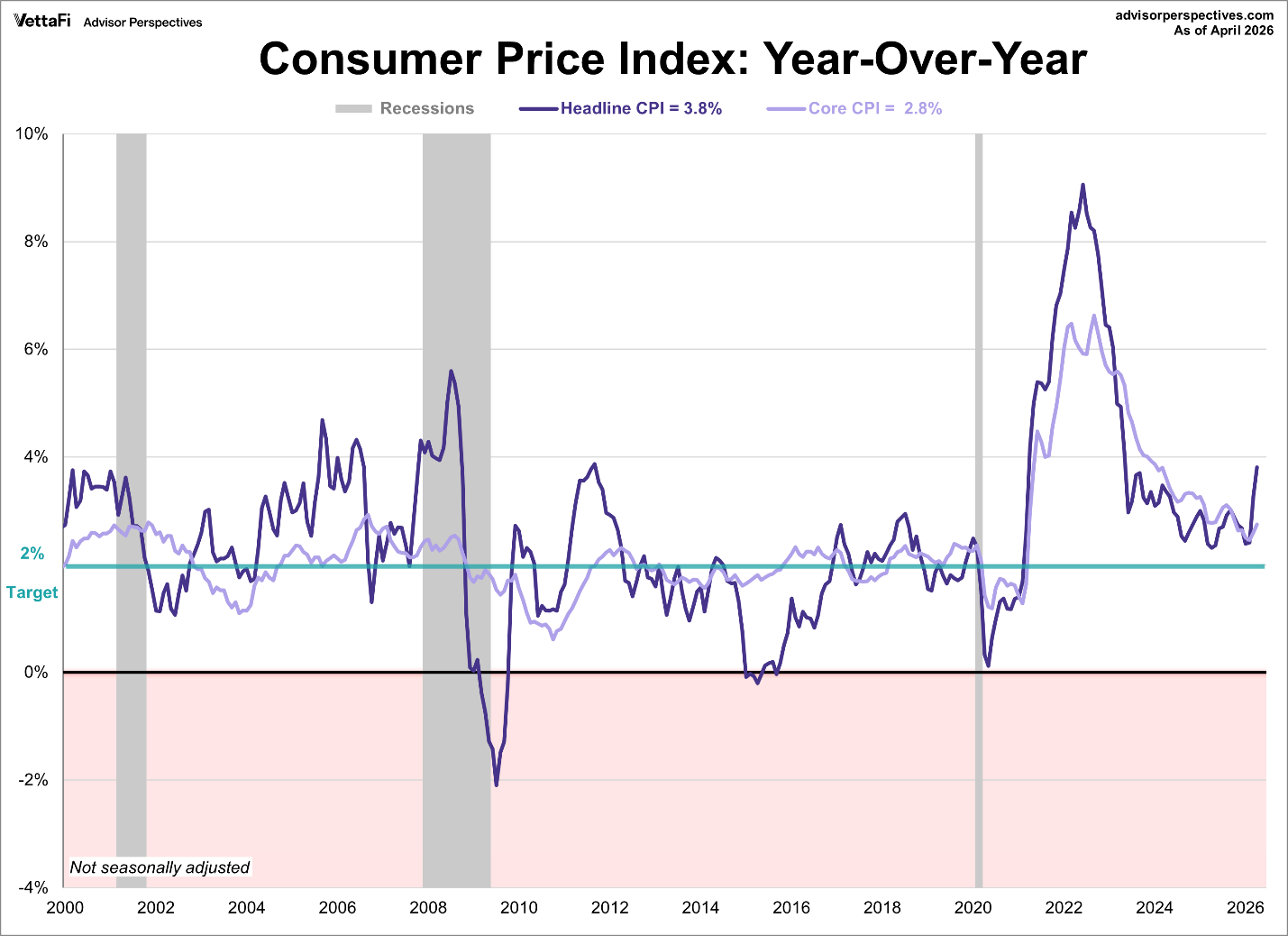
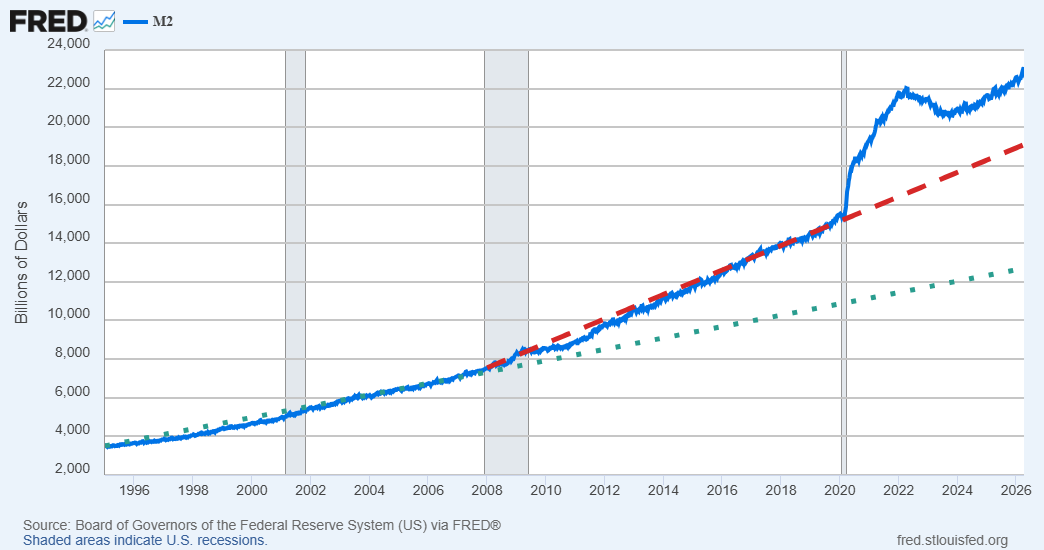
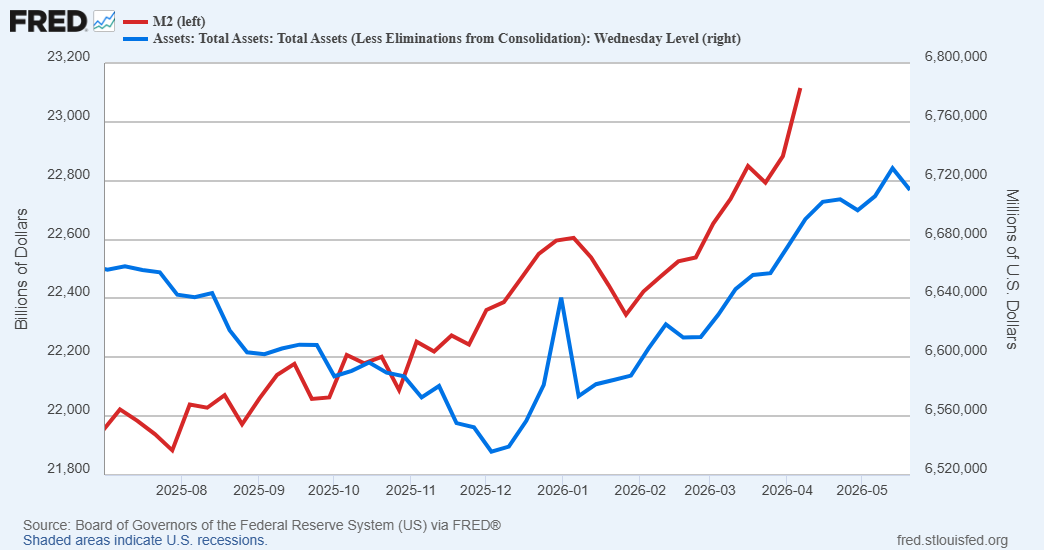
In addition to gasoline reaching $4.50 per gallon, because of the war with Iran, the April Producer Price Index rose 1.4% and the Services Index rose 1.2% (the largest gain in 4 years). In the first graph below, the Headline Consumer Price Index shows a 3.8% increase year-over-year. Other inflationary behaviors include the Fed increasing their balance sheet as well as increasing money supply (M2) (See 2nd & 3rd graphs). The bond market is flashing a signal as well with the 10-year Treasury yield on the rise. Early in 2026 economists predicted the Fed would lower rates by the end of 2026; however, now the consensus is they will raise rates to fight inflation. The new Fed Chairman Warsh may be in a pickle!
For further analysis, continue to read The Details below for more information.
“Inflation hasn’t ruined everything. A dime can still be used as a screwdriver.”
–H. Jackson Brown, Jr.
The Details
It has now been about three months since the start of the war with Iran and the resulting spike in oil prices. At this point all indicators are pointing toward a continuation in price increases. Oil prices are fluctuating, roughly between $90 and $110 per barrel, depending upon the news of the day regarding an agreement with Iran to end fighting and reopen the Strait of Hormuz. Gasoline prices have risen above $4.50 per gallon. The April Producer Price Index (PPI) rose 1.4%, much higher than expected. The Services Index jumped 1.2%, the largest gain in over four years. The majority of the gain in the Services Index was attributable to trade services, causing some to believe that tariff costs are beginning to have a larger effect on prices.
The Consumer Price Index (CPI) for April rose 3.8% year-over-year, the highest level in nearly three years. See the graph below from VettaFi showing the recent spike in the CPI.
The biggest contributors to inflation were energy, shelter and food costs. These categories have the most impact on middle and lower class consumers. “Wolf Richter at Wolf Street published a food-price breakdown this week showing that ground beef is up 18.9% year over year to a record $6.90 per pound, steak up 17.1%, coffee up 29%. Since January 2020, food consumed at home is up 32%.” (Via John Mauldin’s Thoughts from the Front Line)
In addition to the oil supply shock pushing prices higher, the money supply (M2) continues to increase at a faster pace. Notice the change in the trend of growth in the money supply from 1995 to 2008 (green dotted line) compared to the period 2008 to 2020 (red dashed line).
So far this year, M2 has been growing at an even faster pace as shown in the graph below (red line). At the same time the Fed resumed increasing their balance sheet in December 2025 (blue line). These two actions together lead to higher inflation.
The new Fed Chairman, Kevin Warsh, is in a real pickle. With consumers struggling with high and rising prices, large debt balances and high interest rates, will the Fed raise or lower the Fed Funds Rate (FFR)? While the thought prior to the appointment of Mr. Warsh was that rates would be lowered to help consumers, debtors and the overall economy, now the consensus belief is that the Fed will raise the FFR to combat inflation. The bond market is already sending the Chairman a message, as long-term interest rates have risen. Even back in 2024, when the Fed began lowering the FFR rate, the 10-year Treasury yield rose, as highlighted in the graph below. Notice in the graph below the sharp rise in the 10-year yield in 2026.
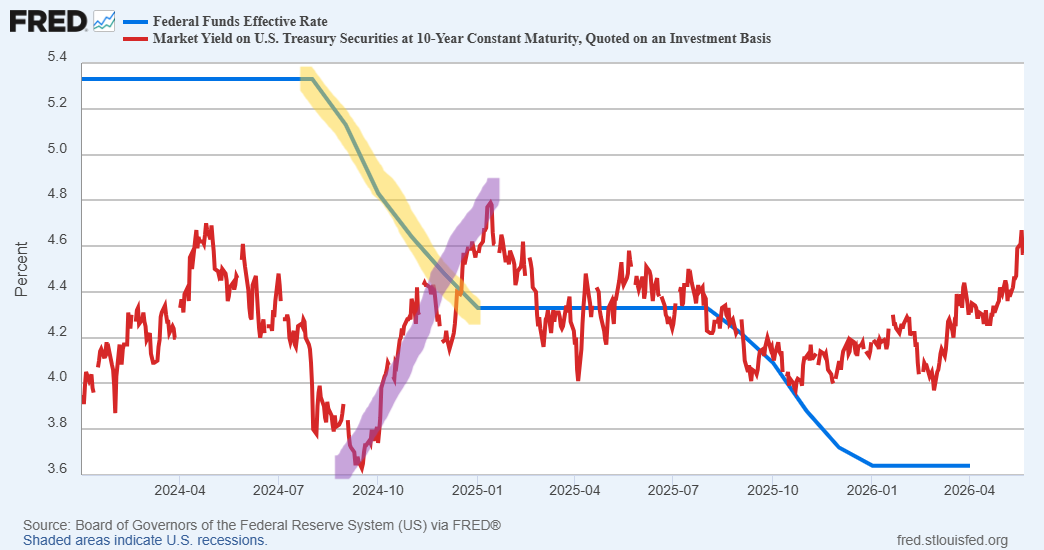
It seems the time for a quick resolution to the energy shock, and the hoped for transitory inflation effects, has passed. It appears that in addition to energy prices, inflation is being boosted by the increase in the money supply while the Fed increases their balance sheet.
If, by chance, an agreement is reached with Iran, and they adhere to the agreement, it is very possible that the immediate effect will be for oil prices in the speculative market to fall. However, it will take months to clear the backlog of ships waiting to pass through the Strait of Hormuz. And it could take as long as a year to return to normal operations. This, combined with the sharp rise in M2 and Fed monetization, could continue to push inflation higher. The bond market is already issuing a warning that inflation is heating up. Let’s see what Chairman Warsh will do.
The S&P 500 Index closed at 7,473, up 0.9% for the week. The yield on the 10-year Treasury Note fell to 4.57%. Oil prices decreased to $97 per barrel, and the national average price of gasoline according to AAA remained at $4.51 per gallon.
© 2026. This material was prepared by Bob Cremerius, CPA/PFS, of Prudent Financial, and does not necessarily represent the views of other presenting parties, nor their affiliates. This information should not be construed as investment, tax or legal advice. Past performance is not indicative of future performance. An index is unmanaged and one cannot invest directly in an index. Actual results, performance or achievements may differ materially from those expressed or implied. All information is believed to be from reliable sources; however we make no representation as to its completeness or accuracy.
Securities offered through Registered Representatives of Cambridge Investment Research, Inc., a broker/dealer, member FINRA/SIPC. Advisory services offered through Cambridge Investment Research Advisors, Inc., a Registered Investment Advisor. Prudent Financial and Cambridge are not affiliated.
The information in this email is confidential and is intended solely for the addressee. If you are not the intended addressee and have received this message in error, please reply to the sender to inform them of this fact.
We cannot accept trade orders through email. Important letters, email or fax messages should be confirmed by calling (901) 820-4406. This email service may not be monitored every day, or after normal business hours.