



Executive Summary
The first graph below details the S&P 500 being at an all-time high while consumer sentiment is at an all-time low. One may ask how or why this is possible given the geopolitical situation, including the rising price of gasoline. Drawing on the opinion article in The New York Times, by Kyla Scanlon, her analysis is investors believe the Federal Reserve will always save the market. Historically, it began with Fed Chairman Volker raising the Fed Funds Rate to over 20% to fight inflation. Then Alan Greenspan followed suit by cutting interest rates to near zero and flooding the system with liquidity to fight recession/depression. As Ms. Scanlon concluded, “The problem isn’t just the war, or the energy crisis, or the debt levels, or the trapped Fed, or the fragility of the A.I. supply chain. It’s all of them simultaneously, potentially compounding one another, processed by a market that believes it will be saved.”
For further analysis, continue to read The Details below for more information.
“Post that ‘a whole civilization will die tonight,’ stocks go up.”
–Kyla Scanlon
The Details
In last week’s missive, I asked if risk in the stock market is being ignored. One of the graphs I included to explain the irrationality of the market was the one below from Creative Planning @CharlieBilello. This graph details the S&P 500 being at an all-time high, and at the same time consumer sentiment is at an all-time low. Speculation is rampant and risk is being ignored.
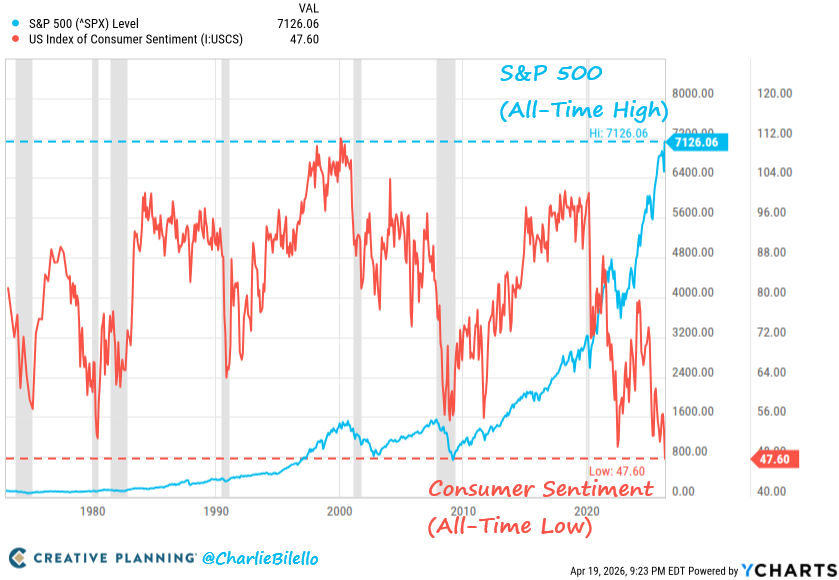
Why is it that investors seem oblivious to clear signs of excess and irrationality? Consumers are truly struggling with prices continuing to rise. The war in Iran has pushed gasoline prices over $4 per gallon, yet speculation in the stock market marches on. A recent opinion article in The New York Times, by Kyla Scanlon, tackled this predicament. The reason, according to Ms. Scanlon, is that investors believe, “It [the stock market] will always be saved.” She traced back the origin of this belief to the actions of former Fed Chairman Paul Volcker. Mr. Volcker used interest rates to crush inflation, by raising the Fed Funds Rate by over 20%. He “…saved the economy by destroying it, while establishing a precedent that the Fed could and would move the economy.”
Greenspan took the baton and flipped it upside down, starting with the October 1987 market crash. The solution to all future market problems became flooding the system with liquidity and cutting interest rates. The theme even earned its own nickname, the “Greenspan put.” Each subsequent crisis, including the Financial Crisis and the Pandemic, resulted in an ever larger recipe of liquidity, and rates cut to near zero percent.
“Markets inferred a guarantee. They’re running the same pattern: This is really bad, but we’ll get saved, so buy the dip.
The problem is that the rescue infrastructure is exhausted. The Fed is trapped. Inflationary pressures mean that rate cuts, the most powerful tool in the monetary tool kit, could risk making things worse. The Greenspan ‘put’ is not really in the cards.”
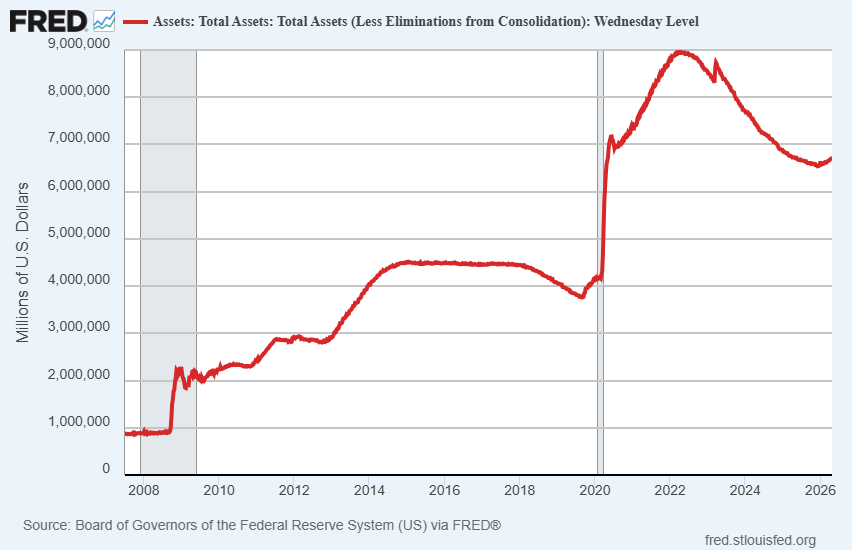
And that is a message I have been proclaiming for some time now. The problem is that debt has soared to incredible heights. Federal debt has crossed $39 trillion, much of which has been monetized by the Fed. Total assets on the Fed’s balance sheet, as shown in the graph below, have soared from under $900 billion at the start of 2008 to $6.7 trillion today. The public was told by the Fed that purchases of Treasuries would be temporary, and the balance sheet would be brought back to “normal” levels. After peaking near $9 trillion in 2022, assets were only allowed to drop to around $6.5 trillion, before the Fed decided more liquidity was needed to prop up the system.
Speculators today believe that the solution to all of the problems is A.I. (artificial intelligence). Putting their money where their mouth is, speculators have pushed the market cap of the Mag 7 stocks so high that they represent over 30% of the S&P 500. The hope is that productivity gains will offset associated job losses. However, this is far from proven. The fallback hope by speculators is that A.I. companies will become too big to fail, just like the big banks. In other words, the government, with help from the Fed through monetization, will bail out the A.I. industry.
The real question in all of this, is how much more can a “trapped” Fed do before something blows up? More liquidity and lower rates will likely push inflation higher. Higher rates to lower inflation (á la Volcker) will crush a debt-ridden economy.
As Ms. Scanlon concluded, “The problem isn’t just the war, or the energy crisis, or the debt levels, or the trapped Fed, or the fragility of the A.I. supply chain. It’s all of them simultaneously, potentially compounding one another, processed by a market that believes it will be saved.”
The S&P 500 Index closed at 7,165, up 0.5% for the week. The yield on the 10-year Treasury Note rose to 4.31%. Oil prices increased to $94 per barrel, and the national average price of gasoline according to AAA rose to $4.10 per gallon.
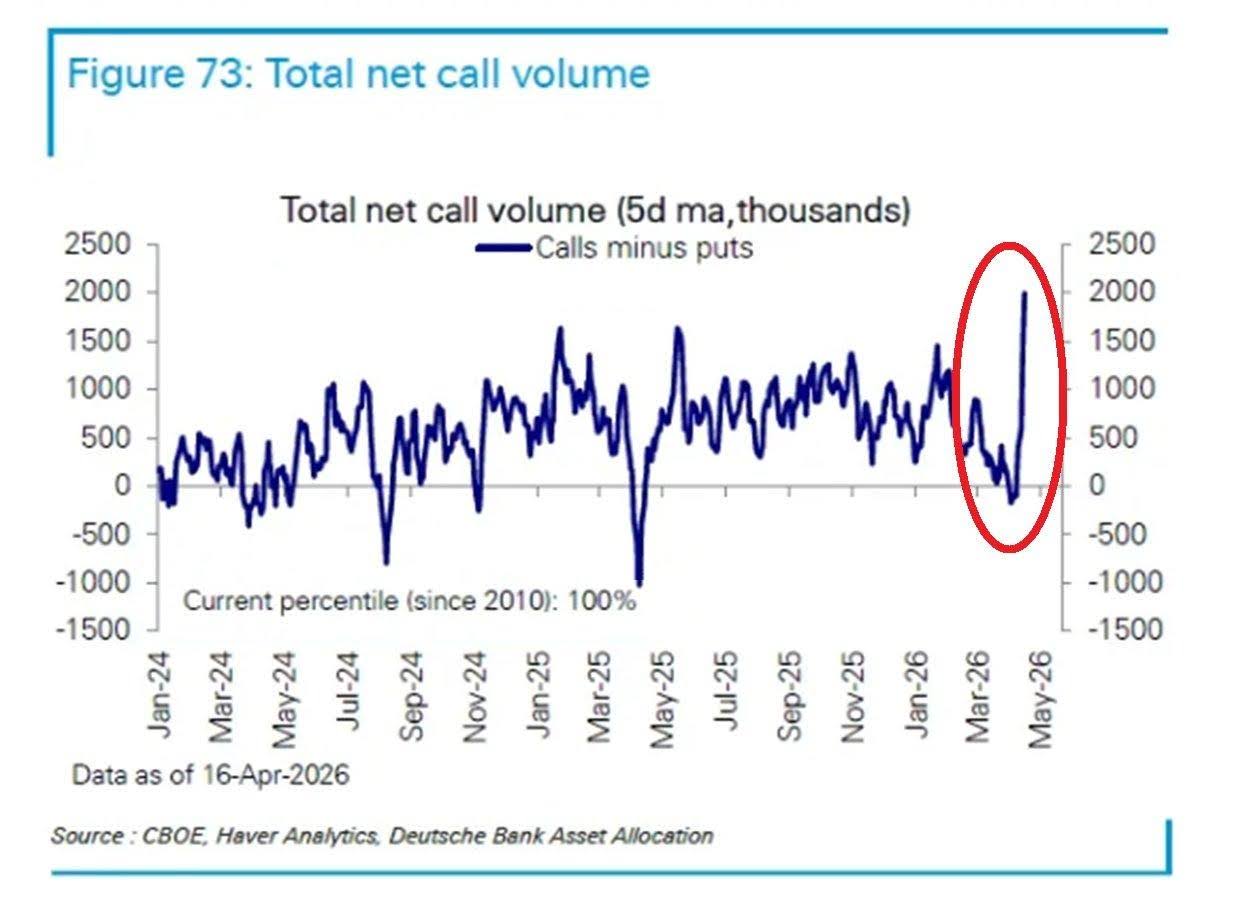
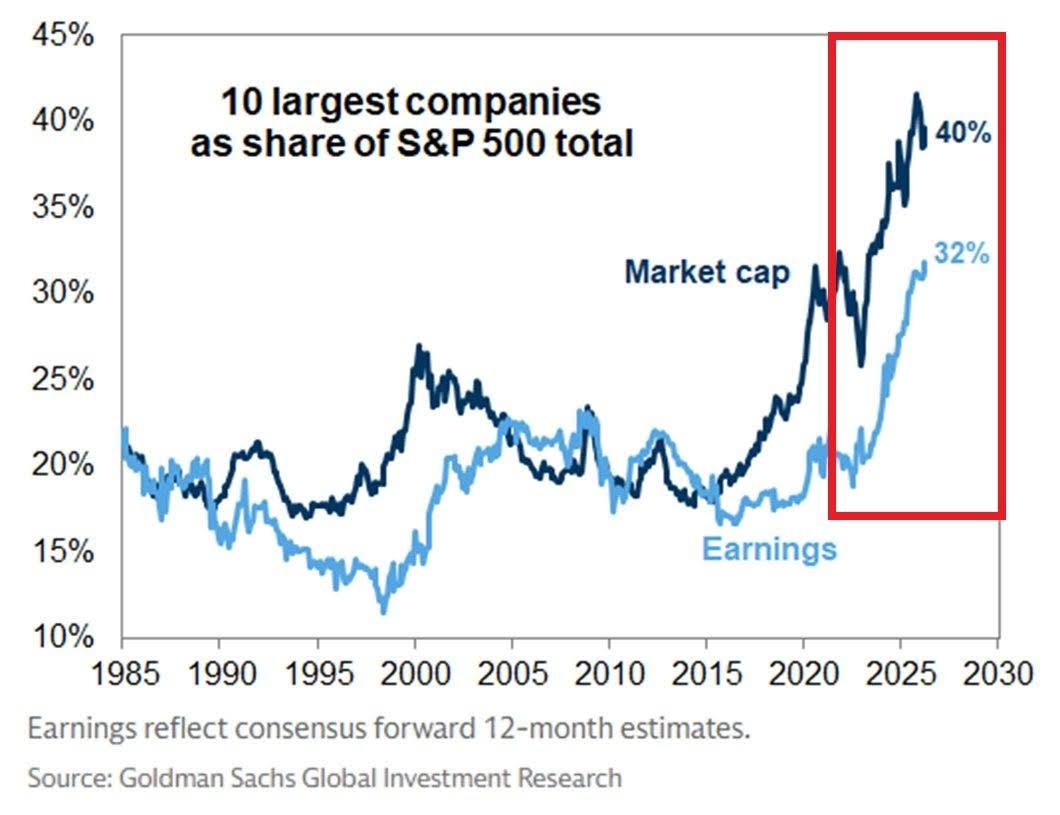
The amount of risk embedded in markets today is also near all-time highs. In an environment where the economy is slowing due to record amounts of debt, the jobs market is weak, oil prices remain high, and no official end is in sight for the war with Iran, it is astonishing that investors continue to pump stock prices higher. The fact that the S&P 500 is now more concentrated than any time over the past 40 years adds another layer of risk. The graph below from Global Markets Investor, via X, illustrates that 40% of the S&P 500 is represented by the 10 largest companies.
The high prices of goods and services, including gasoline prices over $4 per gallon, have consumers worried. Many are already up to their eyeballs in debt. Continued disruption in the oil markets resulting in high oil and gas prices will weigh on consumers, hence the low consumer sentiment.
On the other hand, investors are acting as if there are no problems anywhere. The amount of risk in the stock market today is exorbitant and is being ignored by investors. Unfortunately, this type of irrational movement in the stock market always ends badly. Investors who are not properly hedged today stand to lose an unspeakable amount of money when reality returns.
The S&P 500 Index closed at 7,126, up 4.5% for the week. The yield on the 10-year Treasury Note fell to 4.24%. Oil prices decreased to $84 per barrel, and the national average price of gasoline according to AAA fell to $4.05 per gallon.
© 2026. This material was prepared by Bob Cremerius, CPA/PFS, of Prudent Financial, and does not necessarily represent the views of other presenting parties, nor their affiliates. This information should not be construed as investment, tax or legal advice. Past performance is not indicative of future performance. An index is unmanaged and one cannot invest directly in an index. Actual results, performance or achievements may differ materially from those expressed or implied. All information is believed to be from reliable sources; however we make no representation as to its completeness or accuracy.
Securities offered through Registered Representatives of Cambridge Investment Research, Inc., a broker/dealer, member FINRA/SIPC. Advisory services offered through Cambridge Investment Research Advisors, Inc., a Registered Investment Advisor. Prudent Financial and Cambridge are not affiliated.
The information in this email is confidential and is intended solely for the addressee. If you are not the intended addressee and have received this message in error, please reply to the sender to inform them of this fact.
We cannot accept trade orders through email. Important letters, email or fax messages should be confirmed by calling (901) 820-4406. This email service may not be monitored every day, or after normal business hours.