



Executive Summary
This week continues the review of Dr. Michael Burry’s paper explaining some reasons why stock market valuations have set a record 34 years above the mean – eclipsing the previous 10-year record- and associated downside risk. In 1996, passive equity investments comprised 6% as compared to 60% of investments by 2024. As defined benefit plans were replaced with 401(k) plans, the automatic flow of payroll contributions, without price discovery, into passive index funds ballooned with baby boomer participation. Per Dr. Burry, in 2000 corporate stock buy backs were around $140 billion annually, which grew to over $1trillion by 2025, further lifting prices. The shift from buybacks to AI investment could significantly reduce money flows into equities. Looking at the “mandatory unwind graph” below, one can see the impact of Required Minimum Distributions. By 2028, these outflows will exceed inflows, creating a possible unwind of the stock market bubble. Proceed below for the full take on how the bubble expanded and how it could pop.
For further analysis, continue to read The Details below for more information.
“As ‘bandwagon’ investors join any party, they create their own truth — for a while.”
–Warren Buffett
The Details
Last week I reviewed the first part of Dr. Michael Burry’s paper entitled, “Foundations: U.S. Market Structure & Value” as it relates to secular market cycles and current valuations. He also provided examples of what reversion to the mean (or below) would entail. Currently, markets have set a record of 34 years above the mean. The prior record was 10 years. Why are markets holding so long above the mean? Dr. Burry provides some insight.
Since 2000, investing in “index” funds, or funds that are meant to track a particular index. Unlike actively managed funds which attempted to beat the index’s performance, investing in index funds are considered “passive” investing. As money flows into passive index funds, each stock in the index gets a proportional bid, there is no price discovery. The flows into index funds were accelerated with the passage of the Pension Protection Act in 2006. This act established the framework for the Qualified Default Investment Alternative. Employers were given approval for automatically investing new employees into their 401(k) plans in 1998, under the IRS Ruling 98-30. The Qualified Default Investment Alternative established the use of index funds as the default investment for automatic contributions. The impact has been significant. In 1996, only 6% of equity investments were in passive funds. By 2024 this has grown to over 60%.
Demographics also played into the growth of passive investments. During the baby boomers’ prime earning years, pension plans were replaced by defined contribution plans (401(k) plans), heavily utilizing passive funds. The concentration of assets directed to the largest companies is also a direct result of passive investing as explained by Dr. Burry,
“Another force at work is mechanical, machine-like reflexivity. The largest indices are market capitalization weighted. The larger the company’s market capitalization, the greater percentage of the index, and hence the greater percentage of 401(k) money that mandatorily flows to that larger market capitalization stock. Which helps increase the market capitalization of that stock more than a smaller stock in the same index. And around again.”
Another force pushing large capitalization stock prices higher is corporate buybacks. Dr. Burry explains:
“In 2000, S&P 500 Index stock buybacks were about $140 billion annually -roughly the same as dividends.
In 2015, buybacks were $572 billion, relative to $382 billion in dividends.
By 2022, buybacks surpassed $1 trillion. 2025 broke that record.
Like everything else, buybacks are concentrated in the largest technology companies. The top 20 S&P 500 companies are about half of total buybacks.
It is worse than that. Apple alone is 11% of all buybacks. The top 6 were 30%.
As an aside, these were at high valuations too. Buying above intrinsic value per share dilutes intrinsic value per share.”
I have written before that corporations buying back their stock at extremely overvalued prices is a poor investment in the long run. But this practice is diminishing as large corporations are diverting funds from buybacks to AI investments. The large reduction in the market support from corporate buybacks could have a significant impact on markets.
Dr. Burry has concluded that the consequence of the change in market structure to passive investing is not positive, as he wrote,
“I claimed publicly in 2017 and 2019 that this was going to end poorly. I saw passively invested assets take the crown from actively invested assets, and I considered this is to be the same as filing people into a crowded expandable room through a single small door. The room may grow to gargantuan size, but there is only one door to get out, and the rate of outflow is limited. A fire or panic one day could be something to see, as all move in one direction at the same time, I mused.
If these structural reasons for elevated multiples and valuation actually exist, and my logic for the consequences holds, then one would expect more recent market shocks to be something special in breadth and depth. And they were.
COVID was in fact the most acute, broad equity selloff in history. Think about that. There have been some doozies. Black Mondays and the rest. But COVID created the fastest bear market on record, correlation near unity (1) within equities, across three dozen countries simultaneously. Fortunately, flows to bonds/Treasuries and the dollar provided an outlet, a safety valve. Cross-asset contagion did not happen.
Liberation Day was actually worse. Liberation Day was the rare simultaneous crash in stocks, bonds, and currency. U.S. equities, Treasuries, and the U.S. dollar all fell. Oil fell 7%, Gold crashed. Liberation Day ranks fifth by percentage decline among major acute crashes — but first by real dollar value destruction, and it is not close.”
Another factor impacting the movement of stock prices is high frequency trading. Dr. Burry explains below,
“Since the GFC, high frequency trading (HFT) has grown rapidly, hitting critical mass just before COVID. Today, 60% of trades today are HFT trades.
These traders are typically market makers (~75%), and they have largely replaced the old analog specialist system. Specialists were obliged to sit there and buy when everyone sells or sell when everyone’s buying. That was the specialist’s job. Now, HFT market makers may simply step away when there is a shock or high volatility event. Therefore, it is more fragile than the specialist system and tends to mechanically amplify sudden selloffs and short squeezes.”
And finally, Dr. Burry explains the significant effect of required minimum distributions (RMDs) from retirement plans. The mean baby boomer is 71 years of age. The current age when RMDs must start is 73, although it was earlier for older individuals. Baby boomers over 70 own approximately 30% of all stocks (directly or indirectly). The pool of IRA and 401(k) funds exceed $32 trillion. When RMDs are taken, there is no price discovery or fundamental analysis. Funds are simply withdrawn. And the amount of RMDs is rising rapidly.
“At $250 billion a year now and peaking over $1 trillion in the early-mid 2030s, redemptions will increasingly offset 401(k) contributions until 2028, when the redemptions first exceed contributions.”
The following graph is from Dr. Burry’s paper.
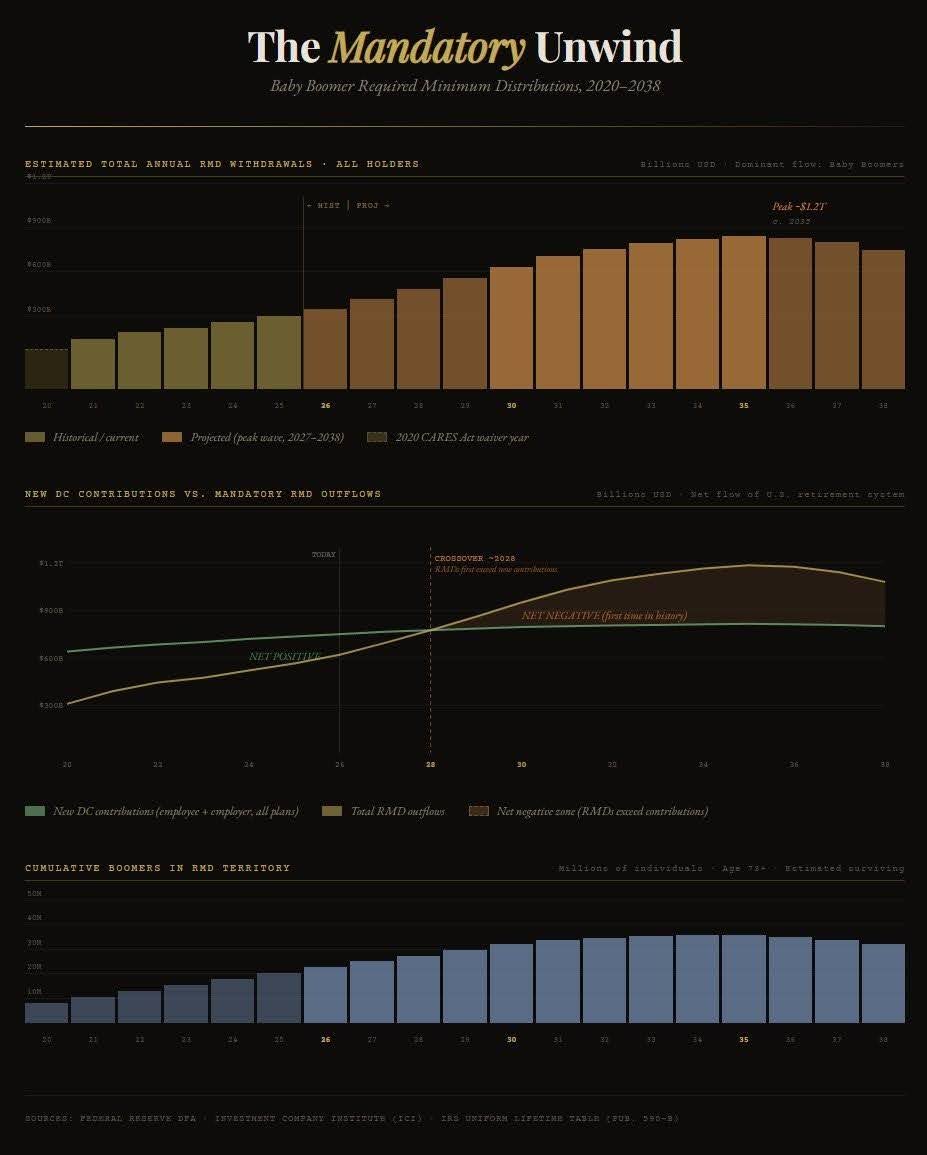
Dr. Burry says the market is like a coiled spring. Think about it. A stock market now 34 years above mean valuations when the prior record was 10 years. No one is using fundamental analysis. Buybacks are shrinking, at least for now. Traders using HFT have replaced Specialists. Aging demographics means a rise in RMDs and selling without price discovery. There is an old Wall Street adage that, the only thing that goes up in a bear market is correlation. That is what happened on Liberation Day.
Losses necessary to reach prior troughs approach 80%. Most investors do not believe this is possible. They have only experienced the 34-year overvalued stock market. Every time a correction began, it was soon propped up only to expand multiples further. But what if next time there is no rescue? What if markets truly drop to prior trough levels? And what if stocks remained undervalued for an extended period of time as they have in prior secular bear markets?
What could cause such a sell-off? Here is how Dr. Burry concludes his paper,
“The catalyst may not be much of anything. The stock market might realize that $5 trillion of VC unicorns do not make lasting customers, or that the free cash flow is disappearing from our largest companies in a blink of an eye. The market might just roll over because it is time. Like in March of 2000.
My point is that the next one is likely to be even more violent than Liberation Day. And one day, the gloom might stick, backed by disappointed expectations and ruined narratives, yet still a long ways from anyone examining rate-sensitive discounted cash flows.
Long Live the Plunge Protection Team!”
The S&P 500 Index closed at 6,583, up 3.4% for the week. The yield on the 10-year Treasury Note fell to 4.35%. Oil prices increased to $112 per barrel, and the national average price of gasoline according to AAA rose to $4.11 per gallon.
© 2026. This material was prepared by Bob Cremerius, CPA/PFS, of Prudent Financial, and does not necessarily represent the views of other presenting parties, nor their affiliates. This information should not be construed as investment, tax or legal advice. Past performance is not indicative of future performance. An index is unmanaged and one cannot invest directly in an index. Actual results, performance or achievements may differ materially from those expressed or implied. All information is believed to be from reliable sources; however we make no representation as to its completeness or accuracy.
Securities offered through Registered Representatives of Cambridge Investment Research, Inc., a broker/dealer, member FINRA/SIPC. Advisory services offered through Cambridge Investment Research Advisors, Inc., a Registered Investment Advisor. Prudent Financial and Cambridge are not affiliated.
The information in this email is confidential and is intended solely for the addressee. If you are not the intended addressee and have received this message in error, please reply to the sender to inform them of this fact.
We cannot accept trade orders through email. Important letters, email or fax messages should be confirmed by calling (901) 820-4406. This email service may not be monitored every day, or after normal business hours.