



Executive Summary
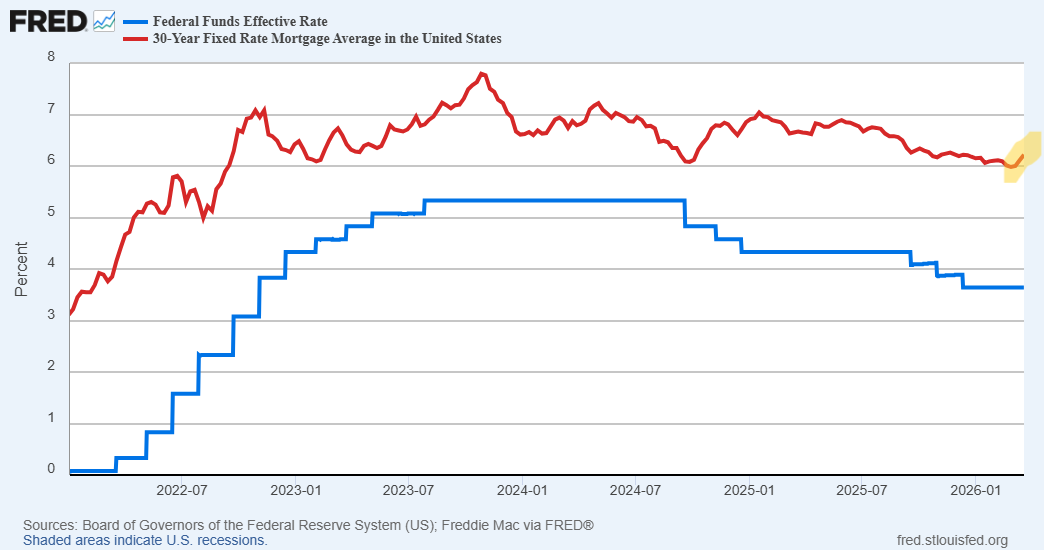
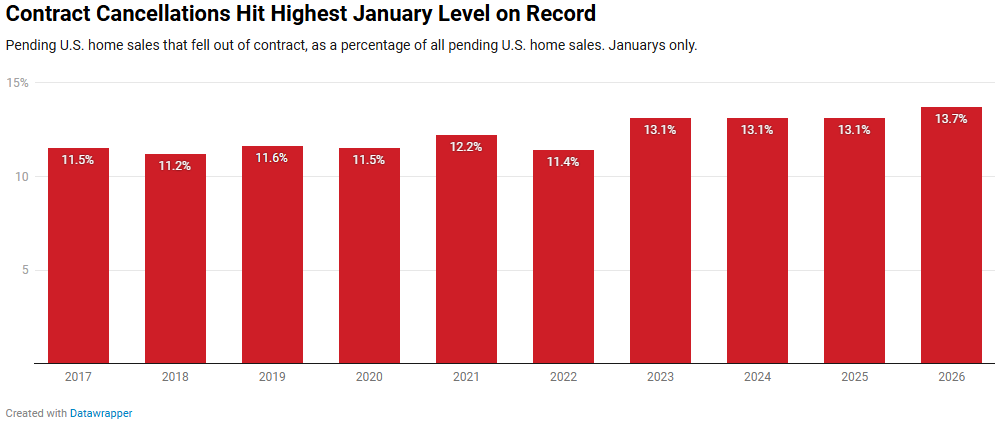
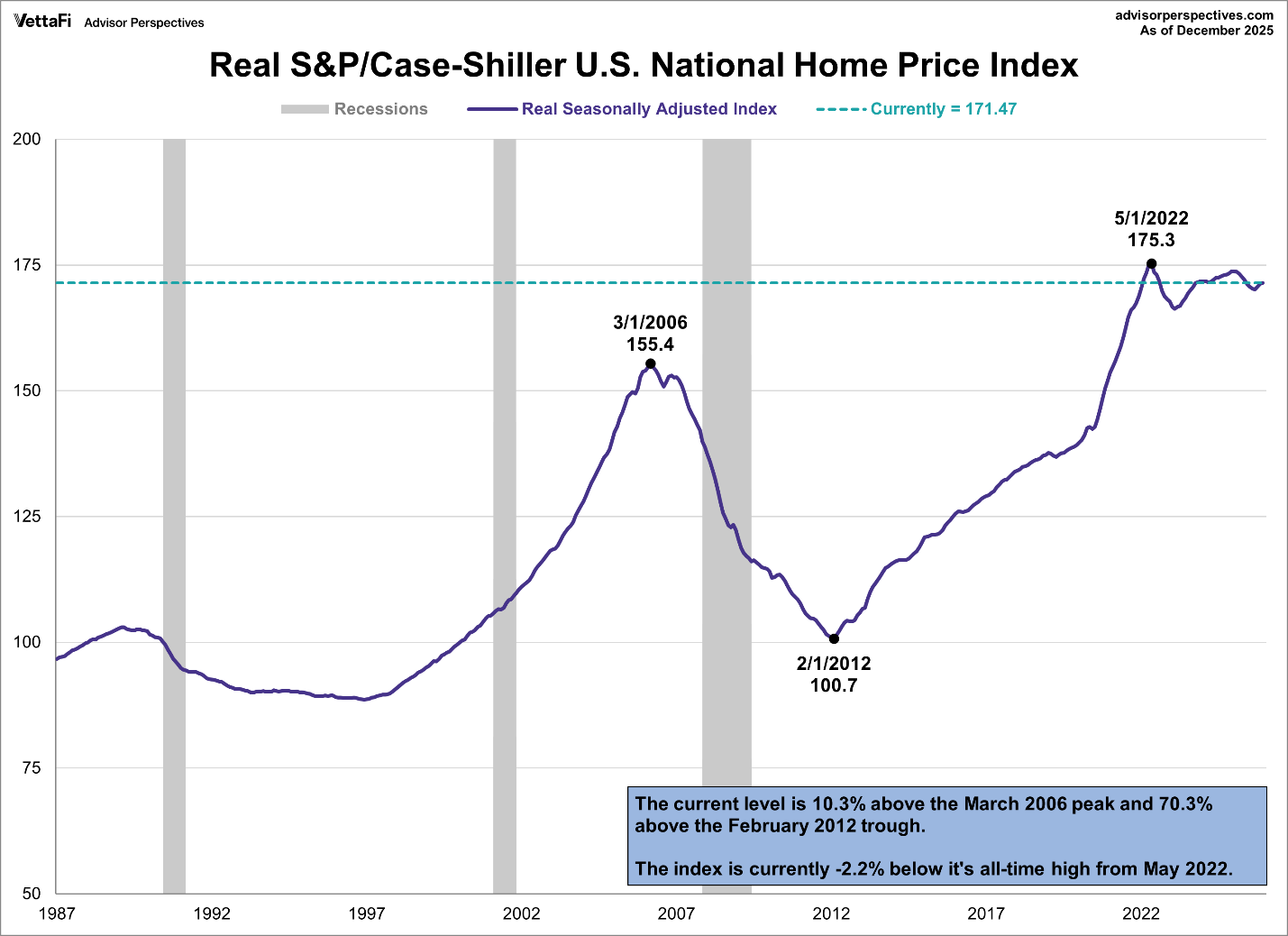
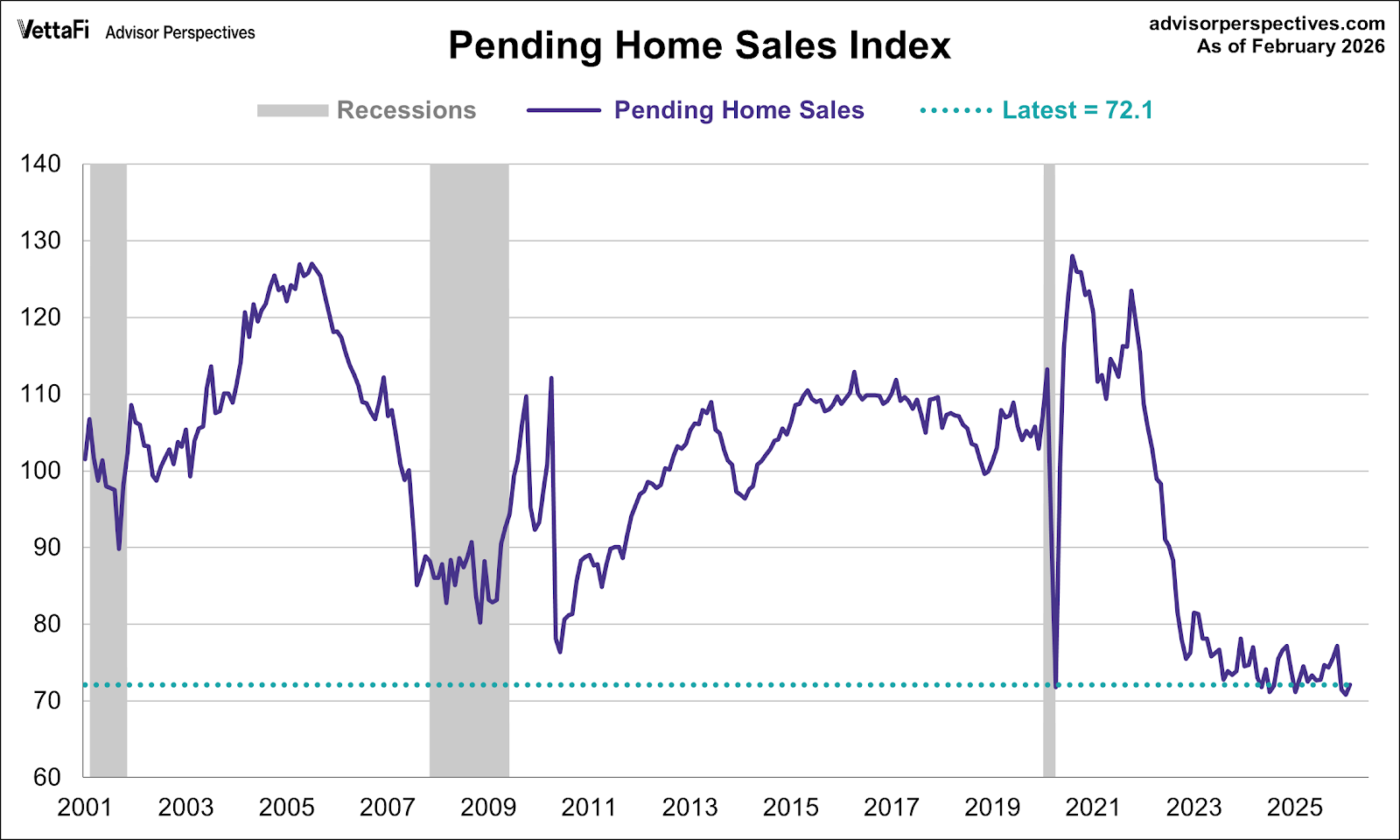
While last week the Fed decided not to change the Fed Funds Rate (the only one they control), long-term rates have been rising (see first graph below). Fears of inflation, the war, and a weakening economy have homebuyers getting cold feet – one in seven contracts are cancelled before closing (see second graph). Low mortgage rates of the last decade sent home prices skyrocketing, remaining near the peak (third graph), leaving homes unaffordable for many Americans. One can see in the final graph, the Pending Home Sales Index is near an all-time low. Home prices need to revert to the long-term mean to make them more affordable. For now, the housing market remains stagnant.
For further analysis, continue to read The Details below for more information.
“Buying a home wouldn’t make much sense if house prices were likely to decline further; no one wants to catch a falling knife.”
–Mark Zandi, economist
The Details
Last week, the Fed decided not to change the Fed Funds Rate (FFR – blue line). After dropping the short-term rate from a range of 5.25-5.50% in 2024 to the current range of 3.50-3.75%, the Fed appears unsure as to what direction to take. Do they lower rates to boost a weakening economy or raise rates to fight inflation? For now, they have decided to sit tight. Long-term rates, however, have not followed suit. The 30-year mortgage rate had fallen slightly below 6% by the end of February, before rising to around 6.35-6.50% Monday, as highlighted in the graph below (red line). Rising inflation indicators along with a jump in oil prices due to the war with Iran has spooked long-term rates.
It appears the fear of inflation combined with the weakening economy has given a rising number of homebuyers cold feet. According to Redfin, one in seven contracts were cancelled in January, the highest number of cancellations since 2017.
The artificially low mortgage rates experienced during the pandemic increased demand and sent home prices skyrocketing. Since peaking in May 2022 as shown in the graph below from VettaFi, real (inflation-adjusted) national home prices have only corrected by about 2.2%. Prices remain about 10% above the March 2006 peak and 70% above the post-Financial Crisis trough in February 2012.
Rising prices of goods and services along with higher mortgage rates have forced many buyers to hold off purchasing a home at this time. The problem is not lack of inventory, but instead extreme prices combined with mortgage rates well over double their 2021 low. Homes are simply unaffordable for the majority of households. This is confirmed by the Pending Home Sales Index below. The Index measures the number of contracts signed but not yet closed. Even without factoring in the number of these which might cancel, the Index is near its all-time low.
The Fed only controls the short-term FFR. Long-term rates, such as the 30-year mortgage, are determined by the market. The market reflects what consumers and investors are willing and able to do. Currently, home prices remain near their inflation-adjusted all-time peak. With interest rates rising again, more homebuyers will decide to delay purchasing until prices become more affordable. Artificially low interest rates, due to extreme monetary policy, pushed prices to exorbitant levels. Home prices need to correct back to a more normal range based upon long-term inflation. Another round of artificially low mortgage rates would only create more problems in the long run, extending the bubble further.
Of course, it is important to remember that the golden rule in real estate is location, location, location. Some areas of the country are doing better than others. Markets differ based upon demographic and economic factors. This analysis is to provide an overview from a national perspective.
Rising mortgage rates while homes remain at bubble prices will only stall the market. Eventually, home prices will be forced to revert to the mean and activity will pick up. The arrival of a recession could accelerate the drop in prices, absent absurd new monetary and fiscal policies. For now, population adjusted home sales remain stagnant.
The S&P 500 Index closed at 6,506, down 1.9% for the week. The yield on the 10-year Treasury Note rose to 4.39%. Oil prices decreased to $98 per barrel, and the national average price of gasoline according to AAA rose to $3.94 per gallon.
© 2026. This material was prepared by Bob Cremerius, CPA/PFS, of Prudent Financial, and does not necessarily represent the views of other presenting parties, nor their affiliates. This information should not be construed as investment, tax or legal advice. Past performance is not indicative of future performance. An index is unmanaged and one cannot invest directly in an index. Actual results, performance or achievements may differ materially from those expressed or implied. All information is believed to be from reliable sources; however we make no representation as to its completeness or accuracy.
Securities offered through Registered Representatives of Cambridge Investment Research, Inc., a broker/dealer, member FINRA/SIPC. Advisory services offered through Cambridge Investment Research Advisors, Inc., a Registered Investment Advisor. Prudent Financial and Cambridge are not affiliated.
The information in this email is confidential and is intended solely for the addressee. If you are not the intended addressee and have received this message in error, please reply to the sender to inform them of this fact.
We cannot accept trade orders through email. Important letters, email or fax messages should be confirmed by calling (901) 820-4406. This email service may not be monitored every day, or after normal business hours.