



Executive Summary
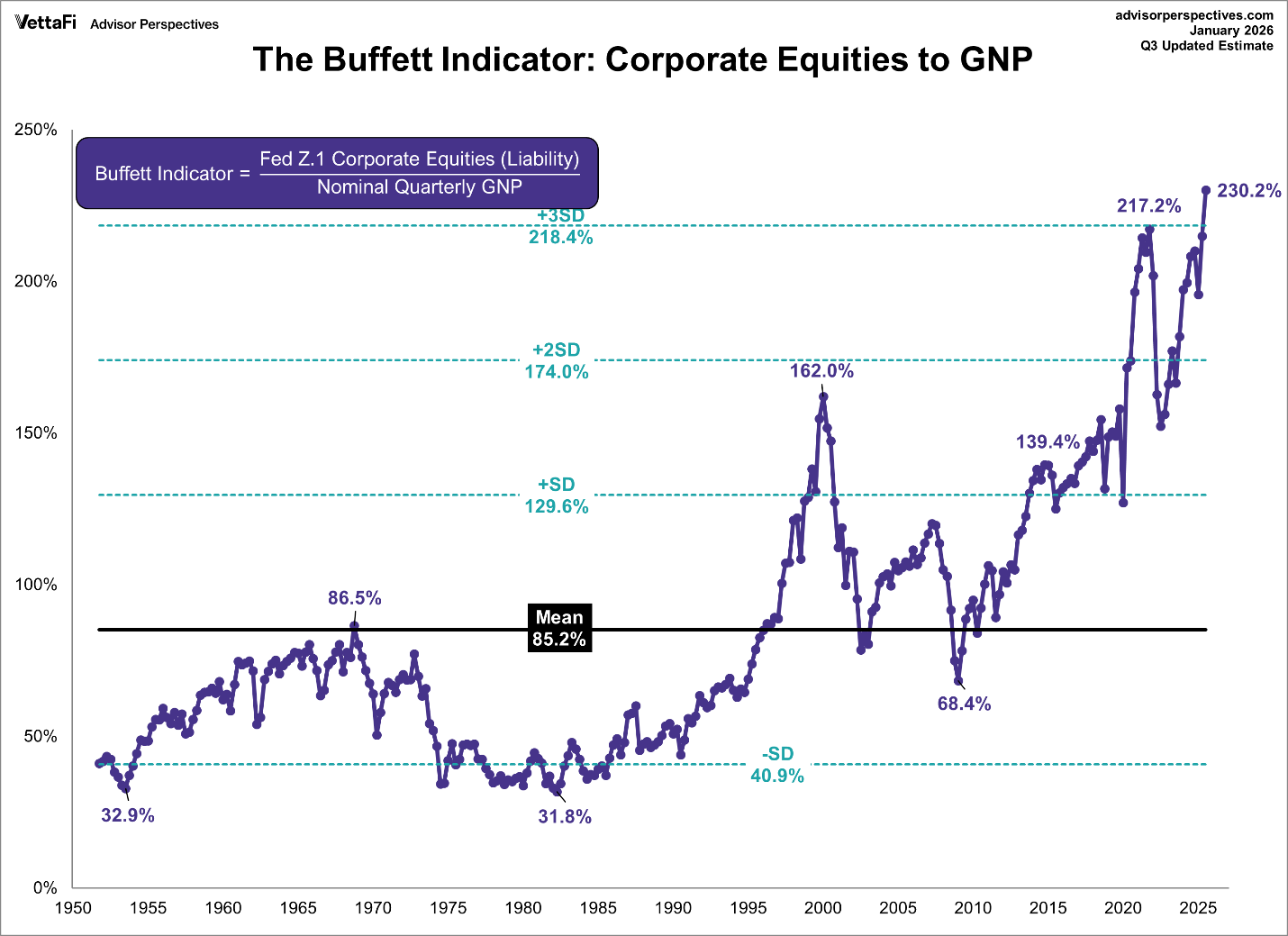
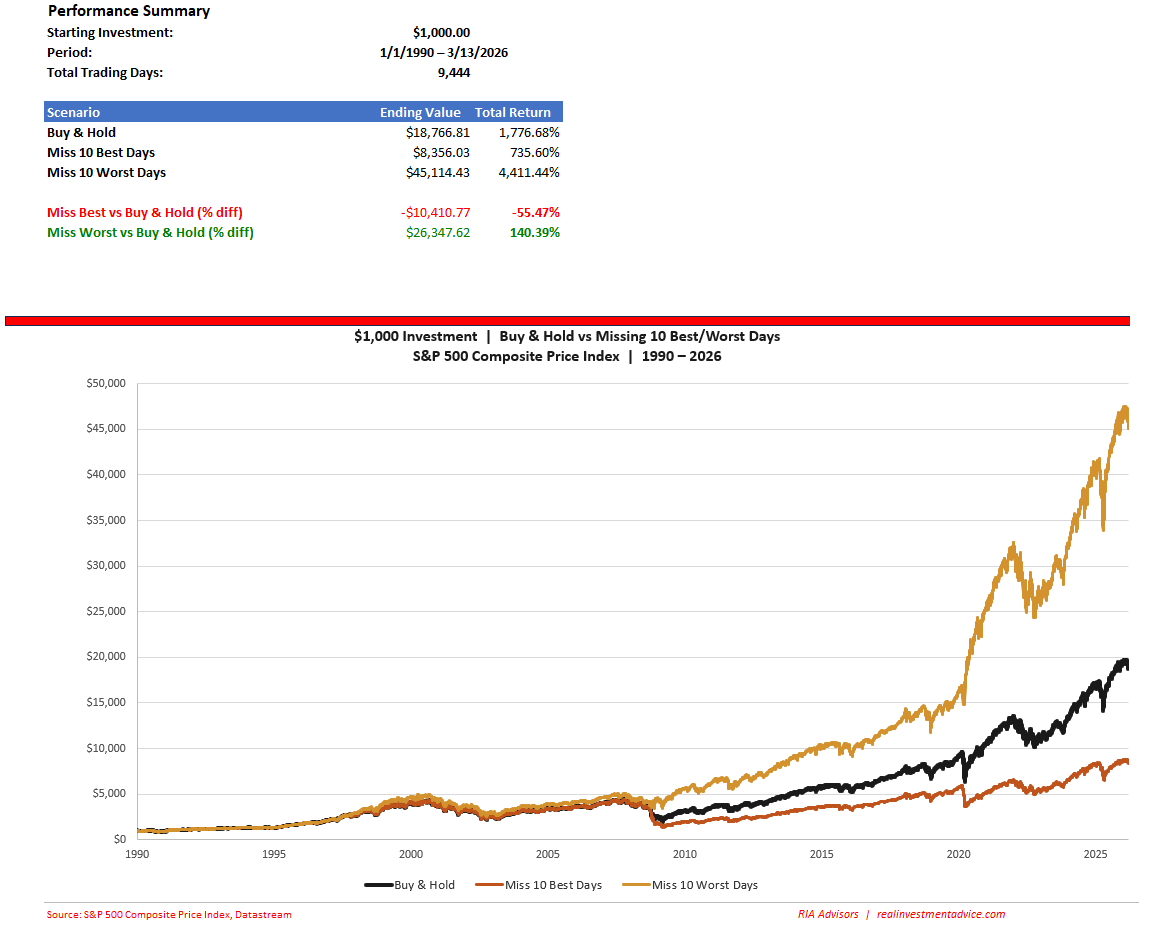
The shock to the oil market created by the war with Iran is increasing fear in the markets. However, some areas were already showing weakness, such as the 2025 labor market. New jobs created averaged only about 15,000 per month and continue that path so far in 2026. The Atlanta Fed 4th quarter GDP estimate, at one point, was over 5% annualized; however, the latest revision put growth at 0.7% annualized. According to the Buffett Indicator (first graph), the stock market is significantly overvalued. And while some claim “missing” the biggest market up days hurts long-term returns, the reality is missing the biggest down days is even more beneficial for returns. The second graph below shows a scenario of actual impacts. Risk of a significant reversion to the mean valuation must be considered for investors. While Fed and Federal government interventions have “rescued” recent market drops, one needs to be prepared for the potential of not so quick recoveries.
For further analysis, continue to read The Details below for more information.
“Allied to the general pattern of market movements is the general pattern of speculative thinking.”
–Benjamin Graham
The Details
Even before the recent shock in the oil market, the economy was showing signs of strain. The one area that had managed to remain strong while other sectors were struggling was the labor market. However, recent revisions to the new jobs figures reveal the labor market was much weaker than thought. The working age population in the U.S. tends to grow by about 250,000 people each month. Therefore, it is an unwritten target, to create at least as many jobs as the population grows. However, after revisions, new jobs created for the entire year 2025 were only about 181,000 or a mere 15,000 per month. For the first two months of 2026, the weakness continues as only 34,000 jobs have been created.
At one point during the fourth quarter 2025, the Atlanta Fed’s GDPNow model was predicting over 5% annualized growth for the quarter. After the latest revision, the annualized GDP growth rate for the fourth quarter was only 0.7%. Again, this weakness was before the war with Iran, and the jump in oil and gas prices. As stated last week, the extent that these higher prices revert to longer term inflation depends upon the duration of elevated oil prices.
In any event, the current weakness in the economy is putting pressure on an already overvalued stock market. Intra-day volatility has picked up significantly. And even though both the Dow and S&P 500 are slightly down for the year, valuations remain near an all-time high. The chart below from VettaFi illustrates The Buffett Indicator, or Corporate Equities divided by the economy (GNP in this graph). The last reading was 230.2% or 145% above the mean, which is over three standard deviations. These rare occurrences always eventually revert to the mean or below. Notice in the graph that in the early 1980’s valuations were 31.8% below the mean. Just to give an example of what it would take to reach those levels, the S&P 500 Index would have to fall by almost 63% to reach the mean, and a plunge of almost 86% to reach the undervalued level of 31.8%.
Since the 1990’s, most investors have become accustomed to unprecedented monetary and fiscal policy being used to rescue markets. So, will they be able to prevent a return to “normal” valuations? The problem with their solutions is they have not solved the underlying problems but merely kicked the can down the road. The level of debt today adds another layer of difficulty in the “print” and delay model. The Fed is already backed into a corner, trying to decide whether to loosen policy to spur the economy, at the risk of sparking high inflation, or tightening to avoid inflation, and thus sending the economy into a potentially deep recession. The Fed meets this week, and although the original thought was, they would lower the Fed Funds Rate, now many pundits believe they will hold off on further rate cuts for now.
With record levels of risk in the stock market and a serious possibility of recession and/or inflation, investors should examine their portfolios and determine how much risk they are willing to take. Most readers, noticing the size of the correction it would take to revert to undervalued levels, probably shake their heads, not believing such a drop is possible. And with the way recent fiscal and monetary policy has been set, they could be right. However, it has happened before. After the 1929 stock market crash, the Dow proceeded to fall about 89%. After the Technology Bubble peak in 2000, the tech-heavy Nasdaq 100 Index fell about 83%. Both of those occurrences took well over a decade (two decades in the Great Depression era) to recoup losses.
That leads to the question, is it better to catch all of the “up” days in the market or to miss the greatest “down” days. Most financial pundits will say that if you miss the best 10 days in the market, your return will drop significantly. And it is true that you will miss out on some gains. However, most do not realize that losses do more harm to a portfolio, and that missing the worst down days is better for your portfolio than catching the best days. The chart below was prepared by Lance Roberts of Realinvestmentadvice.com and shows the benefit of missing the worst 10 days in the market.
I believe the Fed and Federal Government will go to great lengths to prop up the markets. But I also believe that they are at the end of their rope, and the knock-on consequences of their actions will soon follow…either high inflation or a deep recession. Either way, I do not believe now is the time for taking excessive risk in portfolios. If the stock market fell 50% or more and took over 15 years to recover, would it negatively impact your retirement plans?
It is too early to tell if the market will now begin its major correction because the cards are not all on the table yet. In the meantime, I expect the intra-day volatility to continue.
The S&P 500 Index closed at 6,632, down 1.6% for the week. The yield on the 10-year Treasury Note rose to 4.29%. Oil prices increased to $99 per barrel, and the national average price of gasoline according to AAA rose to $3.70 per gallon.
© 2026. This material was prepared by Bob Cremerius, CPA/PFS, of Prudent Financial, and does not necessarily represent the views of other presenting parties, nor their affiliates. This information should not be construed as investment, tax or legal advice. Past performance is not indicative of future performance. An index is unmanaged and one cannot invest directly in an index. Actual results, performance or achievements may differ materially from those expressed or implied. All information is believed to be from reliable sources; however we make no representation as to its completeness or accuracy.
Securities offered through Registered Representatives of Cambridge Investment Research, Inc., a broker/dealer, member FINRA/SIPC. Advisory services offered through Cambridge Investment Research Advisors, Inc., a Registered Investment Advisor. Prudent Financial and Cambridge are not affiliated.
The information in this email is confidential and is intended solely for the addressee. If you are not the intended addressee and have received this message in error, please reply to the sender to inform them of this fact.
We cannot accept trade orders through email. Important letters, email or fax messages should be confirmed by calling (901) 820-4406. This email service may not be monitored every day, or after normal business hours.