



Executive Summary
Prior to the war with Iran, oil prices hovered around $60 per barrel. Upon attacks on Iran’s oil facilities and the closure of the Strait of Hormuz, oil spiked to $120 per barrel Sunday night. After discussions of intervention on Monday from G7 countries and further potential U.S. actions, prices retreated to $95. Policymakers quickly discussed market interventions, though such actions may have unintended long-term consequences. Supply shocks and the resulting sustained high oil prices could contribute to inflation by raising transportation, production, and consumer energy costs. The graph shows how CPI spikes are usually preceded by oil price spikes. Whether inflation materializes depends largely on how long elevated prices persist, with prolonged increases risking stagflation and further economic slowdown. Time will tell the impact.
For further analysis, continue to read The Details below for more information.
“The lesson is clear. Inflation devalues us all.”
–Margaret Thatcher
The Details
Prior to the Iranian war, WTI (West Texas Intermediate) oil prices hovered around $60 per barrel. As tension in the middle east rose, prices began to increase. Once the fighting began, the price jumped to $90 per barrel. Then, Sunday night, oil prices spiked about 30%, at one point reaching about $120 per barrel. The reasons for the sharp increase included: closure of the Strait of Hormuz; Israeli attacks over the weekend on oil facilities including the Shahran oil depot in Tehran; and announced cuts in production due to shipping abilities.
As expected, such high prices immediately garnered the attention of world leaders. The G7 countries began discussing the possibility of releasing 400 million barrels from oil reserves. And President Trump is considering other options including restricting U.S. oil exports; deploying the U.S. Navy to escort ships through the Strait of Hormuz; waiving Federal taxes and lifting Jones Act requirements, which mandate that domestic fuel move only on U.S.-flagged ships; authorizing the U.S. Treasury to trade oil futures or intervene in markets to curb volatility; and extending “stop-gap” measures, such as the current 30-day waiver allowing India to purchase Russian oil to alleviate global market pressure. Instead of allowing markets to work as designed, leaders determine they have to “fix” the problems. Sometimes the “solutions” cause more harm than good over the long term. In any event, by midday Monday, March 9, such talk resulted in WTI oil prices dropping back to around $95 per barrel.
The concern is that high oil prices will end up sparking high inflation and slow an already stumbling economy. The increase in oil prices has already pushed gasoline prices up by at least 20%. So, are inflation concerns legitimate? As I discussed in my series on Currency Debasement, inflation typically results from either an increase in the money supply accompanied by an increase in velocity (spending), or from a supply shock. The current environment would certainly qualify as a supply shock.
The extent of the shock depends upon how high oil prices rise and how long they stay elevated. Oil prices are unique in that they impact many other prices. Oil directly affects the price of heating oil, electricity, diesel and gasoline – as we are currently witnessing. If sustained long enough, the impact will be seen in transportation and production costs, including shipping, trucking, airlines, farming, plastics and chemicals. Eventually, workers will demand higher wages to confront rising prices, which could then lead to price increases in many products and services.
The following graph compares the year-over-year change in the price of WTI oil to the change in the CPI (Consumer Price Index). Notice the data for the recent spike in oil prices has not yet been posted to the St. Louis Fed’s FRED database. Also notice, prior to most spikes in the CPI (red line), there is a similar jump in oil prices (blue line).
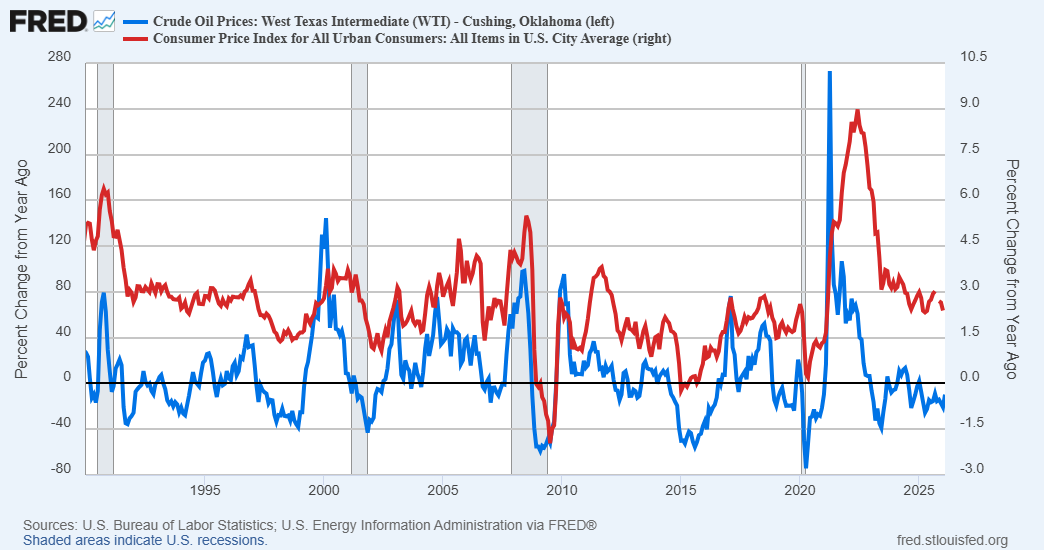
The current administration is stating that this is a short-term rise that will soon reverse. In fact, the President announced a press conference to discuss such Monday afternoon. We will see the extent to which they are willing to go to “control” prices. As a general rule, if prices begin to fall within about three months, then inflation effects should be minimal. However, if they remain elevated between six and twelve months, then the risk of higher inflation becomes more realistic. And, if they remain elevated for over one year, stagflation will likely have arrived.
Any rise in inflation adds to the Federal Reserve Bank’s (Fed’s) dilemma of whether to fight inflation or attempt to boost economic growth. Signs of inflation will likely keep the Fed on the sidelines for now, allowing higher oil prices to further slow economic growth.
It is too early to determine if the recent spike in oil prices will have an inflationary impact. The extent of the oil price increase is sufficient to have an influence on inflation. Now, it is a matter of the duration of the increase. The longer high prices are sustained, the greater the chance of an inflationary impact. If they remain high long enough, a noticeable economic impact will also be observed. Hopefully, any “solution” enacted to reduce prices will not have negative ancillary effects.
Will oil prices spike inflation? If they remain high enough for long enough.
The S&P 500 Index closed at 6,740, down 2.0% for the week. The yield on the 10-year Treasury Note rose to 4.13%. Oil prices increased to $91 per barrel, and the national average price of gasoline according to AAA rose to $3.45 per gallon.
© 2026. This material was prepared by Bob Cremerius, CPA/PFS, of Prudent Financial, and does not necessarily represent the views of other presenting parties, nor their affiliates. This information should not be construed as investment, tax or legal advice. Past performance is not indicative of future performance. An index is unmanaged and one cannot invest directly in an index. Actual results, performance or achievements may differ materially from those expressed or implied. All information is believed to be from reliable sources; however we make no representation as to its completeness or accuracy.
Securities offered through Registered Representatives of Cambridge Investment Research, Inc., a broker/dealer, member FINRA/SIPC. Advisory services offered through Cambridge Investment Research Advisors, Inc., a Registered Investment Advisor. Prudent Financial and Cambridge are not affiliated.
The information in this email is confidential and is intended solely for the addressee. If you are not the intended addressee and have received this message in error, please reply to the sender to inform them of this fact.
We cannot accept trade orders through email. Important letters, email or fax messages should be confirmed by calling (901) 820-4406. This email service may not be monitored every day, or after normal business hours.