



Executive Summary
This week (Part 4) will focus on the risk of U.S. dollar debasement from external, foreign-exchange forces rather than domestic inflation. The U.S. dollar is the world’s reserve currency—established at the WWII era Bretton Woods Agreement pegging the value to gold – which means the dollar is the primary currency for international transactions. President Nixon took the U.S. off the gold standard in 1971 and pegged the dollar to “trust.” While losing reserve status would weaken the dollar, I believe this is unlikely in the near term due to the lack of viable alternatives. A true currency collapse would require multiple extreme conditions occurring simultaneously, including surging inflation expectations, collapsing real yields, deficits exceeding 8-10% of GDP, massive deficits funded by quantitative easing, falling foreign Treasury demand, soaring gold prices, capital controls, and a loss of confidence in the Federal Reserve. Although early signs of some risks exist today, they remain far from crisis levels. Stay tuned for next week’s finale on currency debasement.
For further analysis, continue to read The Details below for more information.
“The fate of the nation and the fate of the currency are one and the same.”
–Franz Pick
The Details
Up to this point I have discussed currency debasement based upon internal factors, primarily domestic inflation. Externally, the dollar can decline in value relative to other currencies, making foreign goods (import prices), international travel, and global investments more expensive in dollar terms. This subject is too complicated to thoroughly discuss in a few pages. In this newsletter, I will hit the “highlights” and oversimplify the discussion for brevity purposes.
A plunge in the value of the dollar relative to other major currencies would create a global crisis. Why has this not happened and what is preventing a major debasement in the dollar globally? Over the long term, there has been little meaningful fluctuation in comparative currency values. Foreign currencies have remained relatively stable over the years as opposed to the currency debasement observed internally through inflation. The fact that the U.S. dollar serves as the reserve currency for the globe adds to the stability. What does that mean? In summary, the reserve status denotes that the dollar is the primary currency used by governments, central banks, global financial institutions, and multinational corporations for trade and international transactions. A brief history, the WWII era Bretton Woods Agreement (1944) established a new framework where the dollar was pegged to gold, and other currencies were pegged to the dollar. In 1971 when President Nixon took the U.S. off of the gold standard, the dollar became pegged to “trust.” Pegging to “trust” could be key to the future value of the dollar.
Foreign trade is invoiced in dollars, even if the U.S. is not a party to the transaction. International payment systems use U.S. based systems such as SWIFT. And foreign central banks hold foreign exchange reserves in dollars. Serving as the reserve currency adds value to the dollar relative to other currencies. In reality, the value attributable to being the reserve currency is probably smaller than most people believe. Losing reserve status would likely depreciate the dollar, but absent other issues, it would probably not be earth-shattering. Then again, losing reserve status would likely come about because of earth-shattering events.
In reality, losing the reserve status is not something I anticipate occurring in the near term. The necessary requirements to be the reserve currency simply are not present elsewhere. Here are some factors required of the nation (or nations e.g. euro) to serve as the reserve currency: military and trade dominance; transparent and credible capital markets; strong property rights; independent central bank; large bond market to absorb reserve liquidity; and global systems to process financial and trade transactions. These are simply not presently available anywhere else.
In order for a significant dollar debasement (collapse) in FX markets, one would expect to see the following, all occurring at once:
- An increase in inflation expectations
- A collapse in real yields even as long-term rates rise
- Deficits exceeding 8-10% of GDP
- The Fed required to institute major QE to fund deficits
- A decrease in foreign Treasury purchases
- Gold prices soaring
- Falling dollar
- Loss of Confidence in the Fed to control the crisis
- Capital controls restricting capital outflows
Although we are seeing the early stages of some of these areas, they are currently nowhere close to what would be necessary to collapse the currency. Presently deficits are running a little over 6% of GDP. QE has not begun in full force. Some central banks have scaled back the purchase of Treasuries, substituting gold. Gold prices are rising and there are mixed thoughts on inflation and short-term interest rates. And no large scale capital controls have been initiated.
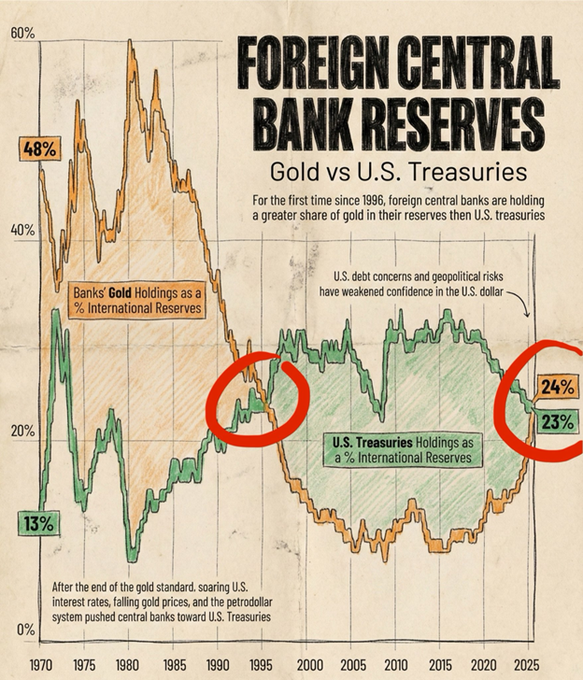
The chart below (source: Global Markets Investor, via X, originator, Tavi Costa, Crescat Capital, LLC) shows the long history of foreign central bank reserves. Notice the decline in gold and rise in Treasuries, as a percentage of total reserves, during the 1980’s and 1990’s. This trend began to reverse around 2017 and recently gold again became the number one holding.
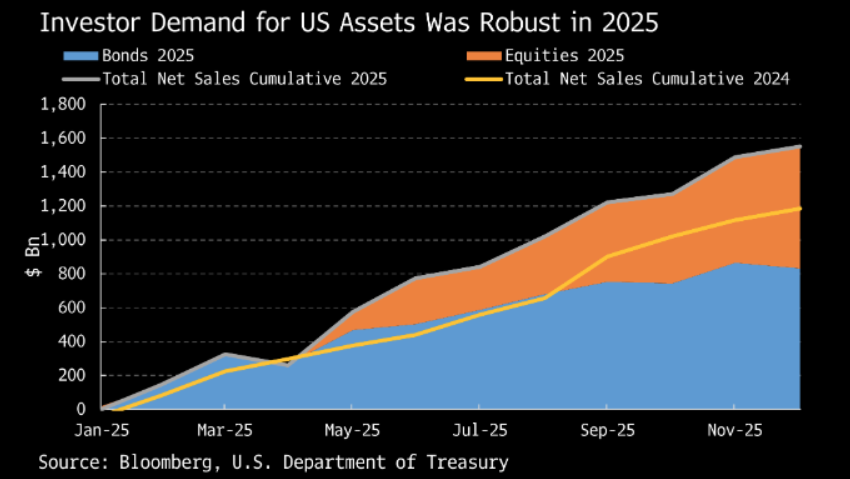
Although gold is taking a larger position for some foreign central bank reserves, the market for Treasuries remains strong as shown in the graph below from Tracy Shuchart via X. However, this is something that should be monitored.
If a financial crisis arises and the Federal government attempts to fight it using the same tools as used during the pandemic, this could cause a loss of confidence, forcing the Fed to institute significant QE to purchase the Treasuries necessary to fund the additional spending. This in turn could spur inflation expectations all while the Fed is lowering short-term rates to combat the crisis. The degree to which the above occurs will weigh on the significance of the crisis and the impact on global governments’ confidence the U.S. can control the situation. If confidence erodes, problems will arise.
Significant currency debasement due to the value of the dollar in the foreign currency markets is less likely to create economic problems than domestic inflation. However, the extremes to which the U.S. Government and the Fed went to during the pandemic means one cannot discount what they could do in the future. One thing I have learned over the years when it comes to crises is that governments have the ability to kick the can down the road further than I would have believed. So, although economic conditions are weakening, I cannot predict the timing of any upcoming crisis that would accelerate any currency debasement. The decline in the currency’s value should become visible in the items described above.
Next week I will wrap up the series on currency debasement with a summary of both internal and external risks to currency debasement.
The S&P 500 Index closed at 6,910, up 1.1% for the week. The yield on the 10-year Treasury Note rose to 4.09%. Oil prices increased to $66 per barrel, and the national average price of gasoline according to AAA remained at $2.93 per gallon.
© 2026. This material was prepared by Bob Cremerius, CPA/PFS, of Prudent Financial, and does not necessarily represent the views of other presenting parties, nor their affiliates. This information should not be construed as investment, tax or legal advice. Past performance is not indicative of future performance. An index is unmanaged and one cannot invest directly in an index. Actual results, performance or achievements may differ materially from those expressed or implied. All information is believed to be from reliable sources; however we make no representation as to its completeness or accuracy.
Securities offered through Registered Representatives of Cambridge Investment Research, Inc., a broker/dealer, member FINRA/SIPC. Advisory services offered through Cambridge Investment Research Advisors, Inc., a Registered Investment Advisor. Prudent Financial and Cambridge are not affiliated.
The information in this email is confidential and is intended solely for the addressee. If you are not the intended addressee and have received this message in error, please reply to the sender to inform them of this fact.
We cannot accept trade orders through email. Important letters, email or fax messages should be confirmed by calling (901) 820-4406. This email service may not be monitored every day, or after normal business hours.