



Executive Summary
This newsletter highlights sections of Dr. Burry’s (famed investor of the movie The Big Short) paper titled: “Foundations: U.S. Market Structure & Value.” In it he posits “…there was no natural conclusion to the bear market of 2007-2009” due to the extreme policy interventions. Currently market valuations stand at three standard deviations above the long-term mean and only slightly below all-time highs of 2000’s (see graph). Dr. Burry points out the Dow and S&P500 have always reverted to their mean valuation levels. Always! Next week will expand on his concerns about what could lie ahead considering the impacts of 401(k) passive investing and demographics.
For further analysis, continue to read The Details below for more information.
“Prosperity will drive men to excess, and repentance for the consequence of these excesses will produce a corresponding depression.”
–William Hamilton
The Details
Recently, Dr. Michael Burry, of The Big Short fame, wrote a paper entitled “Foundations: U.S. Market Structure & Value” where he analyzes secular market cycles through the lens of the Shiller PE, also known as the CAPE (Cyclically Adjusted PE). His long-term examination utilizes the inflation-adjusted Dow and S&P 500 Indices. He points out “… there are times when the extremes are so extreme, it might make sense to sit back and do some of that simple price and earnings math. Maybe that is what Buffett is doing with his $373 billion of cash, maybe that is what Ryan Cohen is doing at GameStop, and it is indeed what I am doing now.”
In this newsletter, I will highlight sections of Dr. Burry’s paper. Many of the themes discussed might sound familiar as I have written similar missives many times over the past decade. However, Dr. Burry’s paper points out some new causes for potential future outcomes (to be examined in next week’s newsletter). Note that although his paper contains numerous graphs and charts, the graph in this newsletter is from VettaFi.
Dr. Burry states, as I have maintained, the last secular (long-term) bear market, 2000-2013, was an outlier. “Of course, never had there been such scale of policy intervention: zero interest rates, quantitative easing, interest on excess reserves held at the Fed, TARP [Troubled Asset Relief Program], nationalizations of three large financial concerns. The government’s backstop was powerful and effective in its delivery of moral hazard for future generations.
I have maintained for some time that there was no natural conclusion to the bear market of 2007-2009. Zero interest rates, IOER [Interest On Excess Reserves], and other crisis-era policies remained in place for a decade or more.”
With valuations at extremes, many investors believed that stock prices would crack with higher interest rates. “10-year yields spiked and broke a four decade downtrend, but the 450 basis point increase in rates saw the Shiller PE increase from 28.4x to 40.1x. Multiples expanded, stocks rose.”
The Shiller PE sits just below the prior record high achieved during the peak of the Technology Bubble in 2000. The graph below from VettaFi shows valuations over three standard deviations from the long-term mean. An extreme rarity.
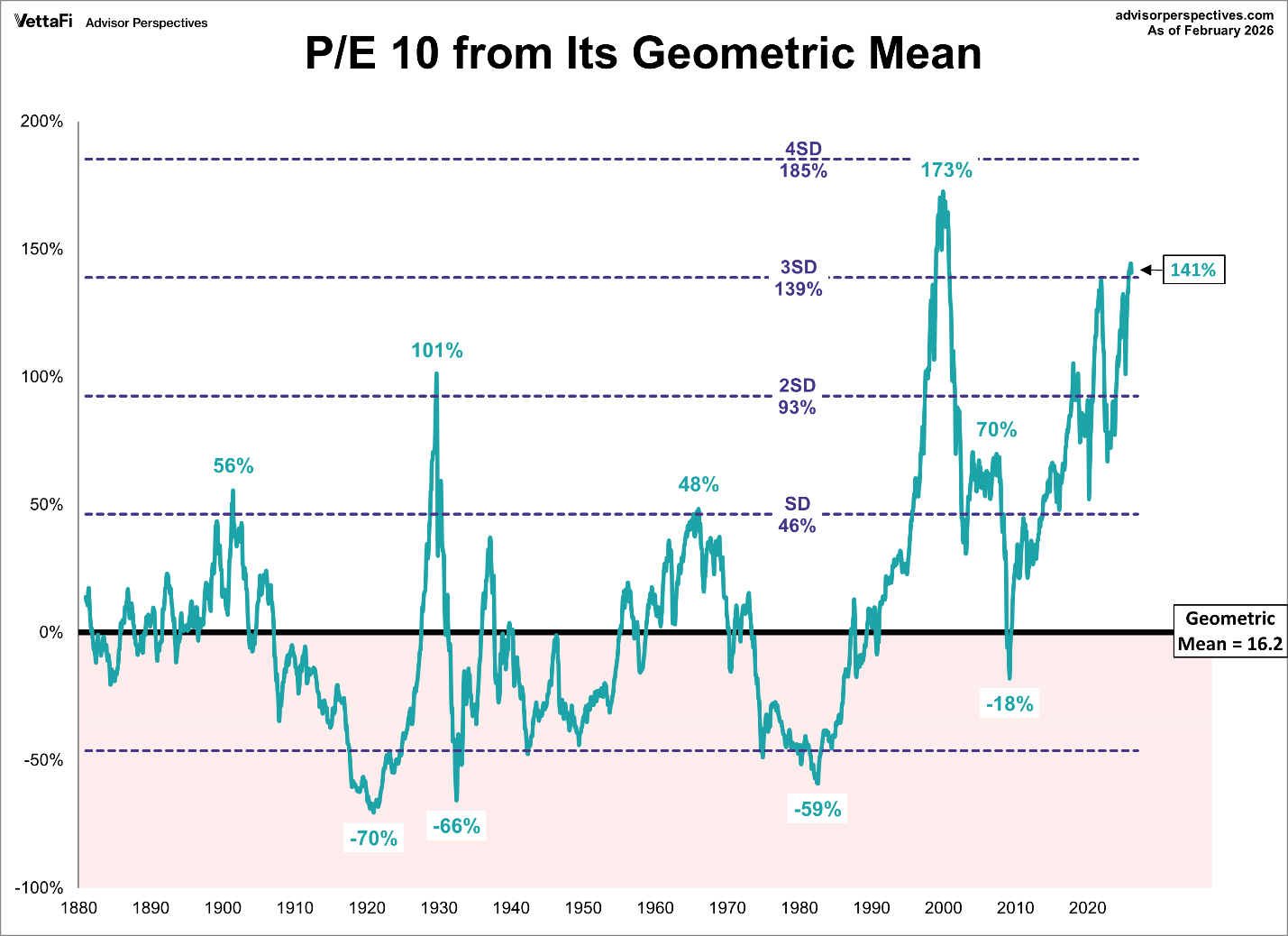
Dr. Burry wrote, “As a warning, the potential drawdowns in the market look shocking, unreal, not possible.” Readers were probably indicating this when they read my missive from a couple of weeks ago, March 17, 2026, when I touched on potential drawdowns from outlandish valuations. Prior to the current bubble in stock prices, Dr. Burry pointed out that the Dow and S&P500 have always reverted to their mean valuation levels. Always.
“The modern investor experience is an exceptional period of expanded multiples on stocks, and with the Shiller PE at 40.1x, as mentioned, it is the second highest peak (to be announced) on record. Of course, from the first place peak, the NASDAQ fell nearly 80% from 2000, and the S&P 500 fell about 50%.”
Using the 126 year historical dataset, the Dow would have to fall roughly 55% to reach the long-term mean. A drawdown of almost 77% would be necessary to fall to the all-history trough average. For the S&P 500 for similar periods, the drawdowns required would be 52% and 77%, respectively.
According to Dr. Burry, “Those declines look like the declines after 2000, after 1929. To me they also look like the kind of declines that might be expected from an extreme disappointment of exuberant speculation on a capital asset buildout [AI], with both margin compression and unit volume compression.”
Why have valuations reached such extreme levels? And why have corrections not dropped below mean valuations as occurred in secular bear markets prior to 1990? Dr. Burry has some interesting thoughts, and concerns about what could lie ahead. These will be examined in next week’s newsletter, so stay tuned.
The S&P 500 Index closed at 6,369, down 2.1% for the week. The yield on the 10-year Treasury Note rose to 4.44%. Oil prices increased to $100 per barrel, and the national average price of gasoline according to AAA rose to $3.98 per gallon.
© 2026. This material was prepared by Bob Cremerius, CPA/PFS, of Prudent Financial, and does not necessarily represent the views of other presenting parties, nor their affiliates. This information should not be construed as investment, tax or legal advice. Past performance is not indicative of future performance. An index is unmanaged and one cannot invest directly in an index. Actual results, performance or achievements may differ materially from those expressed or implied. All information is believed to be from reliable sources; however we make no representation as to its completeness or accuracy.
Securities offered through Registered Representatives of Cambridge Investment Research, Inc., a broker/dealer, member FINRA/SIPC. Advisory services offered through Cambridge Investment Research Advisors, Inc., a Registered Investment Advisor. Prudent Financial and Cambridge are not affiliated.
The information in this email is confidential and is intended solely for the addressee. If you are not the intended addressee and have received this message in error, please reply to the sender to inform them of this fact.
We cannot accept trade orders through email. Important letters, email or fax messages should be confirmed by calling (901) 820-4406. This email service may not be monitored every day, or after normal business hours.