


Executive Summary
In this Part 3 missive on currency debasement, I will focus on the U.S. debt picture and what is necessary to initiate high inflation (see links below to Part 1 & 2). In 2007 the U.S. Federal debt was around $9 trillion, just before the COVID pandemic it had grown to $23 trillion and now is $38.7 trillion. When QE is funding annual Federal deficits, it increases the money supply, and the risk of inflation rises. At current debt levels, if QE becomes mandatory to allow the government to function, consumers could lose confidence in their ability to keep inflation under control. Over the last 25 years, government’s response to any crisis has been to increase spending. When stimulus is direct to the citizens, inflation depends on whether they spend or save and deleverage. As one can see, this is complicated and has many moving pieces. Stay tuned next week as I cover the dollar as the reserve currency.
For further analysis, continue to read The Details below for more information.
“A government that seizes control of the economy for the good of the people, ends up seizing control of the people for the good of the economy.”
–Bob Dole
The Details
In Part 1 of this series, I briefly outlined the causes of currency debasement and provided a graph illustrating the loss of purchasing power due to inflation since 1971. In Part 2 I reviewed the bases for increasing the money supply (M2) and discussed what is necessary to create inflation. In today’s missive, I will examine the debt picture in the U.S. and determine what is necessary to initiate high inflation.
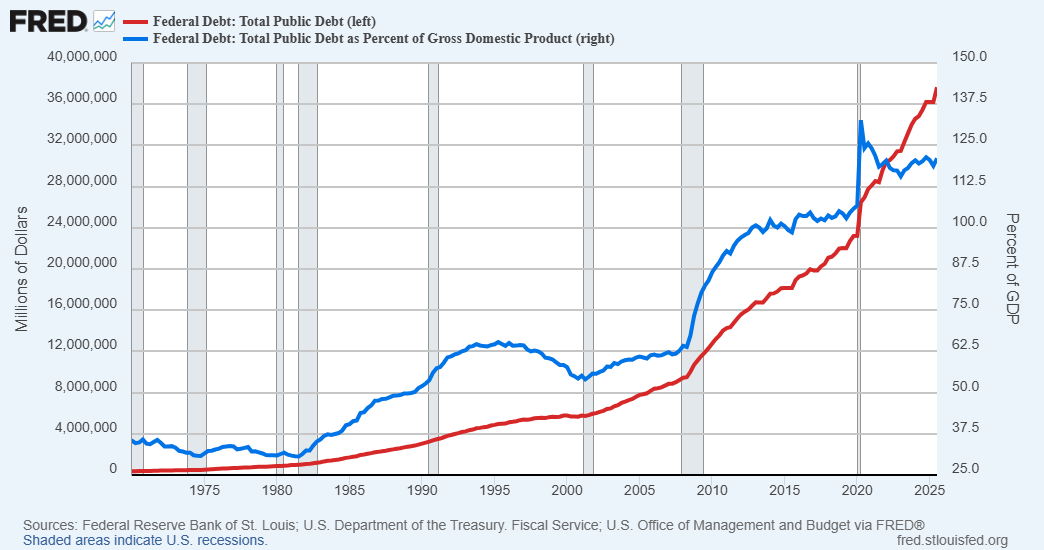
Just prior to the Great Recession and Financial Crisis beginning in 2007, total Federal debt outstanding was around $9 trillion. After the explosion in debt during the Crisis, deficits remained high throughout the post-Crisis years until the pandemic hit. By the time Covid arrived, the Federal debt balance had grown over 2.5 times to above $23 trillion. The response by the Federal government to the pandemic was unprecedented. The combination of stimulus, forgivable PPP loans, business aid, enhanced unemployment benefits, and child tax credit expansions sent the debt soaring. While subsequently retreating slightly, deficits have continued at “recessionary” levels. This pushed the current total Federal debt, according to the USDebtClock.org, to around $38.7 trillion or over four times the pre-Great Recession balance and over 1.6 times the pre-Covid level. See the graph below illustrating the growth in the Federal debt (red line) and debt as a percentage of GDP (blue line).
The graph below from the CBO (Congressional Budget Office) displays the annual Federal deficits. This graph breaks the spending down between interest expenses and all other outlays.
The graph below from the CBO (Congressional Budget Office) displays the annual Federal deficits. This graph breaks the spending down between interest expenses and all other outlays.
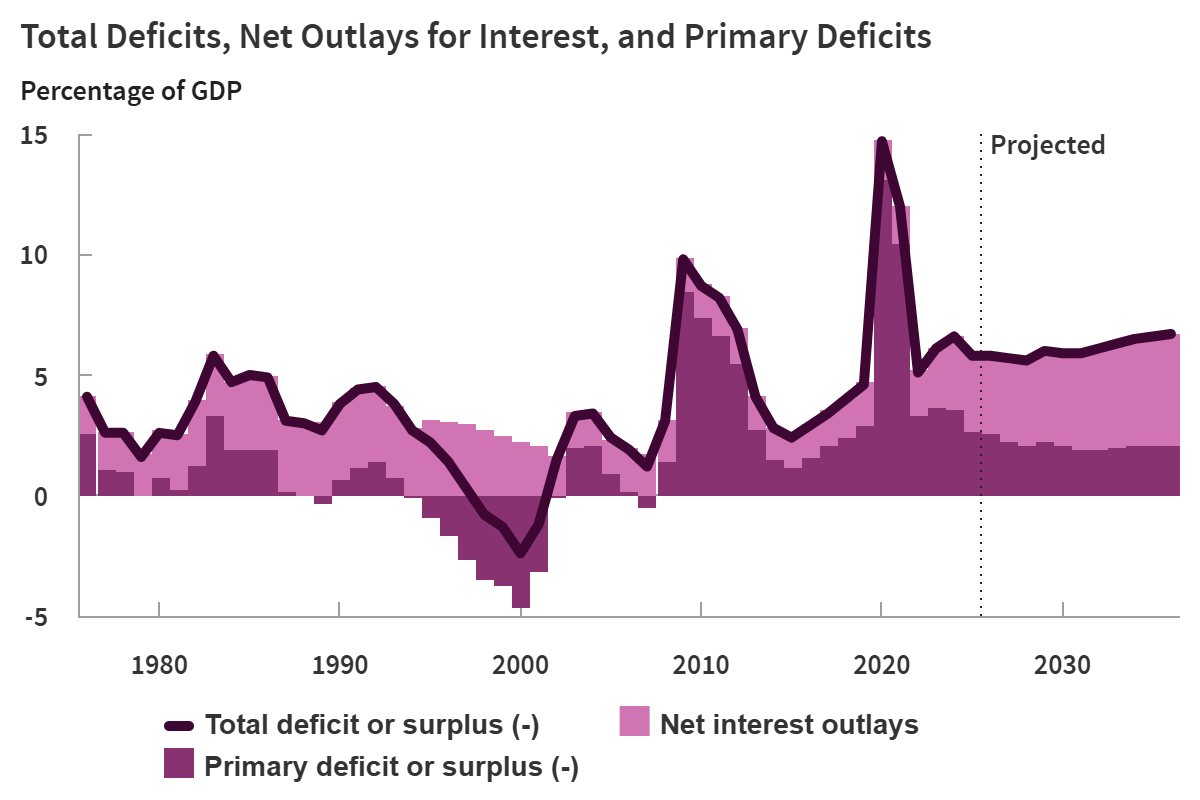
Notice in the first graph that Federal debt to GDP is over 120%. The extreme level of debt relative to the economy combined with rising interest rates is what is concerning. A couple things to note when examining the CBO graph above are the lack of recessions in their projections, and the rising share of interest costs as a portion of the total deficit. During each previous recession, Federal spending has surged as the Federal government attempted to increase spending to compensate for the weakness in the private sector. The problem is, especially since the Great Recession, that once the recession ended, deficit spending has continued at elevated levels. To add fuel to the fire, interest rates have risen and are forcing projected deficits to be higher. Any future recession will spur more Federal stimulus, thus creating more debt that will bear interest at higher rates. Do you see the dilemma?
As discussed last week, in order for deficits to pose an inflationary risk, they must be funded by the Fed through their QE (Quantitative Easing) program. If the Fed is forced to prioritize funding the government, by purchasing Treasury securities and keeping short-term rates low, over inflation prevention, then investors could begin to lose confidence in their ability to control inflation. The loss of confidence will be seen in the bond market as long-term interest rates rise, even as the Fed keeps short-term rates low.
Typically, in a recession demand weakens and disinflationary pressures take over. However, the Federal government’s response during the last two recessions shows the extent to which they will go to prop up the economy. Each time the amount of stimulus required has grown. If this response continues, then next time the reaction could be exorbitant. This level of Federal funding would likely require the Fed’s funding through QE. At current debt levels, if QE becomes mandatory to allow the government to function, consumers could lose confidence in their ability to keep inflation under control. Record amounts of stimulus, if spent, would push the velocity of money up, resulting in price increases. When inflation rises, and consumers lose confidence, they might feel compelled to spend their money before prices rise higher, thus creating a doom loop.
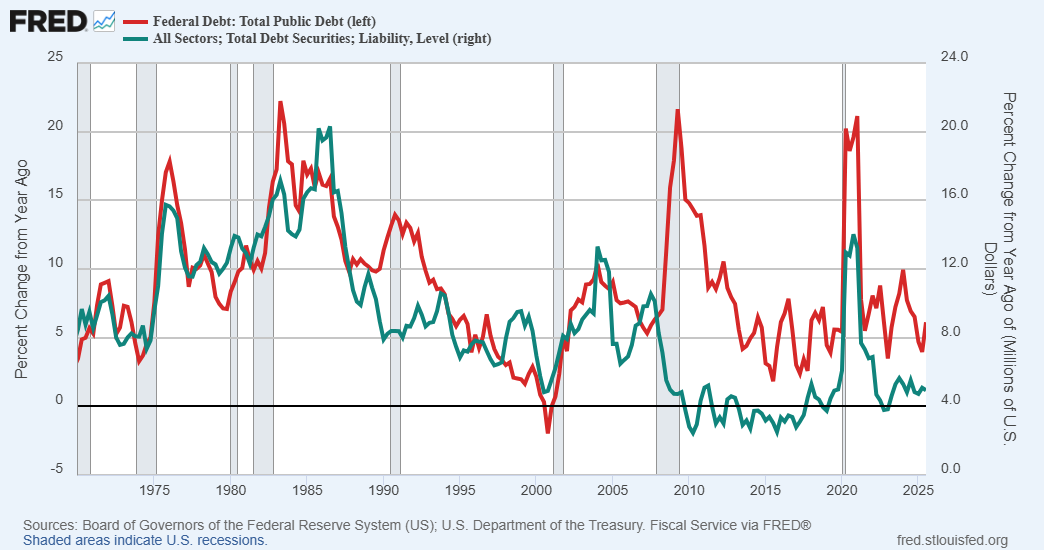
The following graph displays why I have concerns about future responses to recessions. The red line in the graph shows the year-over-year change in total Federal debt. Notice how this line surges during or shortly after each recession (shaded gray lines). The green line shows total debt excluding Federal debt. Notice how prior to the Great Recession the rate of change in Federal and private sector debt was relatively correlated. However, beginning with the Great Recession and continuing through the pandemic to present, debt balances have been transferred from the private sector to the Federal government. Through the various aid and “stimulus” packages over the past almost two decades, Federal bailouts have prevented the outcomes designed by a capitalist system from occurring. Government intervention is now the “norm” and unfortunately, will be “expected” during the next crisis.
The cumulative impact of such actions plus those anticipated during the next recession are why there has been so much discussion of late relating to the future value of our currency.
An increase in the money supply alone is not enough to create inflation. There must either be increased demand/spending or a reduction in supply. If spending increases, it should be visible in the graph of the velocity of M2 below. When this increases sharply, it is likely to see pricing pressures as inflation rises.
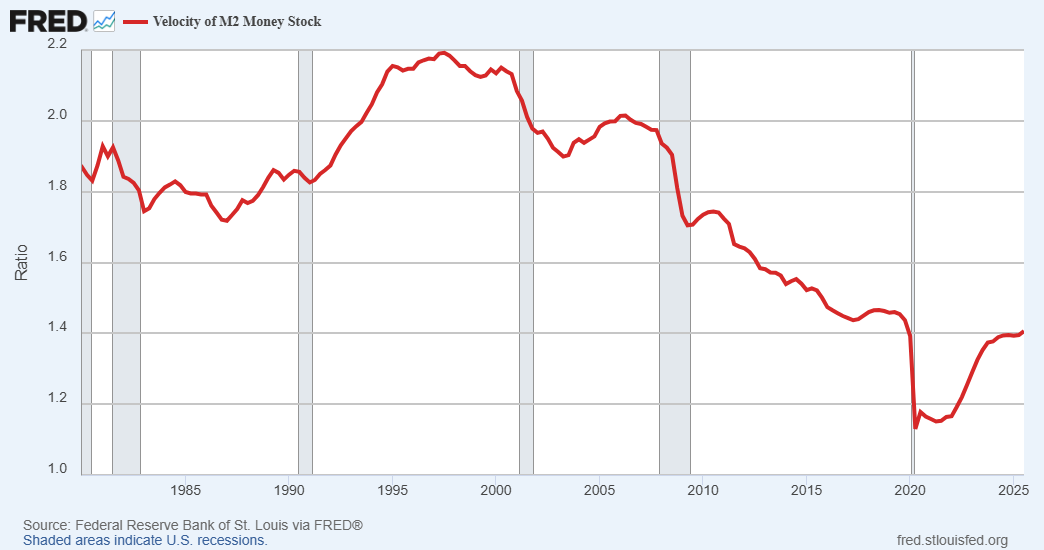
Notice in the graph above, that during the period of QE subsequent to the Great Recession (2007-2009), the velocity of money did not rise, it fell. The money created did not result in high inflation because it was not spent. Prior to the Great Recession, many homeowners had borrowed excessively against their homes. Private debt spiked as shown in the debt rate of change graph shown previously. Therefore, during the crisis, consumer demand fell and many used this period to deleverage. This increase in the money supply was largely used for deleveraging and for investment purposes, hence the surge in stock prices.Notice that velocity did increase after the pandemic and when combined with supply shocks and the massive increase in the money supply, led to high inflation. What could cause a return to high inflation? The cumulative impact of debt and deficits combined with high interest rates means the Federal government will need to continue increasing funds borrowed to cover operations. This will be compounded by the fact that roughly one-third of existing Federal debt will have to be refinanced at higher interest rates this year. Currently, total interest on the Federal debt exceeds $1 trillion annually. For comparison purposes, the Federal government collects approximately $3 trillion annually in individual and corporate income taxes. The CBO estimates interest expense to exceed $2 trillion annually in 10 years. This estimate excludes recessions or any crises in their projection. Based upon the rapid increase in debt, and long-term rates remaining high, it is likely this will occur sooner. As it stands, one-third of income tax revenue is consumed by the interest cost of the Federal debt.
On a side note, the government recently announced a downward revision of over 1 million jobs from the previously reported jobs data for 2025. The revised annual jobs created for 2025 were revised down to 181,000. That is a mere 15,000 jobs per month. This is a recessionary level of job creation. When the next recession is declared, I expect an outsized Federal response with corresponding Fed QE. With a weakening economy, initially demand could fall, creating disinflationary pressures. Any panic in the stock market could result in a flight to safety into Treasuries, causing prices to rise and long-term rates to decrease. However, I do not expect that situation to last long. I think the Federal government and Fed response will be massive and swift. If I am right, the extent of inflation will be determined by the degree consumers spend any stimulus provided.
Only time will tell if and by how much inflation will rise. There are many moving pieces. We now know to focus on the Fed’s funding of deficits, the existence of supply constraints, and the velocity of M2 or how much consumer spending increases. These pieces of the puzzle will give us a heads up about what is to come.
Next week I will briefly review the dollar as a reserve currency and what could cause a devaluation relative to other currencies. I hope you continue to follow this series.
The S&P 500 Index closed at 6,836, down 1.4% for the week. The yield on the 10-year Treasury Note fell to 4.05%. Oil prices decreased to $63 per barrel, and the national average price of gasoline according to AAA increased to $2.93 per gallon.
© 2026. This material was prepared by Bob Cremerius, CPA/PFS, of Prudent Financial, and does not necessarily represent the views of other presenting parties, nor their affiliates. This information should not be construed as investment, tax or legal advice. Past performance is not indicative of future performance. An index is unmanaged and one cannot invest directly in an index. Actual results, performance or achievements may differ materially from those expressed or implied. All information is believed to be from reliable sources; however we make no representation as to its completeness or accuracy.
Securities offered through Registered Representatives of Cambridge Investment Research, Inc., a broker/dealer, member FINRA/SIPC. Advisory services offered through Cambridge Investment Research Advisors, Inc., a Registered Investment Advisor. Prudent Financial and Cambridge are not affiliated.
The information in this email is confidential and is intended solely for the addressee. If you are not the intended addressee and have received this message in error, please reply to the sender to inform them of this fact.
We cannot accept trade orders through email. Important letters, email or fax messages should be confirmed by calling (901) 820-4406. This email service may not be monitored every day, or after normal business hours.