



Executive Summary
Last week I introduced the concept of currency debasement, or the loss of purchasing power of the dollar. I stated that this occurs largely due to inflation. This week, Part 2, addresses the chief pretexts for an increase in the money supply, specifically M2, and what it takes to create inflation. Increases in M2 occur through expansion in bank lending and when the Federal Reserve Bank funds Federal government deficit spending through asset purchases (Quantitative Easing or QE). Both the velocity of money and the supply of goods and services impact whether increases in M2 results in inflation. In The Details I will dispel some of the myths regarding the causes of inflation. Experimental fiscal and monetary policies seem to be the path for the next crisis response, thus stay tuned for the next explanation of threats to the dollar’s purchasing power.
For further analysis, continue to read The Details below for more information.
“The first panacea for a mismanaged nation is inflation of the currency; the second is war. Both bring a temporary prosperity; both bring a permanent ruin.”
–Ernest Hemingway
The Details
In last week’s missive, I introduced the concept of currency debasement as the loss of purchasing power of the dollar. I mentioned that this occurs domestically largely due to inflation, and inflation occurs typically when too much money has been created. This week I will discuss the chief pretexts for an increase in the money supply or M2 (M2 – currency, checking and savings accounts, CDs – under $100k, and retail money market funds), and what it takes to create inflation. In this discussion, I hope to clear up some of the misconceptions about what causes a rise in both M2 and inflation.
Two of the primary means for increasing the money supply include an expansion in bank lending, and when the Federal Reserve Bank (Fed) funds Federal budget deficits through asset purchases, commonly known as Quantitative Easing (QE). In the first scenario, new money is created when a bank loan is funded. Simply stated, a bank deposits the loan proceeds into the borrower’s account and creates a loan receivable asset.
Many people mistakenly believe that deficit spending causes an increase in the money supply. However, in reality, this is only true if the deficit spending is funded by the Fed through QE. If the Fed is not engaged in QE, then while funds are injected into the economy, via deficit spending, they are also being withdrawn through investor purchases of Treasury securities, netting zero new money.
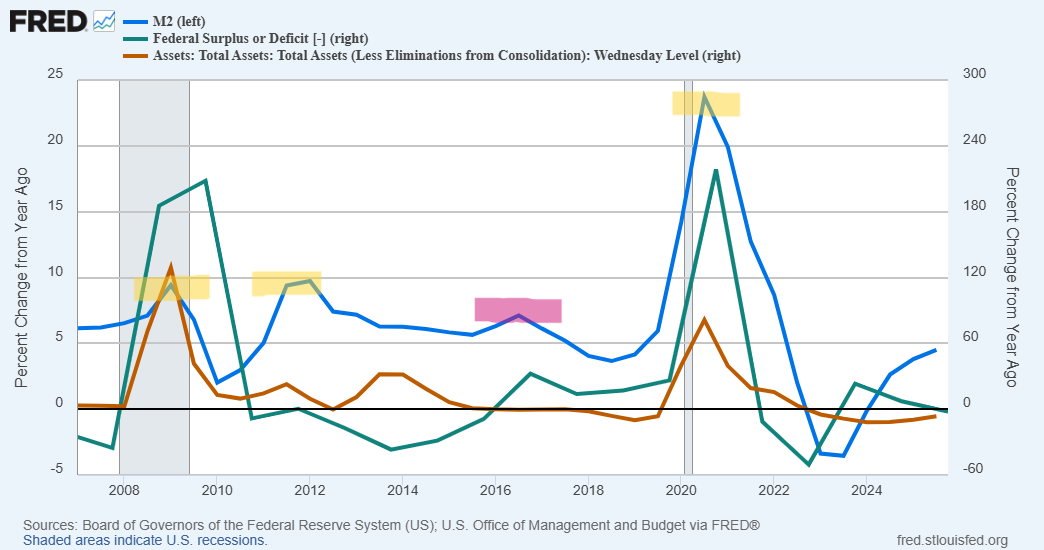
The graph below, although a little busy, compares three important elements: the year-over-year percentage change in M2 (blue), the Federal deficit (green), and the level of the Fed’s balance sheet (red). Notice the enormous increase in all three lines during the Financial Crisis/Great Recession from 2008-2009. The Federal government implemented an incredible amount of stimulus which was then funded by the Fed’s QE programs. This combination pushed the money supply higher, highlighted in yellow. The freezing of the economy during Covid led to unprecedented Federal stimulus programs, leading to record high deficits, all funded by QE. The historic levels of Fed-funded deficits sparked a surge in M2 (2021 yellow highlight).
In the graph, notice the period of increased deficit spending from 2015-2016. This was not funded by the Fed (no QE), so it is logical to think it would not lead to an increase in the money supply. However, during this period commercial lending soared by almost 9%, as interest rates were extremely low. This significant jump in lending pushed M2 higher (purple highlight).
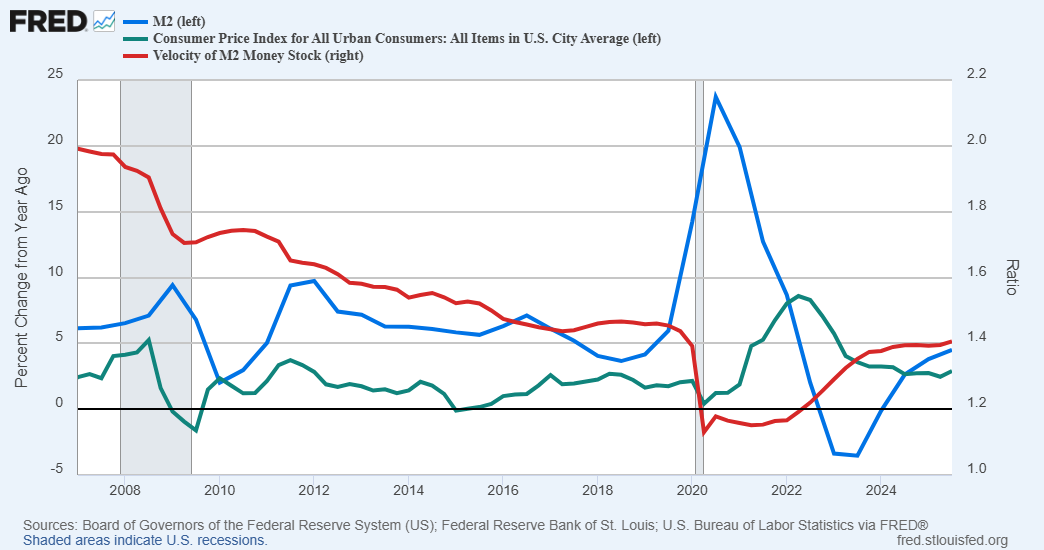
Last week, I included a graph which highlighted the increase in M2 just prior to bouts of inflation as shown by the CPI (Consumer Price Index). It is important to note that an increase in M2 does not guarantee an increase in inflation. To create inflation, normally, one would expect to see an increase in the velocity of money – or how often a dollar is used to purchase goods and services in specific period. If money is created and then spent on goods and services, this should put upward pressure on prices as demand outpaces supply.
However, this is not always the case. It is possible to increase the money supply with deficits funded by the Fed, while at the same time the velocity of money remains flat or increases only slightly. Under that scenario, what happens to inflation? If the money distributed through deficit spending is saved by consumers, then velocity will remain low and there should be little increase in inflation. Yet, as shown in the graph below highlighting the year-over-year percent change in M2 (blue) and CPI (green), and the measure of M2 velocity (red), during the years impacted by Covid, the money supply (M2) and inflation (CPI) soared, while the velocity of M2 only increased slightly. How did the economy generate over 9% inflation by June 2022?
The answer aligns with the economic problems associated with the pandemic. While consumers did spend some of the massive stimulus distributed, as shown by the relative slight increase in velocity, this increase alone was not enough to create such a high level of inflation. The significant increase in prices occurred due to a combination of the Fed-funded stimulus and the drastic decrease in the supply of goods and services available. As the economy shuttered, when some level of demand returned, the massive shortage of goods and services sent prices skyrocketing.
Since the Financial Crisis in 2008-2009, the Fed has engaged, by their own words, in experimental, non-conventional monetary policies. Just as it appeared they were willing to attempt a return to more “normal” policies, the pandemic hit. The reactions to the pandemic by both the Fed and the Federal government were even more extreme. The policy responses were like the Financial Crisis on steroids. Through all of this, financial pundits attempted to sort out the impacts of the new policies. Many contradictory opinions were espoused.
In trying to outline the components of currency debasement, it is important to understand the foundation which underlies the loss of purchasing power. In this newsletter, I have outlined the impact of fiscal and monetary policy on the money supply. I then tried to connect the money supply to inflation – which as discussed is one of the primary components to currency debasement. The imploding of the Real Estate Bubble leading to the Financial Crisis/Great Recession resulted in policies which were only compounded during Covid. It seems the playbook has been established for how the Fed, and the Federal government will respond to the next crisis. It is critical to understand the implications these policies will have on the value of the dollar.
Stay tuned for a continuation of this series on Currency Debasement.
The S&P 500 Index closed at 6,932, net flat after much volatility for the week. The yield on the 10-year Treasury Note fell to 4.21%. Oil prices decreased to $64 per barrel, and the national average price of gasoline according to AAA increased to $2.90 per gallon.
© 2026. This material was prepared by Bob Cremerius, CPA/PFS, of Prudent Financial, and does not necessarily represent the views of other presenting parties, nor their affiliates. This information should not be construed as investment, tax or legal advice. Past performance is not indicative of future performance. An index is unmanaged and one cannot invest directly in an index. Actual results, performance or achievements may differ materially from those expressed or implied. All information is believed to be from reliable sources; however we make no representation as to its completeness or accuracy.
Securities offered through Registered Representatives of Cambridge Investment Research, Inc., a broker/dealer, member FINRA/SIPC. Advisory services offered through Cambridge Investment Research Advisors, Inc., a Registered Investment Advisor. Prudent Financial and Cambridge are not affiliated.
The information in this email is confidential and is intended solely for the addressee. If you are not the intended addressee and have received this message in error, please reply to the sender to inform them of this fact.
We cannot accept trade orders through email. Important letters, email or fax messages should be confirmed by calling (901) 820-4406. This email service may not be monitored every day, or after normal business hours.